In This Article
A pet friendly ant killer for pet food bowls is an ant control product used so that the active ingredient stays away from your animal’s food, water and mouth. In practice that means enclosed bait stations or carefully targeted treatments placed near the bowl, never in it, and applied exactly as the label directs.
Ants are not fussy diners. A ceramic bowl of kibble, a splash of gravy on the tiles, a dribble of water that never quite dries: to a scout ant, that’s a buffet with a reservation. Within hours one explorer becomes a conga line, and you’re standing in the kitchen at 7am wondering whether you’re feeding a dog or a colony.
Here’s the awkward bit. The obvious fix is a can of spray and a good soaking, which is exactly what you don’t want near a bowl your dog licks clean twice a day. So the real question isn’t “what kills ants?” It’s “what kills ants without putting my pet in the firing line?”
One honest note first. No insecticide can truthfully be called harmless, and the Health and Safety Executive’s label guidance treats words like “non-toxic” and “harmless” as misleading for approved products. So in this guide, pet friendly ant killer for pet food bowls means a product that is designed or positioned to limit pet contact. Think sealed stations, bitter-tasting gels and spot treatments that dry before anyone walks through. You still use it strictly as the label says. The HSE’s guidance on using biocides puts the first rule plainly: read and understand the label before you start.
Below are seven real products listed on amazon.co.uk, an honest look at what each does well and where it falls short, and practical sections on skirting boards, worktops, contact kill formulations, food safe application and ant entry points. Everything rests on manufacturer, regulator and aggregated review information. I haven’t tested these products myself, and I won’t pretend otherwise.
Quick Comparison: Which Ant Killer Suits Which Job?
| Product | Format | Best For |
|---|---|---|
| NOPE! Ant Killer Baited Gel Syringe & Reusable Bait Stations | Refillable gel bait | Households with curious dogs |
| Zero In Dual Action Gel Ant Bait | Sealed gel stations | Cheap indoor corner coverage |
| AntClear (formerly Ant Stop!) Bait Station | Gel bait station | Indoor and sheltered outdoor use |
| Deadfast Ant Killer Plus Bait Station | Gel bait station | Budget multi-station coverage |
| Nemasys No Ant | Nematode liquid | Garden nests, chemical-free approach |
| NOPE! CP Ant Killer Spray | Contact spray | Trails and thresholds, away from bowls |
| Nippon Ant Killer Powder | Dust | Outdoor nest entrances |
Looking at the table, enclosed gel baits are the natural starting point if your priority is a pet friendly ant killer for pet food bowls, because the poison sits inside a station rather than on a surface. Sprays and powders earn their place at doors and nest entrances, well away from where your animal eats. The Nemasys No Ant route suits the gardener who would rather avoid insecticide entirely, though it asks for patience.
💬 Just one click — help others make better buying decisions too!😊
Top 7 Pet Friendly Ant Killer Options for Pet Food Bowls: Expert Analysis
Prices below are ranges from the time of research (November 2026) and change constantly, so check the current price on amazon.co.uk before buying.
1. NOPE! Ant Killer Baited Gel Syringe & Reusable Bait Stations — bitter-coated gel, lockable stations
The standout feature is Bitrex, the intensely bitter agent that manufacturer Safeguard adds to the gel to discourage accidental swallowing.
The kit pairs reusable stations with a 10g gel syringe, and the stations come in two versions: a sticky pad for indoors and a garden spike for outdoors. The multi-dose bundle works out at roughly six doses, so you refill rather than bin plastic every fortnight. The formula is deliberately slow-acting, which lets workers carry it back to the queen over several weeks.
Based on the spec comparison, this is the most thoughtfully designed option for dog households. A bitter taste and a lockable enclosure add two layers between a nosy snout and the bait. Bitrex is a deterrent, not a guarantee, so the station still belongs behind a cupboard door or appliance, not beside the water bowl.
Reviewers on retailer listings commonly describe a steady daily stream of kitchen ants thinning quickly after placement. Treat “overnight” claims sceptically, since the manufacturer itself says activity falls gradually as the bait spreads.
Pros:
- ✅ Bitrex-treated gel deters accidental swallowing
- ✅ Refillable stations reduce plastic waste
- ✅ Works indoors and outdoors with the right base
Cons:
- ❌ Slow-acting, so ants keep appearing for days
- ❌ Dearer upfront than basic twin packs
Expect to pay around £10-£15 for a starter kit. That is fair value if you refill the stations across a whole season.
2. Zero In Dual Action Gel Ant Bait — sealed, corner-fit, very cheap
This one wins on simplicity: a sealed triangular station that tucks into a corner and activates with a push-top.
Per the EU authorisation summary, each station holds 5g of honey-based gel containing 0.1% 1R-trans phenothrin. It is authorised for indoor use against the black garden ant, at one or two stations per room and no more than one per 8 m². That summary also lists it under the same authorisation as Rentokil Ant Killer Gel, so they appear to be one formulation sold under two names. The UK listing may differ, so check your pack, but buy whichever is cheaper.
The same document says to keep baits away from children and animals and away from food, drink and animal feed. A bowl of kibble is animal feed, so no station should touch it. Sensible placement is a few feet away along the ant route, under a unit or behind an appliance.
One reviewer reported placing four stations along ant “super highways” with the problem gone in about a week. Others complain it was slow or did nothing, which fits the slow-acting design.
Pros:
- ✅ Sealed design keeps the gel contained
- ✅ Corner-fit shape hides neatly out of reach
- ✅ Very low cost per station
Cons:
- ❌ Indoor use only
- ❌ Limited bait volume per station
Expect to pay under £6 for a twin pack, which is good value for light infestations.
3. AntClear (formerly Ant Stop!) Bait Station — generous bait, indoor or sheltered outdoor use
Previously sold as Home Defence Ant Stop!, this station is now branded AntClear, so don’t be thrown if listings use either name.
The manufacturer says it contains spinosad and chrysanthemum extract. Each twin-pack station holds about 10g of bait, more than the 4-5g stations elsewhere, and you snap off four spurs to expose entry holes. Expert Reviews’ writer says results arrive in three to six days.
The catch is the exposed spurs. They make the station slightly less sealed than a push-top design, and the label says keep out of reach of children and pets. For an indoor kitchen with a dog, put it inside a cupboard run or behind the fridge. Outdoors, it needs a dry spot, so cover it with a tile or brick.
Retailer reviewers describe quick results on kitchen ants, though some of those reviews are older. The Expert Reviews writer says they use it at home.
Pros:
- ✅ Large 10g bait load per station
- ✅ Suits indoor and sheltered outdoor spots
- ✅ Widely stocked, with an established track record
Cons:
- ❌ Must stay dry, so outdoors it needs cover
- ❌ Brand rename can confuse listings
It sits under £10 for a twin pack, and the larger bait load gives it a strong value case.
4. Deadfast Ant Killer Plus Bait Station — three stations, indoxacarb formula
The headline here is the three-station pack, which lets you cover several ant routes in one purchase.
Each station holds 4g of gel, and retailer listings claim coverage of up to 40 m². The active is indoxacarb, which the brand says only becomes lethal once an ant ingests it. Retailers add that it is safer around children and pets, but that is marketing language. The pack label says store away from food, drink and animal feeding stuffs, and that is the rule to follow.
For multi-room homes, three stations means one by the back door, one by the pet feeding area’s approach route and one spare. The stations are disposable and can’t be refilled.
A listing mirror captured an average of about four stars from more than two thousand ratings, though live figures will differ. The sample was big enough to suggest it generally works, without being a guarantee for your colony.
Pros:
- ✅ Three ready-to-use stations per pack
- ✅ Wide claimed coverage per listing
- ✅ Inexpensive for the volume
Cons:
- ❌ Disposable, not refillable
- ❌ “Pet safe” retailer wording is not a label guarantee
Expect to pay roughly £5-£7, which makes it an excellent budget pick.
5. Nemasys No Ant — chemical-free outdoor nest approach
If you want to avoid insecticide near your animals altogether, this is the odd one out.
It’s a concentrated liquid containing microscopic nematodes, diluted in water and applied to the garden. Expert Reviews describes it as non-lethal and harmless to pets, people and wildlife, and says it works on common UK ants including flying ones. That “harmless” is the reviewer’s claim, so keep the HSE caution about such words in mind.
It’s outdoor only, it must be refrigerated until use, and the area needs watering for at least two weeks. That is a project, not a quick fix. Realistically it suits the patio nest that keeps sending scouts towards the back door, not the ants already in your kitchen.
I couldn’t find enough verifiable customer feedback to summarise, so I’d rather say that than invent it.
Pros:
- ✅ No conventional insecticide involved
- ✅ Works on common UK ants, flying ones included
- ✅ Outdoor treatment reduces what reaches the kitchen
Cons:
- ❌ Needs refrigeration until use
- ❌ Requires weeks of watering and outdoor use only
Expect around £10-£15. It is decent value for gardens and a poor fit for indoor emergencies.
6. NOPE! CP Ant Killer Spray — long-lasting contact spray for trails and thresholds
This is the contact kill option, and its strength is reach: a 500ml bottle covers roughly 10-20 m² at 25-50ml per square metre.
It contains 0.1% cypermethrin in a water-based, solvent-free formula that Expert Reviews calls odourless. They also note household approval from the HSE, and say it kills eggs, larvae and pupae as well as adults. Retailers quote residual activity from about eight weeks to three months, so the claims vary.
The label matters most here. It must not be used on food contact surfaces, and unprotected people and animals must stay away until it is fully dry. So this spray goes on ant routes and entry points in a thin band, never around the bowls. For a household whose dog eats beside the back door, apply it outside the door, not on the kitchen floor.
I found very little reviewer text to summarise. Expert Reviews’ praise for speed and residual action is the main evidence.
Pros:
- ✅ Kills on contact and keeps working afterwards
- ✅ Covers a generous area per bottle
- ✅ Odourless water-based formula
Cons:
- ❌ Surfaces stay hazardous to pets until dry
- ❌ Not for food contact surfaces
Expect around £13-£16. It is good value if you treat thresholds and gaps, and poor value if you spray whole floors.
7. Nippon Ant Killer Powder — long-lasting dust for outdoor nest entrances
Longevity is the draw: up to six months of control from a 300g puffer.
The active ingredient is permethrin. The label I found says children and pets need not be excluded from treated areas, with the usual warnings against use near food areas, on soft furnishings or where water could be contaminated. It’s also described as hazardous to bees. Contrast that with Zero In Ant Killer Powder and Zero In Ultra Power Ant & Insect Killer, which some retailers list as not suitable around pets. Different labels, different rules, so never assume.
Use it where ants emerge outdoors, at nest entrances and along patio edges, and keep it out of the kitchen. A dusty powder next to an open bowl is exactly the scenario this article exists to prevent.
Review text was thin in what I could verify, but Expert Reviews names it its best powder, and it’s sold widely at low prices.
Pros:
- ✅ Up to six months of control, per the reviewer and listings
- ✅ Very cheap per treatment
- ✅ Suits nest entrances and cracks outdoors
Cons:
- ❌ Not for food areas or soft furnishings
- ❌ Hazardous to bees and waterways
Expect to pay roughly £3-£8. It offers excellent value outdoors, but only outdoors.
| Product | Active / Method | Where | Pet-Conscious Feature | Price Range | Best For |
|---|---|---|---|---|---|
| NOPE! Ant Killer Baited Gel | Baited gel with Bitrex | Indoor/outdoor | Bitter agent, lockable stations | £10-£15 | Dog households |
| Zero In Dual Action Gel Ant Bait | Phenothrin 0.1% gel | Indoor | Sealed station | Under £6 | Light infestations |
| AntClear | Spinosad bait | Indoor/outdoor | Enclosed spurs | Under £10 | Larger nests |
| Deadfast Ant Killer Plus | Indoxacarb gel | Indoor/outdoor | Sealed stations | £5-£7 | Multi-room homes |
| Nemasys No Ant | Nematodes | Outdoor | No conventional insecticide | £10-£15 | Garden nests |
| NOPE! CP Ant Killer Spray | Cypermethrin 0.1% | Indoor/outdoor | Dry-before-contact rule | £13-£16 | Thresholds |
| Nippon Ant Killer Powder | Permethrin dust | Mainly outdoor | Label allows pets in treated areas | £3-£8 | Nest entrances |
Reading across the table, the baits cluster in the cheap-to-mid range and win on containment, while the spray and powder trade containment for reach. If you buy only two products, the pairing that makes sense is one gel bait for inside and the Nippon Ant Killer Powder or NOPE! CP Ant Killer Spray for outside entry points. I haven’t quoted star ratings because they shift daily; check the live listing before you decide.
✨ Ready to Pick Your Ant Defence?
🔍 Take your pet friendly ant killer for pet food bowls plan from guesswork to a proper strategy. Click any highlighted product to check current pricing and availability, then pair a bait with an outdoor treatment. Your pet’s bowl stays where it belongs: on the floor, ant-free.
Practical Guide: How to Treat Ants Around Pet Food Bowls, Step by Step
Most ant-killer failures are placement failures. Here is a sequence that works with how ants actually behave.
- Watch the trail for a day. Note where ants enter and where they head to. The route matters more than the bowl itself.
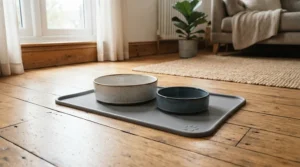
- Cut the buffet. Pick up uneaten food promptly, wipe spills and put the bowl on a mat sitting in a shallow tray of water, a simple “moat” that costs nothing.
- Place baits on the route, not at the bowl. The ECHA summary for gel baits says to keep them away from animal feed, so aim for a spot out of reach, such as behind an appliance.
- Don’t spray the trail leading to the bait. Killing foragers on contact stops them carrying the bait home, which is the whole point of bait.
- Check every seven days. NOPE advises weekly checks and replacing consumed gel, which also tells you if the bait is working.
- Wash bowls and hands. Wash the bowl before refilling it, and wash your hands after handling any station.
- Store leftovers safely. Keep unused products in original packaging, locked away from animals.
Expect baits to take days or weeks. Activity usually tapers rather than stopping overnight, and that is a sign the colony is sharing the bait.
Real-World Scenarios: Three UK Households, Three Setups
The terraced house with a Labrador (budget around £25). Ants arrive under the back door and make a beeline for the food bowl. A NOPE! Ant Killer Baited Gel kit goes behind the kitchen units, and a band of Nippon Ant Killer Powder goes outside at the threshold. The bowl moves to a water-moated mat.
The first-floor flat with two cats (budget around £10). No garden means no outdoor treatments, and some permethrin product labels warn against cat access, so powders are out. Two Zero In Dual Action Gel Ant Bait stations go behind the fridge and under the sink. Bowls move to a high shelf during treatment.
The family home with a garden nest (budget around £30). Ants are coming from a patio nest. Nemasys No Ant treats the nest over a couple of weeks while Deadfast Ant Killer Plus stations cover three indoor routes. For a household with a pet rabbit or other small animal, ask your vet before using any insecticide product, because species differ in sensitivity.
How to Choose a Pet Friendly Ant Killer for Pet Food Bowls
- Start with containment. Enclosed bait stations keep the active ingredient away from fur and paws better than surface treatments.
- Check where you’ll use it. Indoor-only products are labelled that way, so don’t take Zero In Dual Action Gel Ant Bait outside.
- Know your pet. Cats, rabbits and fish can react differently to the same ingredient, so ask your vet when unsure.
- Match speed to the problem. Contact kill gives immediate relief, bait handles the colony.
- Read the food rule. Look for “not for use on food contact surfaces” and “keep away from feed”.
- Check the dry-time and re-entry rule. Sprays state when animals can return.
- Look for HSE approval. Biocides sold in the UK should carry the required authorisation details on the label.
Ant Spray for Kitchen Skirting Boards: Where It Helps and Where It Doesn’t
Skirting boards are the motorways of the ant world. The gap where wall meets floor gives scouts cover, and a nest behind the plaster can feed the line for months.
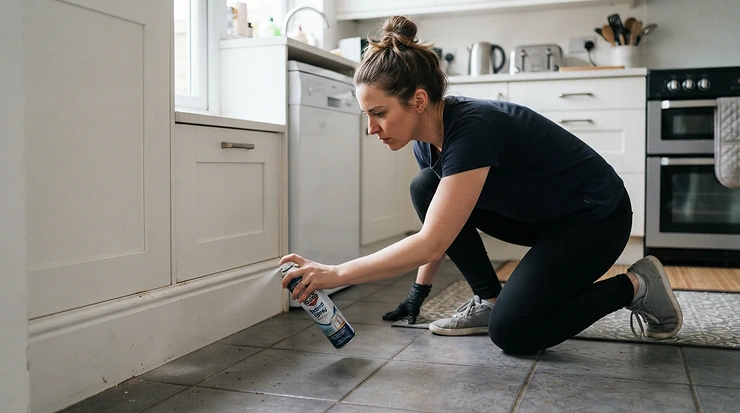
An ant spray for kitchen skirting boards works best as a narrow band along the base, not a drenching. The NOPE! CP Ant Killer Spray instructs 25-50ml per square metre, so a thin line along a few metres of skirting uses very little. Move bowls and mats to another room first, keep animals out until the surface is fully dry, and wipe nearby food-contact areas separately.
Be wary of staining. One retailer reviewer of a different spray, the Zero In Ultra Power Ant & Insect Killer‘s 300ml sibling, warned about yellowing on paintwork or PVC. Painted wood and white PVC skirting are exactly where that would show, so test on a hidden corner first.
For a household with pets, an ant spray for kitchen skirting boards is a tool for specific routes. It is not a kitchen-wide cure.
Non Staining Ant Killer Spray for Worktops: A Reality Check
Here is the honest answer: I found no ant product label that promises “non staining”, and I’d distrust any listing that does.
The nearest thing is the NOPE! CP Ant Killer Spray, a pale yellow, water-based, solvent-free liquid that Expert Reviews calls odourless. That sounds gentle, but its label says not to use it on food contact surfaces. Worktops are food contact surfaces.
So the safer approach to a non staining ant killer spray for worktops is not to treat the worktop surface at all. Treat the crack at the back edge, the gap round the sink or the cable hole in the unit, from where ants emerge. Then wipe the worktop clean of crumbs and let baits do the colony work elsewhere.
If you ever do use a spray near a worktop edge, patch-test an inconspicuous area, follow the label to the letter and let it dry completely. A non staining ant killer spray for worktops is a hope, not a promise, and no product page can guarantee your particular laminate.
Contact Kill Insecticide vs Bait: Which Works Faster, Which Works Better?
A contact kill insecticide does what it says: ants die when they touch the treated surface or are sprayed directly. It’s fast and satisfying, but it mostly removes the workers you can see. The nest, where the queen keeps laying, carries on.
Baits play a longer game. Worker ants carry gel back and share it mouth to mouth in a process called trophallaxis, which lets the colony act like a communal stomach. That is why bait seems slow and why it works.
| Approach | Speed | Reaches Nest | Pet-Contact Risk | Best For |
|---|---|---|---|---|
| Gel bait stations | Days to weeks | Yes | Lower when enclosed | Kitchens and indoor routes |
| Contact kill insecticide spray | Minutes | Rarely | Higher until dry | Thresholds and gaps |
| Powder (Nippon Ant Killer Powder) | Hours to days | Sometimes | Variable by label | Outdoor entrances |
| Nemasys No Ant and hygiene | Weeks | Outdoors | Very low | Garden nests |
The pattern is clear: bait deals with the cause, contact kill insecticide deals with the symptoms, and combining them carelessly cancels both out. Use bait on the routes you want ants to use, and contact products only where bait can’t reach. In a pet household, enclosed bait and outdoor treatment should do most of the work.
Food Safe Application: How to Read the Label Like a Pro
Strictly speaking, “food safe application” isn’t an approval category for ant killers. It’s a habit: keeping product and food apart, every time.
Three label phrases do the heavy lifting. “Not for use on food contact surfaces” appears on the NOPE! CP Ant Killer Spray. “Keep away from food, drink and animal feed” appears in the gel-bait authorisation summary behind Zero In Dual Action Gel Ant Bait. And “do not use near food preparation areas” covers many powders, including Nippon Ant Killer Powder.
Apply that to pet bowls. Remove them before treating anything nearby, wash them afterwards and keep the feeding zone free of powder, spray and bait. For food safe application with gels, place stations on ant routes, not beside the bowl.
If your pet does get exposed, act quickly. PDSA notes it can take hours or days for signs of poisoning to appear, so call your vet rather than waiting for symptoms, and have the product packaging to hand.
Ant Entry Points: Find Them, Seal Them, Treat Them
Killing ants without closing ant entry points is bailing a boat without fixing the hole.
Common ant entry points include door thresholds, airbricks, window frames, gaps around pipes and cables, cracks where a patio meets the house wall, and the gap behind a dishwasher. Follow the trail in daylight, then trace it outside.
Once you’ve found them, seal gaps with flexible sealant where it’s practical, then treat from outside. Spray the route and entrances with the NOPE! CP Ant Killer Spray, whose label advises spraying along ant routes at entry and exit points. Alternatively, apply Nippon Ant Killer Powder at nest entrances in dry weather, mindful of its warnings about bees and water.
Outdoor baits need a dry spot. Expert Reviews’ advice on the Ant Stop! station was a tile or brick cover. Blocking a nest entrance without treating the colony can just send ants looking for another way in, so seal and bait together.
Common Mistakes When Buying and Using Ant Killer Around Pets
- Trusting “pet safe” on a listing. Retailer wording isn’t the label. The HSE says approved products mustn’t be described as harmless, so use the label as your guide.
- Putting a station against the bowl. Some labels say to keep bait away from animal feed. Distance is cheap insurance.
- Spraying the bait trail. You kill the carriers, and the bait never reaches the nest.
- Using powder indoors. Several powders restrict use near food areas.
- Forgetting the species. Cats, rabbits and fish don’t share dogs’ tolerances.
- Skipping storage. Locked cupboard, original packaging, no exceptions.
Vets Now lists household chemicals among everyday pet hazards, so treat storage as part of the job. If you think your pet has been exposed, ring your vet straight away; the HSE advises seeking veterinary help and reporting the incident.
Long-Term Cost & Value: What You’ll Actually Spend
Cheap ant control is a false economy when it fails, so think in cost per problem solved, not cost per pack.
| Product | Price Range | Coverage Note | Value Verdict |
|---|---|---|---|
| Zero In Dual Action Gel Ant Bait | Under £6 | One station per 8 m² | Best entry price |
| Deadfast Ant Killer Plus Bait Station | £5-£7 | Three stations per pack | Best multi-room value |
| NOPE! Ant Killer Baited Gel | £10-£15 | Refillable doses | Best for the season |
| NOPE! CP Ant Killer Spray | £13-£16 | 10-20 m² per bottle | Good if used sparingly |
| Nippon Ant Killer Powder | £3-£8 | Up to six months outdoors | Best outdoor value |
A realistic plan costs £15-£30 for the season: one bait product indoors and one treatment outdoors. Ant problems recur most years, so the refillable NOPE! Ant Killer Baited Gel can work out cheaper than repeatedly buying disposable packs. If an infestation persists, a pest controller costs more but may save weeks of frustration.
FAQs: Pet Friendly Ant Killer for Pet Food Bowls
❓ Can I put ant bait next to my dog's water bowl?
❓ How long does gel ant bait take to work?
❓ Is a water moat a good alternative to ant killer?
❓ Can I use ant powder inside the house?
❓ What should I do if my pet licks ant bait?
Conclusion: The Smartest Way to Protect Your Pet’s Bowl and Your Kitchen
No product makes a bowl of kibble ant-proof on its own. A pet friendly ant killer for pet food bowls works when you combine three things: containment, placement and discipline.
For most UK households the shortlist looks like this. NOPE! Ant Killer Baited Gel Syringe & Reusable Bait Stations is the standout for dog owners thanks to its bitter-coated gel and lockable stations. Zero In Dual Action Gel Ant Bait and Deadfast Ant Killer Plus Bait Station are the budget workhorses for indoor routes, and AntClear brings a generous bait load. Outside, Nippon Ant Killer Powder and the NOPE! CP Ant Killer Spray handle entry points, while Nemasys No Ant suits gardeners who want to avoid conventional insecticide.
Whatever you choose, read the label, keep products away from bowls, move bowls during treatment, wash up afterwards and store everything locked away. Do that, and the only thing marching across your kitchen floor will be your dog.
Recommended for You
- Borax Ant Bait Stations For Indoor Use: 7 Smart Picks (2026)
- Sugar Ant Gel Bait For Kitchen Worktops: 7 Best Picks (2026)
- Ant Killer Powder For Patio Paving Cracks: 7 Proven Picks 2026
Disclaimer: This article contains affiliate links. As an Amazon Associate, I earn from qualifying purchases. If you purchase products through these links, we may earn a small commission at no additional cost to you.
✨ Found this helpful? Share it with your friends! 💬🤗
