
In This Article
You spotted the droppings behind the washing machine. Or heard the gnawing in the loft at 2am that sounded suspiciously purposeful. Maybe the dog has been staring at the gap under the garden shed with an intensity she normally reserves for the postman. Either way, the conclusion is the same: you’ve got rats, and something needs to be done about it.
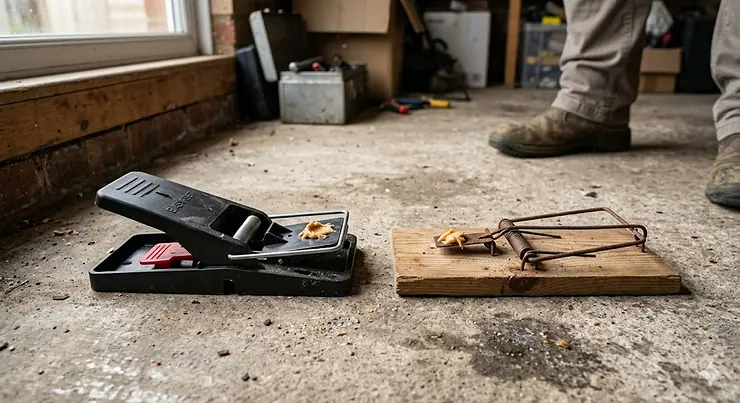
Here’s the question that trips up most British homeowners at this point: plastic snap rat trap vs wooden snap rat trap — does it actually matter which one you buy? The short answer is yes, more than most people realise. The longer answer is what this guide is for.
Both types use the same basic kill mechanism — a spring-loaded bar that snaps down with enough force to dispatch a rat quickly — but they diverge significantly in materials, durability, ease of use, hygiene, and how well they hold up to the particular punishment of a British garden or damp loft space. Choosing the wrong type doesn’t just waste money; it can mean a trap that misfires, gets waterlogged, or simply fails to catch anything for weeks while your uninvited lodger redecorates behind your skirting boards.
According to the British Pest Control Association, rat callouts in the UK have been rising steadily in recent years, driven by milder winters, construction activity, and changes in bin collection schedules. Brown rats (Rattus norvegicus) are particularly prevalent in British urban and suburban gardens — adaptable, suspicious of new objects, and frankly smarter than they have any right to be.
In this guide, I’ve reviewed seven of the best snap rat traps currently available on Amazon.co.uk — covering both plastic and traditional wooden options — to help you make the right call for your home, garden, and budget.
Quick Comparison: Plastic vs Wooden Snap Rat Trap
| Feature | Plastic Snap Trap | Wooden Snap Trap |
|---|---|---|
| Durability in damp conditions | ✅ Excellent — won’t warp or swell | ⚠️ Poor — absorbs moisture, warps |
| Hygiene & cleaning | ✅ Wipe-clean, non-porous | ❌ Wood retains scent and bacteria |
| Ease of setting | ✅ Modern designs are safer to set | ⚠️ Traditional mechanism, finger risk |
| Catch sensitivity | ✅ Wide trigger pads on modern models | ✅ Treadle design = very sensitive |
| Reusability | ✅ Multiple seasons | ⚠️ Limited — wood degrades |
| Price range | £5–£30 (packs) | £4–£15 (packs) |
| Best For | Ongoing infestations, outdoor/shed use | Budget first-timer, indoor sheltered use |
| Amazon.co.uk Availability | Widely available, Prime-eligible | Available, some stock limited |
From this comparison, the story becomes clear quickly. Plastic snap traps have a meaningful practical edge for most UK households — especially for outdoor use in gardens, sheds, and garages where British weather will make short work of wooden traps. That said, wooden designs like the classic Little Nipper have earned their reputation over more than a century, and their treadle mechanism genuinely does produce a high catch rate in sheltered indoor settings. Price-conscious buyers tackling a one-off indoor problem will find wooden traps surprisingly competitive. The real mistake is using a wooden trap outdoors in November and wondering why it stopped working after the first fortnight of rain.
✨ Don’t Miss These Exclusive Deals!
🔍 Take your rat control to the next level with these carefully selected products. Click on any highlighted item to check current pricing and availability on Amazon.co.uk. These picks will help you find exactly what you need!
Top 7 Rat Traps on Amazon.co.uk: Expert Analysis 🐀
1. ROSHIELD 4x Rat Traps — Professional Quality Heavy Duty
The ROSHIELD set is arguably the closest thing the UK market has to a professional standard plastic snap trap that any homeowner can buy. This is what pest controllers actually use — not the budget versions you’ll find in the garden centre — and it shows in the build quality.
The welded kill bar is the detail that matters most here. Cheaper plastic traps use a kill bar that’s simply pressed into place; the ROSHIELD’s is welded, meaning it won’t flex or shift under the force of a large brown rat. The trigger plate is noticeably more sensitive than standard designs, which translates to fewer bait thefts and more successful catches. Dimensions are substantial — large enough to handle the biggest rats you’re likely to encounter in a British garden or behind a kitchen plinth.
For UK buyers with an ongoing infestation, this is where I’d start. The plastic body is wipe-clean after use, which matters when you’re emptying traps in a damp shed wearing your least-favourite gardening gloves. Roshield is a UK-focused pest control brand, and their understanding of British conditions is evident — these traps are designed for repeated outdoor use without degrading. UK reviewers consistently report catches within the first 24 hours when positioned correctly along active rat runs. One UK customer noted it achieved “in 6 hours what I’d been trying to do for a week” with conventional traps.
That said, some reviews flag that the trigger plate can be slightly small for very large brown rats — a quirk worth noting if your visitor appears, shall we say, well-fed.
✅ Welded kill bar for reliable strikes
✅ Sensitive trigger plate reduces bait theft
✅ Designed for UK professional pest control use
❌ Trigger plate may be too small for exceptionally large rats
❌ Bare open trap — keep away from pets and children
Available in 2-pack and 4-pack. Check current pricing on Amazon.co.uk — a solid investment at any tier.
2. NOPE! Rat Snap Trap (4-pack)
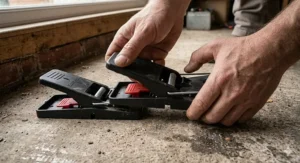
NOPE! is a newer entrant to the UK rat trap market with an unusual amount of confidence in its branding — and to be fair, the product backs it up. The headline claim is “3X strength snapping,” which sounds like marketing hyperbole until you actually set one and feel the coiled spring tension. It’s meaningfully stronger than the ROSHIELD and most other open plastic traps I’ve seen on Amazon.co.uk.
What’s genuinely clever is the deep bait cup design. Most open snap traps have a shallow bait platform that rats can lick clean without stepping on the trigger — infuriating when you return to find the peanut butter gone and the trap still set. NOPE!’s recessed cup forces the rat to commit more fully to reaching the bait, improving trigger rates. Dimensions are 14 × 7.6 × 9.5 cm — big enough for full-grown rats, usable for mice too.
This trap is ideal for the homeowner who’s tried cheaper snap traps, had their bait stolen twice, and is now mildly furious. The step up in spring tension and bait cup design addresses exactly those two frustrations. UK reviews from verified buyers praise the clean, instant kills and easy cleaning between uses. One reviewer’s summary: “Setup is straightforward… The traps activate cleanly and reset without fuss.”
For outdoor use, pair with a NOPE! bait box station (sold separately) — the trap itself isn’t weatherproofed against sustained British rain.
✅ Up to 3x spring tension vs standard traps
✅ Deep bait cup defeats bait theft
✅ Wipe-clean plastic, quick reset
❌ Premium pricing for a 4-pack vs competitors
❌ Best used inside or with a separate bait station outdoors
An excellent choice in the mid-range bracket — check current price on Amazon.co.uk.
3. Froboo Rat Reaper 2-Pack (with Peanut Butter Bait Sachets)
The Rat Reaper takes a fundamentally different design philosophy from the open snap traps above. It looks like a small black plastic tunnel — roughly 25cm long — and that’s precisely the point. The snap mechanism is entirely concealed inside the tunnel, with entry holes at each end. Rats, being naturally drawn to enclosed, dark tunnel-like structures that mimic their own burrows, enter with less hesitation than they would approach an open trap.
The result is a trap that’s simultaneously more effective with suspicious, experienced rats and significantly safer in homes with pets or curious children. A Labrador’s nose can’t reach the mechanism; a toddler’s finger can’t trigger it. The dual-entry design — rats can approach from either end — also increases catch probability compared to directional single-entry traps.
Each pack includes peanut butter bait sachets, which removes the faff of sourcing bait separately and gets you set up immediately. Pest control professionals across the UK consistently recommend peanut butter over all other bait options; its sticky texture keeps it in place and its scent is irresistible to rats in a way that the cartoon staple of cheese simply isn’t.
For families with young children or dogs, or for anyone placing traps in areas accessible to non-target animals, the Rat Reaper is the most sensible plastic snap option in this list. The slightly higher price per trap versus open designs is justified entirely by the safety margin.
✅ Concealed mechanism — safe for pets and children
✅ Tunnel design exploits rats’ natural behaviour
✅ Peanut butter bait included
❌ Slightly bulkier, less discreet under kitchen units
❌ Higher cost per trap than open designs
Check current price on Amazon.co.uk — Prime-eligible for next-day delivery.
4. Pest X Pro Shadow Professional Rat Trap Box (2-pack)
The Shadow is in a different category from the other plastic options here. It’s not just a trap — it’s a complete enclosed bait station that houses a snap trap mechanism inside a lockable hard plastic box. Think of it as the armoured personnel carrier of rat control, versus the other traps’ pistol approach.
The practical benefit in a UK context is significant. If you’re dealing with rats outdoors — along fence lines, near compost bins, behind sheds, or under decking — a bare open trap is a liability. It’s exposed to rain, accessible to hedgehogs (a protected species under UK law), and potentially hazardous to a neighbour’s cat. The Shadow eliminates all of those concerns. The box is robust, weatherproof, and locks with a key, meaning only you can access the mechanism inside.
It’s manufactured in the UK using recycled materials, which is a genuine sustainability point rather than a marketing tick-box. Professional pest controllers charge upwards of £200 for site visits, and many are using this exact product — the cost difference for the DIY buyer is obvious.
The trade-off is setup time. Placing a bare snap trap takes ten seconds. Opening the Shadow box, positioning and baiting the internal mechanism, then closing and locking it takes a couple of minutes per station. Worth it outdoors. Probably overkill under your kitchen units.
✅ Weatherproof enclosed station — ideal for UK gardens and outdoors
✅ Lockable — safe for children, pets, and protected wildlife
✅ Made in the UK from recycled materials
❌ More setup steps than an open trap
❌ Higher price point — overkill for quick indoor use
A strong long-term investment. Check current price on Amazon.co.uk.
5. Ratkil Rat Traps 2-Pack — Large Heavy Duty
Ratkil occupies a useful middle ground in the plastic snap trap market: more affordable than the ROSHIELD or NOPE!, solidly built, and widely available on Amazon.co.uk with strong Prime delivery coverage. The marketing describes it as a “conventional style break-back trap,” which is accurate — it mimics the classic wooden break-back mechanism but executes it in durable plastic with a robust spring.
The non-absorbent plastic body is the key advantage over traditional wooden traps for UK conditions. Wood swells with moisture, which slows the mechanism and reduces strike force; the Ratkil’s plastic housing simply doesn’t. In a British summer (or, let’s be honest, a British summer that feels like a British October), this matters far more than any spec sheet suggests.
Where the Ratkil occasionally falls short — as some UK reviewers have noted — is consistency. A small proportion of units seem to have overly stiff trigger plates, meaning rats can occasionally steal bait without triggering the mechanism. This is the quality control roulette that comes with the lower price bracket. The solution is to test each trap before deploying: set it, place a small piece of paper on the trigger, and confirm it releases cleanly.
For budget-conscious buyers tackling a first-time infestation indoors or in a sheltered shed, the Ratkil is a highly practical starting point.
✅ Budget-friendly entry point
✅ Non-absorbent plastic holds up in damp conditions
✅ Strong spring mechanism on well-manufactured units
❌ Some inconsistency in trigger sensitivity across units
❌ No included bait — you’ll need peanut butter separately
Check current price and availability on Amazon.co.uk.
6. Pest-Stop Little Nipper Rat Trap (Traditional Wooden, 6-Pack)
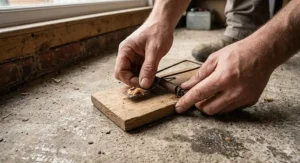
Here it is. The Little Nipper. If British rat control were a cricket match, the Little Nipper would be the opener who’s been at the crease since 1897 and refuses to retire. Manufactured originally by Procter Bros Ltd — a name still synonymous with pest control in the UK — this wooden snap trap has a distinctive treadle design that has remained virtually unchanged for over a century. Not because nobody thought to improve it. Because it works.
The treadle mechanism is the key differentiator from plastic open traps. Rather than requiring the rat to step on a pressure plate, the treadle design means the rat has to step onto the bait platform to reach the food. The slightest movement releases the wire. The result is an exceptionally high strike rate in sheltered indoor environments — under floorboards, behind plinths, in loft spaces. UK pest professionals still recommend it for indoor use despite the proliferation of plastic alternatives.
The caveat is loud and important: wooden rat traps and British weather are deeply incompatible. Moisture causes the wood to swell, slowing the mechanism and reducing spring force. Use this trap outdoors and it’ll be a soggy, ineffective lump within a fortnight. Keep it indoors, in a garage, or in a dry, sheltered shed, and it earns every penny of its modest price.
The 6-pack value is excellent for buyers dealing with an indoor infestation who need to cover multiple run locations simultaneously.
✅ Over 125 years of proven effectiveness
✅ Treadle mechanism = extremely high indoor catch rate
✅ Outstanding value in a 6-pack
❌ Completely unsuitable for outdoor or exposed use in UK weather
❌ Wood absorbs bait scent and bacteria — hygiene concern after multiple uses
Check current price on Amazon.co.uk — one of the most affordable rat control options available.
7. Black Cat Rat Trap — Quick-Kill Claw Snap Trap
The Black Cat is the one that made pest controllers switch to decaf. Its traditional claw-style mechanism delivers a genuinely ferocious snap — the product itself claims it can kill at least 200 rats per trap and warns explicitly that it can break fingers, which is the kind of spec sheet honesty you rarely encounter. Set this one carefully.
The design is simple: a heavy-duty spring-powered claw arm, a trigger beneath which bait is placed, and a release mechanism at the back to reduce finger-trap incidents when disarming. UK reviewers consistently report it succeeding where conventional snap traps had failed for weeks. One noted catching four rats — including two large ones — that had been ignoring traditional snap traps entirely. The bait options are versatile: UK reviewers have had success with liquorice, walnuts, dried fruit, and peanut butter, suggesting rats find this trap credible enough to approach with confidence.
The Black Cat sits in an interesting position between the traditional wooden trap aesthetic and modern plastic construction. It’s not a hygiene hero — cleaning it after use requires care and gloves — but for persistent infestations where other traps have failed, its raw power and traditional triggering logic often succeeds.
Not one for households with children or inquisitive pets. Very much one for the experienced DIY pest controller or for secure shed and barn deployment.
✅ Extremely powerful kill mechanism
✅ Works when conventional snap traps have failed
✅ Versatile bait compatibility
❌ Significant finger injury risk — must be handled with care
❌ Not suitable for households with children or pets
Check current price on Amazon.co.uk.
Top 7 Products: At-a-Glance Comparison
| Product | Type | Best For | Pack Size | Price Range |
|---|---|---|---|---|
| ROSHIELD 4x Rat Traps | Plastic open | Ongoing infestations, indoor & covered outdoor | 2 or 4 | Mid-range |
| NOPE! Rat Snap Trap | Plastic open (high-tension) | Bait theft problem, repeat-set | 4 | Mid-range |
| Froboo Rat Reaper | Plastic tunnel | Homes with pets/children | 2 | Mid-range |
| Pest X Pro Shadow | Plastic enclosed station | Outdoor & garden use | 2 | Premium |
| Ratkil Rat Traps | Plastic break-back style | Budget indoor use | 2 | Budget |
| Little Nipper | Wooden traditional | Sheltered indoor/loft | 6 | Budget |
| Black Cat | Metal claw / traditional | Stubborn infestations, barn/shed | 1-2 | Budget–mid |
The breakdown tells an interesting story: budget buyers have genuinely good options at both ends of the material spectrum, with the Little Nipper’s 6-pack offering exceptional indoor value and the Ratkil providing affordable plastic performance. Mid-range buyers are spoilt for choice with the ROSHIELD and NOPE!, while those with ongoing or outdoor-heavy infestations should seriously consider the Pest X Pro Shadow despite its higher entry cost — the long-term savings versus repeated pest controller call-outs make it look rather sensible.
✨ Don’t Miss These Exclusive Deals!
🔍 Ready to take action? Click any highlighted product to check current pricing and Prime delivery availability on Amazon.co.uk. Act quickly — rat problems compound faster than most homeowners expect.
How to Use Rat Snap Traps Effectively in British Conditions 🛠️
Buying the right trap is only half the battle. Here’s what most Amazon product listings don’t tell you — the practical knowledge that separates a successful catch in 24 hours from two weeks of frustrated bait theft.
Wear gloves every single time. This cannot be overstated. Rats have an extraordinary sense of smell and will detect human scent on a trap almost immediately. A freshly handled, ungloved trap placed along a rat run is effectively invisible to the rat in terms of trustworthiness. Use disposable nitrile gloves or rubber gardening gloves every time you handle, bait, set, or move a trap.
Position along runs, not in the open. Rats travel along the edges of walls, following the same routes repeatedly. Place your trap perpendicular to a wall with the trigger end facing the wall — this forces the rat to step directly onto the trigger as it moves along its run. A trap placed in the middle of the floor is more likely to collect dust than rats.
For wooden traps indoors: dry placement only. If you’re using a Little Nipper or similar wooden snap trap, keep it in genuinely dry locations — under floorboards, in a loft with minimal moisture, behind a kitchen plinth. Check the wood is dry before setting; a swollen, damp wooden trap has reduced spring force and increased misfire risk.
For plastic traps outdoors: consider a bait station. Even robust plastic traps benefit from shelter outdoors. Rain dilutes bait scent and can make the mechanism sluggish in sustained downpours. Pairing an open plastic snap trap with an enclosed bait station (like the Roshield bait box or the Pest X Pro Shadow system) dramatically improves catch rates in British gardens during the autumn and winter months.
Check every 24 hours minimum. UK pest control guidance, as well as welfare considerations under the Animal Welfare Act 2006, requires that traps be checked regularly. A live, injured, or trapped animal left for days is both inhumane and, frankly, unpleasant to deal with afterwards. Build it into your daily garden routine.
Bait strategically. Peanut butter is the consensus winner among UK pest professionals — sticky, strongly scented, and difficult to steal without triggering the mechanism. Press a small amount into the bait cup or treadle. Avoid fresh foods that deteriorate quickly in British damp; they attract slugs before rats.
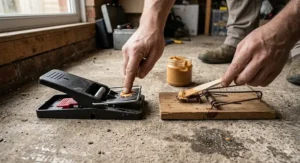
Real-World Scenarios: Which UK Buyer Needs Which Trap?
Different homes, different problems, different budgets. Here’s how I’d match the products in this guide to three common UK situations.
The terraced house homeowner in Manchester with rats under the kitchen units. You need something hygienic, effective, and safe to use in a tight indoor space. The Froboo Rat Reaper is my recommendation — its tunnel design means no exposed mechanism near food preparation areas, it’s tamper-resistant if there are small children about, and the included peanut butter sachets mean you’re set up in minutes. If budget is the priority, the Little Nipper 6-pack placed along the kick-board runs with the trigger facing the wall will serve admirably.
The semi-detached homeowner in Bristol with rats in the garden and compost bin area. This is where outdoor durability becomes non-negotiable. A wooden trap left near a compost bin in a Bristol garden from October will be a waterlogged wreck by November. The Pest X Pro Shadow is the right tool — weatherproof, lockable (important if neighbouring cats are wandering through), and designed for exactly this kind of permanent garden deployment. Pair two stations along the most active runs near the compost bin and fence perimeter.
The rural Lincolnshire farmer dealing with barn rats that have defeated every trap tried. The Black Cat is the one for this scenario, deployed in secure locations away from livestock and working dogs. Its raw mechanical force and traditional triggering logic often succeeds with rats that have learned to approach — and pilfer — conventional snap traps without consequence. For the same farm setting, the NOPE! 4-pack is the better choice if there’s any risk of non-target animal contact, given its deep bait cup improves trigger rate without relying on sheer spring violence.
Plastic Snap Rat Trap vs Wooden Snap Rat Trap: The Deeper Analysis
This is the question the entire guide is built around, and it deserves a more nuanced answer than “plastic is modern, wood is old.”
The case for plastic: Modern plastic snap traps are simply better engineered for the realities of British pest control in 2026. They don’t absorb moisture, so their spring mechanisms remain consistent across the full force of a British autumn. They’re non-porous, meaning they don’t harbour bacteria or retain the scent of previous catches — critically important if you’re reusing traps across multiple sessions, as accumulated rat scent on a wooden trap can actually make it less effective over time (wary rats detect the smell of dead conspecifics and avoid the area). High-quality plastic snap traps like the ROSHIELD and NOPE! are also built to withstand dozens of resets without spring fatigue. In a country where the average temperature barely exceeds 20°C and rain is effectively a year-round phenomenon, plastic’s moisture resistance is a decisive advantage.
The case for wood: The Little Nipper’s treadle mechanism is genuinely difficult to replicate in plastic at the same price point. The way a rat must physically step onto the platform — rather than just brush against a trigger pad — produces an extremely high indoor catch rate that some plastic designs struggle to match. There’s also the environmental argument: natural wood is biodegradable, requires no petrochemical manufacturing, and can be composted after its useful life. For buyers committed to reducing plastic use where possible, the Little Nipper’s indoor performance makes it a principled rather than merely nostalgic choice.
Where the choice actually matters: Outdoors in the UK, always choose plastic. Indoors in a dry, sheltered space, either will work, but wooden traps with treadle mechanisms edge ahead on catch sensitivity. The Pest X Pro Shadow changes the calculus entirely for outdoor use — it’s a plastic system that protects any internal trap (including wooden) from the elements, meaning you can have the best of both worlds if you choose.
According to research referenced by Pest Management Science and the UK government’s HSE guidance on rodent control, effective mechanical trapping combined with good hygiene practice is a first-line approach to rat control before considering rodenticide use. This is increasingly relevant as anticoagulant resistance among UK brown rat populations grows — a problem that makes traditional poison bait progressively less reliable, and mechanical traps progressively more important.
Common Mistakes When Buying a Rat Trap in the UK
Getting the product right is one thing. Using it correctly is another. Here are the errors I see UK buyers making most consistently.
Buying the wrong trap for the location. The single biggest mistake. A wooden trap in a British garden is not a rat trap; it’s a rain experiment. An indoor-only plastic snap trap in a November garden is barely better. Match the trap to the deployment environment: plastic for outdoors, either for sheltered indoors, and an enclosed station if pets or children are a concern.
Under-baiting. A trace of peanut butter the size of a pea is not sufficient. Apply enough to require the rat to press into the bait cup or treadle — this is what triggers the mechanism. Tentative sniffing from a distance doesn’t set off a well-calibrated trap.
Placing too few traps. Rats establish multiple regular runs, often within a few metres of each other. One trap catches one rat. If you have two or three rats (likely — they rarely holiday solo), you need at least that many traps, ideally more, placed simultaneously. Experienced UK pest controllers typically place a minimum of three or four traps per site.
Ignoring the root cause. Snap traps are a solution, not a prevention. If there’s an accessible food source — unsecured compost bins, bird feeders with spillage, pet food left outside — the traps will catch rats indefinitely without resolving the underlying issue. The British Pest Control Association recommends a “survey, treat, and prevent” approach for any sustained rat problem.
Handling traps barehanded. Already mentioned in the usage guide, and worth repeating here because so many UK reviewers wonder why their traps aren’t catching despite correct placement. Human scent is enough to make a wary brown rat treat a trap as a suspicious object for days.
Features That Actually Matter (And Those That Don’t)
The rat trap market is not immune to marketing noise. Here’s how to filter it.
Matters: Spring strength and kill bar quality. A weak spring injures rather than kills, which is inhumane, messy, and means you have to deal with a very unhappy rat. Look for welded kill bars (ROSHIELD, NOPE!) over pressed-fit designs.
Matters: Trigger sensitivity. The gap between “bait theft” and “successful catch” is almost entirely determined by how sensitively the trigger plate responds to rat weight distribution. Treadle designs (Little Nipper) and deep bait cups (NOPE!) both address this more elegantly than a flat pressure plate.
Matters: Material resistance to British weather. If there’s any possibility of outdoor or damp-environment use, non-porous plastic is the correct answer.
Doesn’t matter (much): Colour. Despite what the Froboo Rat Reaper XXL claims about rats seeing UV light on its green trigger plate, the primary mechanism of attraction is bait scent, not trap appearance. The UV light claim is technically true — rats do have some UV sensitivity — but there’s limited field evidence it meaningfully improves catch rates over a well-baited conventional design.
Doesn’t matter: Pack size bragging. Six cheap, badly calibrated traps are worth less than two well-built ones. Prioritise mechanism quality over sheer quantity.
Long-Term Cost and Value: GBP Reality Check 💷
Let’s talk actual value over time, because “cheap upfront” and “cheap overall” are very different things.
A professional pest controller visit for a rat infestation in the UK typically runs from £100–£250 for an initial treatment, with follow-up visits adding £50–£150 each. Multiple visits for a persistent problem can push total costs well above £400. Against that baseline, even the premium Pest X Pro Shadow looks like a bargain.
Wooden traps present the lowest upfront cost — the Little Nipper 6-pack is one of the most affordable options on Amazon.co.uk — but their limited outdoor lifespan means replacement costs accumulate. A pack of six wooden traps replaced twice per year costs more than a quality plastic option that lasts multiple seasons with proper care.
Plastic open snap traps in the mid-range (ROSHIELD, NOPE!, Froboo Rat Reaper) represent the best long-term value for most UK households: durable enough for multi-season reuse, effective enough to eliminate the need for professional call-outs in most cases, and priced accessibly for initial purchase.
For farms, large gardens, or properties with chronic rodent pressure, the Pest X Pro Shadow system — despite its higher entry cost — pays for itself after the first prevented pest controller visit.
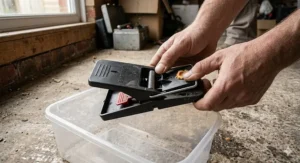
FAQ ❓
❓ Is a plastic or wooden rat trap better for use in a British garden?
❓ What is the best bait to use in a snap rat trap in the UK?
❓ Are snap rat traps legal to use in the UK?
❓ Can I use a wooden rat trap in a loft or under floorboards?
❓ Do I need a professional pest controller if snap traps aren't working?
Conclusion: Which Should You Choose?
Here’s the honest summary. For most British homeowners in 2026, a quality plastic snap trap is the right call. The UK climate — damp, mild, and reliably wet — simply doesn’t suit wooden traps anywhere except bone-dry indoor locations. Modern plastic designs like the ROSHIELD, NOPE!, and Froboo Rat Reaper are better built, easier to clean, more durable across seasons, and broadly as effective as their wooden counterparts indoors, with a significant edge outdoors.
The exception that proves the rule is the Pest-Stop Little Nipper. For dry, sheltered indoor use — lofts, behind kitchen plinths, under floorboards — its treadle mechanism produces a catch sensitivity that many plastic designs still struggle to match at the same price point. If you’re dealing with an indoor infestation on a tight budget, six Little Nippers and a jar of peanut butter is hard to argue against.
For outdoor, garden, or barn deployment, the Pest X Pro Shadow is the premium solution worth every penny of its higher price — weather-resistant, lockable, and the trap that professional pest controllers actually use. The ROSHIELD and NOPE! 4-packs cover the middle ground beautifully for most households.
Whatever you choose: wear gloves, check daily, and address the food source. The trap catches the rat; the prevention stops the next one.
✨ Don’t Miss These Exclusive Deals!
🔍 Ready to solve your rat problem? Click on any highlighted product above to check the latest pricing and Prime availability on Amazon.co.uk. Most are eligible for next-day delivery — so you could have your trap set by tomorrow morning. 🛡️
Recommended for You 📚
- How to Use a Humane Rat Trap: 7 Best Picks for 2026 (Safely!)
- Best Live Catch Rat Trap 2026: 7 Humane Picks Reviewed
- Best Snap Rat Traps UK 2026: 7 That Kill Instantly
Disclaimer: This article contains affiliate links. As an Amazon Associate, I earn from qualifying purchases. If you purchase products through these links, we may earn a small commission at no additional cost to you.
✨ Found this helpful? Share it with your mates! 💬🤗
