
In This Article
There’s a very specific kind of 3am dread that comes with hearing something scratch behind the skirting board. You lie there, doing the maths on how long it’s been since you last saw a stray crumb on the kitchen floor, and by morning you’ve made a decision: something has to be done. That decision usually splits into two camps, and the split runs deeper than most people expect. Snap traps vs humane mouse traps isn’t just a shopping question — it’s a small ethical fork in the road that a lot of otherwise decisive people suddenly can’t cross.
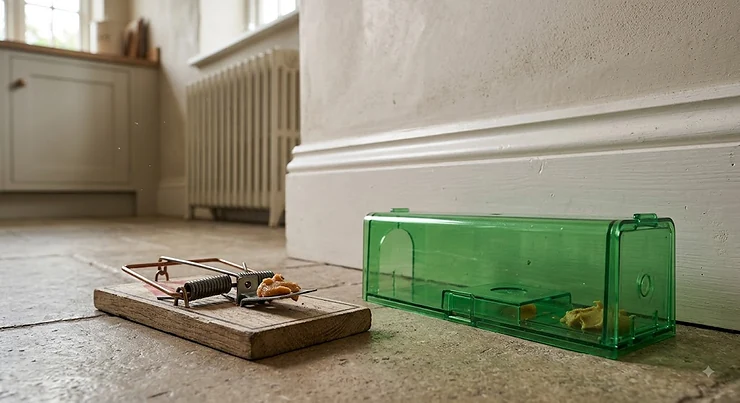
So here’s the short version. Snap traps are spring-loaded kill traps that despatch a mouse in a fraction of a second when triggered correctly; humane traps are enclosed boxes or tunnels that capture a mouse alive, unharmed, for release elsewhere. Both are legal, both are widely sold in the UK, and both work — but they work differently, they suit different households, and one of them asks a lot more of you afterwards than the other does.
This guide pulls apart snap traps vs humane mouse traps properly: real products with real specifications, honestly summarised review sentiment, and the practical stuff — checking frequency, release distance for mice, and what actually happens once you’ve caught something — that most listings skip entirely. Whether you’re weighing up humane vs lethal pest control on principle or just want the mouse gone by Friday, you’ll find a straight answer here rather than a shrug.
Quick Comparison Table: Snap Traps vs Humane Mouse Traps
| Factor | Snap Traps | Humane Mouse Traps |
|---|---|---|
| Kill method | Instant kill traps — spring bar, near-instant if set correctly | No-kill mouse traps — live capture only |
| Checking frequency | Once daily is generally sufficient | Every few hours, ideally hourly |
| Best for | Fast, decisive control of an active infestation | One or two mice, ethical preference, homes with young children present |
| Reusability | Reusable (wipe clean) or single-use, depending on model | Reusable indefinitely |
| Aftercare needed | Disposal only | Transport and release required |
The table above makes the trade-off fairly plain: snap traps front-load the difficult part (the moment of the catch) and then ask almost nothing of you, while humane traps push that difficulty downstream into daily checks and a release you have to plan and carry out properly. Neither is the “easy” option once you look past the first impression — a poorly checked humane trap can cause more suffering than a well-placed snap trap, which is the uncomfortable bit most marketing copy glosses over. If your household includes small children or a resident who can’t stomach disposal, that shifts the calculation considerably, and we’ll come back to exactly how in the sections below.
💬 Found this comparison useful? Save it or share it with someone else fighting the same 3am mouse dilemma!
Top 7 Snap Traps and Humane Mouse Traps: Expert Analysis
We’ve picked seven real, currently available products spanning budget to premium, covering both sides of the snap traps vs humane mouse traps divide. Every product below includes genuine specification analysis and aggregated review sentiment — never invented quotes or ratings.
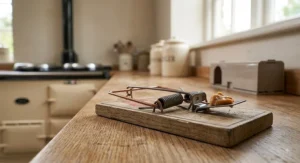
1. Victor M325 Wooden Mouse Snap Trap — the century-old design that refuses to retire
The M325 is about as close to the platonic ideal of a mouse trap as exists: a wooden base, a wire spring bar, and — the one genuine upgrade over the 1898 original — an expanded plastic trigger pedal instead of a narrow metal one. That wider pedal matters more than it sounds like it should, because a bigger target means a mouse is far more likely to actually set the trap off rather than nibbling around the edge of a metal hair-trigger and walking away unscathed. The pedal also comes pre-scented, so peanut butter is optional rather than essential, though it does noticeably improve catch rates.
Specs-wise, you’re looking at FSC-certified wood construction, a footprint of roughly 4 by 1.75 inches, and a sensitivity dial marked “S” for sensitive and “F” for firm — genuinely useful if you’re trapping in a spot where a draught or a curious cat might set it off by accident. This is the trap professional pest controllers reach for by default, not because it’s flashy but because a century of iteration has quietly ironed out most of the ways a cheap trap can fail. Reviewers consistently report that the wooden build outlasts plastic rivals through repeated use, though a minority note the wire spring bar needs a confident hand to set without catching your fingers — gloves are worth the ten seconds it takes to put them on.
Pros:
- ✅ Century-proven mechanism trusted by pest professionals
- ✅ Wide pre-scented pedal increases first-strike catch rate
- ✅ Adjustable sensitivity for tricky placements
Cons:
- ❌ Wire bar requires care when setting by hand
- ❌ Wood surface can’t be disinfected as easily as plastic
Typically sold in small multi-packs in the under-£10 range, the Victor M325 earns its keep on reliability rather than novelty — this is the trap to buy if you want something that simply works, without extra features to fuss over.
2. ROSHIELD 6 x Mouse Trap — best value for whole-house coverage
Pest control has one rule that beginners consistently underestimate: you need more traps than you think. One or two traps for a suspected infestation is usually a mistake, because mice are territorial along specific runs and a trap sitting even a metre off their path will simply be ignored. The ROSHIELD 6 x Mouse Trap pack solves that problem outright by giving you six heavy-duty, high-sensitivity snap traps in one purchase — enough to line a kitchen, utility room and hallway in a single afternoon.
Built from reinforced plastic rather than wood, each trap is rated by ROSHIELD as reusable after cleaning, with a sensitive trigger designed to respond to lighter contact than older wire-spring designs. The brand explicitly advises against “take-away” baits like ham, recommending ropy, sticky options like peanut butter or chocolate spread instead, precisely because a mouse has to linger and lick rather than grab and run — every extra second of contact improves the odds the trigger fires. Aggregated buyer sentiment on this range skews positive for value and snap force, with a recurring theme in reviews being that six traps genuinely changed the outcome of a persistent infestation compared with using just one or two.
Pros:
- ✅ Six traps cover multiple rooms in one purchase
- ✅ High-sensitivity trigger responds to light contact
- ✅ Reusable plastic build wipes clean between catches
Cons:
- ❌ Snap force strong enough to require careful finger placement
- ❌ Plastic housing feels less premium than wooden traps
At around £10-£15 for the six-pack, the ROSHIELD 6 x Mouse Trap works out as one of the cheapest ways to arm an entire house at once, which is exactly why it turns up so often in “best value” roundups.
3. The Big Cheese Quick Click Mouse Trap Twinpack — easiest pre-baited snap trap to use
If the wire-and-wood design of a classic snap trap has ever put you off — and for a lot of people, it genuinely does — The Big Cheese Quick Click Mouse Trap removes almost every point of friction. It arrives pre-baited with a poison-free attractant, needs a single touch to activate, and disposal is a matter of clicking the mechanism to release the mouse into a bin without any direct contact at all. For anyone who’s hesitated over a trap purely because they didn’t want to touch a dead mouse, this is the model built specifically to solve that problem.
The trade-off for that convenience is scale: it’s sold in a twinpack rather than the six-plus quantities budget options offer, so it’s better suited to a light, early-stage problem than an established infestation. What most buyers overlook about this model is that the “no-touch” click-to-dispose mechanism is arguably its biggest real-world selling point, more than the kill mechanism itself, because it’s the barrier that stops squeamish households from using a snap trap at all. Reviewers broadly confirm the one-touch setup works as described, with a smaller number noting that the plastic housing shows wear faster than metal alternatives after repeated resets.
Pros:
- ✅ Pre-baited and ready to use straight from the pack
- ✅ Click-to-dispose mechanism avoids any direct contact
- ✅ Simple enough for first-time trap users
Cons:
- ❌ Twinpack quantity limits coverage for bigger infestations
- ❌ Plastic components wear faster than metal designs
Priced around £6-£9 for the twinpack, The Big Cheese Quick Click Mouse Trap is best viewed as the easy on-ramp into instant kill traps rather than a heavy-duty solution on its own.
4. ASPECTEK 6-Pack Mouse Trap — best budget bulk snap trap
Sitting between the ROSHIELD pack and premium options, the ASPECTEK 6-Pack Mouse Trap is a professionally styled reusable snap trap sold specifically as a bulk, whole-property solution. The design keeps bait placement and the trigger mechanism deliberately straightforward, which in practice means less fiddling to get each trap set correctly and less chance of a false, wasted trigger from an awkward mechanism.
That simplicity is the whole appeal here. A trap that’s fiddly to set gets set badly, and a badly set trap either fails to catch anything or — worse from a welfare standpoint — catches a mouse without killing it cleanly. ASPECTEK’s straightforward pedal-and-bar layout is quick to reset after a catch too, which matters when you’re working through a run of six traps in one evening rather than fussing over one. Buyers researching this range consistently position it as an excellent-value option among snap traps, particularly for anyone treating several rooms at once rather than a single problem spot.
Pros:
- ✅ Professional-style design keeps setup genuinely simple
- ✅ Quick to reset for repeated multi-room use
- ✅ Strong value across a full six-pack
Cons:
- ❌ No adjustable sensitivity setting like the Victor M325
- ❌ Basic plastic construction lacks the M325’s proven longevity
Expect to pay roughly £12-£18 for the six-pack, positioning the ASPECTEK 6-Pack Mouse Trap as a solid mid-range bulk buy for anyone who wants professional styling without professional pricing.
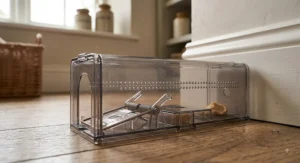
5. The Big Cheese Humane Mouse Trap – Double Entry — best no-touch release trap
Flip over to the humane vs lethal pest control question and The Big Cheese Humane Mouse Trap – Double Entry is one of the most straightforward live-capture options on the UK market. The tip-and-trap mechanism means a mouse entering from either end triggers a locking bar that seals it inside without any blade, spring bar, or crushing mechanism whatsoever — the entire design exists specifically as an alternative to a traditional snap trap.
What the spec sheet won’t tell you, but the design implies clearly, is that a double-entry system roughly doubles your chance of a catch compared with single-entry humane traps, because mice explore along walls in both directions and don’t need to approach from a specific side. Release is designed to be handled without touching the mouse directly — you simply carry the sealed trap to your release point and open it there. It’s sold as a reusable twinpack, and aggregated review sentiment is mixed but leans positive on catch rate, with the most common criticism being that a nervous mouse can sometimes hesitate at the entrance rather than committing fully.
Pros:
- ✅ Double-entry design roughly doubles catch opportunities
- ✅ No direct contact needed for release
- ✅ Fully reusable with no consumable parts
Cons:
- ❌ Requires more frequent checking than a snap trap
- ❌ Some reported hesitation from mice at the entrance
Priced around £8-£12 for a twinpack, the Big Cheese Humane Mouse Trap – Double Entry is a genuinely solid entry point if no-kill mouse traps are a firm requirement rather than a preference.
6. KEPLIN Humane Mouse Trap — sturdiest metal-reinforced no-kill design
Plastic live-capture traps have a reputation, not entirely undeserved, for being chewed through by a determined or panicked mouse before you get to it. The KEPLIN Humane Mouse Trap addresses that directly with metal-reinforced construction around the key stress points, aimed squarely at garages, sheds, and outbuildings where a trap might sit for longer between checks than is strictly advisable.
Marketed explicitly as pet- and child-friendly, it uses a touch-free design so you never need to handle a live, frightened animal directly during release. Reviewers researching this category consistently flag metal reinforcement as the deciding factor over cheaper all-plastic alternatives, precisely because a trap that fails structurally mid-capture is worse than no trap at all — it either lets the mouse escape mid-transport or, worse, injures it in the process. The honest caveat here is that metal reinforcement adds bulk, so it’s a less discreet option than slimline plastic tunnels if you need something tucked behind a kickboard.
Pros:
- ✅ Metal reinforcement resists chewing and structural failure
- ✅ Touch-free operation for handling and release
- ✅ Suited to outdoor and outbuilding use
Cons:
- ❌ Bulkier than slimline plastic humane traps
- ❌ Single-pack purchase limits multi-mouse households
At roughly £9-£14 per pack, the KEPLIN Humane Mouse Trap is the pick for anyone whose main worry with no-kill mouse traps is durability rather than catch rate.
7. The Big Cheese Live Multi-Catch Mouse Trap — best for catching several mice at once
Most humane traps are built around a single catch: one mouse, one release, reset and repeat. The Big Cheese Live Multi-Catch Mouse Trap breaks that pattern by holding up to four mice at once before you need to intervene, using a self-setting mechanism that re-arms automatically after each capture rather than requiring you to manually reset it between catches.
For a household committed to a fully no-kill mouse traps approach but dealing with more than one or two individuals, this is the model that actually scales. The self-setting feature means you’re not checking and resetting after every single catch — you can realistically leave it overnight and deal with multiple mice in one release trip the next morning, provided that’s still within a welfare-acceptable timeframe (more on that in the animal welfare guidance section below). It’s supplied pre-baited and ready to use. Aggregated feedback on multi-catch humane designs generally highlights convenience as the standout benefit, with the main honest criticism being that a fuller trap can grow noisier and more stressful for the animals already inside as new ones are added.
Pros:
- ✅ Holds up to four mice before requiring release
- ✅ Self-setting mechanism resets automatically after each catch
- ✅ Reduces how often you need to intervene
Cons:
- ❌ Multiple mice sharing one trap raises welfare considerations
- ❌ Premium mechanism costs more than single-catch designs
Typically priced around £12-£18, the Big Cheese Live Multi-Catch Mouse Trap suits a genuine infestation being handled the humane way, rather than a single stray visitor.
Top 7 Products: Specs, Price Range and Best For
| Product | Type | Reusable | Price Range | Best For |
|---|---|---|---|---|
| Victor M325 Wooden Mouse Snap Trap | Snap | Yes | Under £10 | Reliable classic performance |
| ROSHIELD 6 x Mouse Trap | Snap | Yes | £10-£15 | Whole-house multi-room coverage |
| The Big Cheese Quick Click Mouse Trap | Snap | Yes | £6-£9 | First-time users, light problems |
| ASPECTEK 6-Pack Mouse Trap | Snap | Yes | £12-£18 | Budget bulk buying |
| The Big Cheese Humane Mouse Trap – Double Entry | Humane | Yes | £8-£12 | No-touch, entry-level humane trapping |
| KEPLIN Humane Mouse Trap | Humane | Yes | £9-£14 | Sheds, garages, outdoor durability |
| The Big Cheese Live Multi-Catch Mouse Trap | Humane | Yes | £12-£18 | Larger no-kill households |
Looking at the spread here, the pattern is fairly clear: snap traps dominate the budget-to-mid range because the mechanism is simple and cheap to manufacture at scale, while humane designs cluster slightly higher because a working locking mechanism and inspection window cost more to engineer than a spring bar. If cost is your only constraint, the ROSHIELD 6 x Mouse Trap and ASPECTEK 6-Pack Mouse Trap deliver the most traps per pound; if you need the no-kill mouse traps route specifically, the Big Cheese Humane Mouse Trap – Double Entry is the cheapest genuinely well-reviewed option on this list.
✨ Ready to Sort Your Mouse Problem Tonight?
🔍 Whichever side of the snap traps vs humane mouse traps debate you land on, the right pack makes the difference between a one-week fix and a month of frustration. Check current pricing and availability on any of the products above before you commit.
Practical Usage Guide: Setting Up Traps for Success
Getting a trap out of the packaging and onto the floor is the easy 5% of the job — placement and technique account for the rest. Start by tracking droppings, gnaw marks, or greasy smear marks along skirting boards, since mice travel the same routes repeatedly and rarely cross open floor space. Place traps perpendicular to the wall with the trigger end facing the skirting board, spaced roughly two to three feet apart along any confirmed run, and use a small, sticky bait like peanut butter rather than a “grab-and-go” option like cheese or ham, since sticky bait forces contact with the trigger.
For snap traps specifically, set several at once rather than one or two — a common first-30-days mistake is under-trapping, which lets surviving mice grow trap-shy. Wear gloves when handling any trap, both to protect your fingers from spring force and to avoid transferring human scent, which mice are notably wary of. For humane traps, the equivalent mistake is under-checking: a trap left unchecked overnight can leave a mouse stressed, dehydrated, or exposed to cold for far longer than is acceptable, which undermines the entire ethical case for choosing a no-kill mouse trap in the first place. Check humane traps at minimum every few hours during daylight, and never leave one baited and unchecked over a working day or an overnight stretch without a clear plan for who checks it and when.
Real-World Scenarios: Matching the Trap to Your Situation
The renter with one stray visitor. If you’ve spotted a single mouse once and want it gone without drama, a twinpack humane trap like The Big Cheese Humane Mouse Trap – Double Entry is proportionate — low cost, low commitment, and no disposal to deal with, provided you can commit to checking it regularly and releasing promptly.
The family with an active kitchen infestation. Multiple mice, droppings in more than one room, and a household that just wants results — this is where a bulk snap trap pack like the ROSHIELD 6 x Mouse Trap earns its place. Six traps set correctly along confirmed runs will typically resolve a moderate infestation faster than a single humane trap ever could, simply through volume and speed.
The animal-welfare household with a bigger problem. If lethal control is a genuine non-starter but you’re dealing with more than one mouse, the Big Cheese Live Multi-Catch Mouse Trap is built for exactly this — no-kill mouse traps that scale past a single catch, provided you’re realistic about the extra daily commitment that comes with it.
Problem → Solution: Common Trapping Issues
Mice ignoring the trap entirely usually means placement, not the trap itself — move it directly against a confirmed wall run rather than the middle of a room. A snap trap firing without a catch generally points to sensitivity set too high or bait placed where a mouse can lick it without triggering the pedal; press bait firmly into the cup rather than balancing it on top. A humane trap that keeps turning up empty after several days often means the entrance door isn’t swinging freely — check it hasn’t stuck with dust or debris. And if you’re catching mice faster than you can release them humanely, that’s usually a sign the infestation has outgrown a single-catch humane trap, and either a multi-catch design or a temporary switch to instant kill traps for the bulk of the population, paired with humane traps for stragglers, is the more realistic path forward.

How to Choose Between Snap Traps and Humane Mouse Traps
- Decide on your ethical baseline first. If a no-kill mouse traps approach is non-negotiable for you, that eliminates half the market immediately and saves time comparing products you’d never actually buy.
- Be honest about your checking capacity. Humane traps only stay humane if checked every few hours; if your daily schedule genuinely can’t support that, a well-placed snap trap causes less overall suffering than a neglected live trap.
- Assess scale of the problem. One mouse suits a single humane trap; multiple confirmed mice across several rooms favours bulk snap trap packs or a multi-catch humane design.
- Factor in who else lives in the house. Households with toddlers or pets that roam freely may prefer enclosed humane traps or snap traps positioned in inaccessible spots, since exposed spring bars carry a small injury risk to curious hands and paws.
- Think about disposal versus release. Snap traps end with a bin bag; humane traps end with a car journey and a release protocol. Pick the one you’ll actually follow through on consistently.
- Check reusability and long-term cost. Reusable snap and humane traps both work out cheaper over months than single-use disposable designs, so factor total cost of ownership rather than the sticker price alone.
- Match the trap to the location. Metal-reinforced humane designs and heavy-duty snap traps suit outdoor sheds and garages better than lightweight indoor-only models.
Snap Traps vs Humane Mouse Traps: The Full Comparison
The humane vs lethal pest control debate tends to get framed as a simple moral binary, but the reality on the ground is more nuanced than that. A well-built, correctly set snap trap kills in a fraction of a second — the UFAW’s guidance on rodent control notes that spring-powered killing traps, used properly, are among the more humane lethal options precisely because death is rapid and the mouse doesn’t suffer through it. The word “humane,” in other words, isn’t reserved exclusively for live-capture traps; a snap trap that works as designed is arguably kinder than a poorly checked live trap that leaves a mouse frightened and dehydrated for half a day.
Where humane traps genuinely win is in situations where killing simply isn’t acceptable to the household, regardless of speed — moral or religious objections, young children who’d be distressed by a dead mouse, or simply a personal line some people won’t cross. The trade-off is that a live-capture trap shifts responsibility onto you: the mouse’s welfare from the moment of capture to the moment of release depends entirely on how promptly and carefully you handle that gap. Get it wrong, and a “humane” method can end up causing more prolonged distress than the alternative it was meant to avoid. Neither side of this comparison is automatically the ethical high ground — it depends on execution, not just intention.
Common Mistakes When Buying and Using Mouse Traps
The single most common mistake is under-buying — one or two traps for a problem that needs six or eight, which drags a fixable infestation out for weeks. A close second is inconsistent bait: switching between different bait types confuses the scent trail mice are following, so pick one sticky option and stick with it across every trap. With humane traps specifically, the recurring error is treating “reusable” as “set and forget” — these traps demand active daily management, not a one-off setup. And on the snap trap side, people frequently under-set the sensitivity dial out of nervousness about the spring force, which ironically makes the trap less effective and more likely to injure rather than kill cleanly if a mouse does trigger it.
What to Expect: Real-World Trap Effectiveness
Trap effectiveness in practice comes down to three things far more than brand: correct placement along a confirmed run, appropriate bait, and enough traps for the scale of the problem. A single trap of any type placed in the wrong spot will sit empty for weeks regardless of how well-engineered it is. Reviewers across both snap and humane categories consistently link disappointing trap effectiveness back to placement error rather than product failure — traps set in open floor space, away from walls, or without bait pressed properly into the trigger cup. Get placement right and both trap types perform close to their advertised catch rates within the first few days; get it wrong and even a premium trap will underperform a budget one placed correctly.
Animal Welfare Guidance: Humane Trapping, Release Distance and Your Legal Duties
If you’ve chosen the no-kill mouse traps route, welfare doesn’t end at the moment of capture — it arguably matters more from that point onward. The RSPCA’s guidance on living with rats and mice is explicit that releasing a single trapped mouse can affect its own survival chances, while leaving it in a trap until several are caught also risks harm, which is exactly why multi-catch designs need particularly close attention. As a general benchmark, wildlife guidance commonly points to release distance for mice of roughly a mile or more from the capture point to meaningfully reduce the chance it simply returns indoors, though further isn’t automatically kinder — releasing a mouse somewhere with no natural food, water or cover can leave it worse off than staying put.
Checking frequency is non-negotiable: humane traps should be inspected at least every few hours, since mice can suffer from stress, dehydration and cold exposure surprisingly quickly when confined. If a live-caught mouse is found injured or unwell, seeking veterinary or local wildlife advice is more appropriate than release. On the legal side, the Prevention of Damage by Pests Act 1949 places a duty on UK local authorities to keep their areas free from rats and mice so far as practicable, and occupiers are expected to notify their local authority if an infestation is significant — worth knowing if a DIY approach isn’t containing the problem. For deeper animal welfare guidance on the pros and cons of every control method, UFAW’s rodent control guidance is a genuinely useful, evidence-based resource rather than marketing copy dressed up as advice.
Long-Term Cost & Maintenance: A Year of Snap Traps vs Humane Traps
Over a twelve-month period, reusable snap traps and reusable humane traps land in a similar total-cost bracket, since neither requires ongoing consumables beyond the odd tub of peanut butter. Where the real cost difference shows up is time rather than money: a snap trap pack, once set, needs checking roughly once a day until the problem clears, while a humane trap demands several checks daily for as long as it’s active — and every one of those checks, in a genuine infestation, potentially means a release trip that eats into an hour or more of your week. If your household values time over ethics-adjacent effort, that’s a real cost worth weighing, not just an inconvenience to shrug off.
Maintenance itself is straightforward for both types — a quick wipe with mild disinfectant between catches keeps either design working at full sensitivity, and neither wood nor plastic traps typically need replacing within a year of normal household use unless the mechanism itself fails.

FAQ
❓ Are snap traps more humane than live traps?
❓ How far should you release a mouse from a humane trap?
❓ Do humane mouse traps actually work?
❓ How often should you check a humane mouse trap?
❓ Can you use snap traps and humane traps together?
Conclusion
If this guide leaves you with one takeaway, let it be this: snap traps vs humane mouse traps isn’t really a question of which method is objectively kinder in the abstract, because the honest answer is “it depends how well you use it.” A snap trap set correctly and checked daily is a fast, clean solution with a genuinely humane kill mechanism behind it. A humane trap checked diligently and released promptly and properly is exactly what it claims to be — a no-kill mouse trap that lets you resolve the problem without ending a life. The version that goes wrong, in both cases, is the neglected one: the snap trap left unset in the wrong spot, or the humane trap left unchecked overnight.
Match the product to your household, your schedule and your genuine tolerance for the disposal-versus-release trade-off, buy enough traps for the actual scale of the problem rather than the scale you’re hoping it is, and follow through consistently on whichever method you choose. That combination, more than any single product on this list, is what actually gets rid of mice.
✨ Still Deciding Which Trap Is Right for You?
🔍 Take another look at the seven options above and check current pricing before you buy — the right choice tonight could mean a mouse-free kitchen by the weekend.
Recommended for You
- Best Mouse Traps UK 2026: 7 Proven Picks That Actually Work
- 7 Best Mouse Traps Under £20 in 2026: Real Budget Picks
- Does Peppermint Oil Really Repel Rats? 7 Options Ranked for 2026
Disclaimer: This article contains affiliate links. As an Amazon Associate, I earn from qualifying purchases. If you purchase products through these links, we may earn a small commission at no additional cost to you.
✨ Found this helpful? Share it with someone else fighting off a mouse problem right now! 💬🐭
