
In This Article
There’s a particular kind of dread that comes with hearing a scratch in the skirting board at eleven o’clock at night, then remembering your toddler crawls along that exact stretch of carpet every morning before you’ve had coffee. Or your terrier, who considers anything smaller than a football to be a personal challenge. Mice don’t care about your household risk assessment. But the trap you choose absolutely should.
That’s the whole problem with the classic wooden snap trap your grandad swore by: it’s brutally effective on mice and just as capable of clamping down on a curious finger or an inquisitive paw. Child and pet safe mouse traps solve this by putting a physical barrier — a tunnel, a lid, a locking housing — between the mechanism and anything bigger than a rodent. Over the next few thousand words we’ve dug into seven real, currently available products, compared how they actually perform against each other, and worked through the practical questions (where to place them, what “tamper resistant” really means, what to do if your infestation is bigger than a lone mouse) that no Amazon listing bothers to answer properly.
A few housekeeping notes before we dive in: prices below are approximate ranges rather than fixed figures, because retail pricing shifts constantly — always check the current price on the product page before buying.
What is a child and pet safe mouse trap? It’s a rodent trap engineered with a covered, tunnelled, or locking housing so the killing or capture mechanism can’t be triggered by fingers, paws, or noses — while still being narrow enough that only a mouse-sized animal can reach the trigger plate inside.
Quick Comparison Table: At a Glance
| Product | Type | Reusable? | Best For | Price Range |
|---|---|---|---|---|
| The Big Cheese Sealed & Safe Mouse Trap | Covered kill trap | No (disposable) | Squeamish first-timers | around £6-£10 |
| Tomcat Kill & Contain Mouse Trap | Covered kill trap | No (disposable) | Tight, awkward spaces | around £8-£12 |
| Victor Covered Mouse Trap | Covered snap trap | Yes | Repeat infestations | around £10-£15 |
| TRATPER Mouse Tunnel Trap | Tunnel-housed snap trap | Yes | Homes with dogs or cats | around £12-£18 |
| Pest-Stop Trip-Trap Humane Mouse Trap | Live-catch trap | Yes | No-kill households | around £5-£20 |
| The Big Cheese Live Multi-Catch Mouse Trap | Humane multi-catch | Yes | Larger infestations | around £8-£12 |
| KENNEAS Humane Mouse Trap (4-Pack) | Live-catch trap | Yes | Whole-house coverage on a budget | around £15-£20 |
Looking at this table, the split really comes down to one decision you need to make before anything else: kill or catch-and-release. The Big Cheese Sealed & Safe and Tomcat Kill & Contain are both fire-and-forget disposable units that suit anyone who wants the problem gone with zero clean-up, while the Pest-Stop Trip-Trap and KENNEAS traps are for households that would rather relocate a mouse than end it. Budget-wise, single disposable traps edge it for a light, one-off mouse, but if you’re dealing with an ongoing infestation, a reusable covered trap like the Victor or TRATPER works out considerably cheaper per catch over a few months. According to the RSPCA, humane deterrents should generally be tried before any lethal method, which is worth bearing in mind as you weigh up which column of this table matters most to you.
💬 Found this comparison useful? Bookmark it before you head to the shops — you’ll thank yourself later.
Top 7 Child and Pet Safe Mouse Traps: Expert Analysis
We picked these seven specifically to cover the full spread: disposable and reusable, lethal and humane, budget and premium, imported American brands and proper British-designed kit. Every one of them is currently sold and shipped to UK addresses, and every one uses a covered or tunnelled housing that keeps the trigger mechanism away from bigger fingers and paws.
1. The Big Cheese Sealed & Safe Mouse Trap — best budget disposable trap for nervous first-timers
If the thought of touching a dead mouse makes your stomach turn, this is the trap built for exactly that anxiety. It arrives pre-baited, so there’s no fiddling about with peanut butter under time pressure, and the whole unit is designed to be thrown away, mouse and all, once it’s done its job.
The housing is a sealed plastic tunnel that hides the catch from view entirely — you check an indicator rather than opening a lid to look. STV International, the British firm behind The Big Cheese range, positions the entry point against a skirting board so a mouse walks the full length of the tunnel before the trigger fires, which in practice means small fingers or a cat’s paw simply can’t reach far enough in to set it off. This one is best suited to a single stray mouse or the early stage of an infestation, rather than a serious multi-mouse problem where the cost of disposable units per catch adds up quickly.
Reviewers on Amazon consistently report that it’s straightforward to place and that the sealed design does genuinely stop them from ever seeing the mouse itself, though a recurring theme in feedback is that results can take a couple of days if the bait well isn’t topped up with something stronger, like The Big Cheese’s own attractant paste.
Pros:
- ✅ Fully pre-baited, ready to use out of the box
- ✅ Sealed tunnel means zero visual or physical contact
- ✅ British-made brand widely stocked in UK supermarkets
Cons:
- ❌ Single-use, so ongoing costs add up with heavy infestations
- ❌ Not a humane option — this is a kill trap
At around £6-£10 for a twin pack, the Big Cheese Sealed & Safe Mouse Trap represents solid value if you only need to deal with one or two mice; for anything larger, the reusable options further down this list will save you money.
2. Tomcat Kill & Contain Mouse Trap — best for tight spaces and no-touch disposal
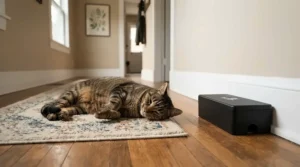
Tomcat’s Kill & Contain range is one of the most widely reviewed covered traps on Amazon, and the design brief is obvious the moment you pick one up: get the mouse inside a low-profile shell, kill it quickly, and let you bin the entire unit without ever making contact.
The trap sits at a low, flat profile specifically so it fits behind appliances, under kitchen units, and along tight skirting runs where a bulkier trap simply won’t go. Mice climb a short internal ramp toward bait that’s invisible from the entrance, a layout that also happens to be too narrow and enclosed for a cat’s paw or a small child’s fingers to reach the trigger. Based on the spec comparison with older-style covered traps, the “one-touch set” mechanism (you press down once rather than wrestling with a spring bar) is a genuine usability upgrade for anyone nervous about snap traps generally.
A common thread in customer feedback is real satisfaction with never having to see or handle the mouse — several reviewers specifically mention ordering repeat boxes because the disposal experience was so much less unpleasant than a traditional trap. On the other hand, a subset of buyers who’d used older Tomcat designs for years have noted that a redesigned internal ramp on newer batches made mice more reluctant to approach the bait fully, so results were more hit-and-miss than they remembered.
Pros:
- ✅ Low profile fits tight gaps behind appliances
- ✅ One-touch set mechanism, no exposed spring bar
- ✅ Toss-and-replace design avoids any contact with the catch
Cons:
- ❌ Disposable, so per-catch cost rises with repeat use
- ❌ Some reviewers report inconsistent results with the newer ramp design
Priced in the £8-£12 range for a two-pack, the Tomcat Kill & Contain Mouse Trap earns its spot for anyone whose mouse problem is confined to a handful of specific pinch-points around the kitchen or utility room.
3. Victor Covered Mouse Trap — best reusable covered snap trap for repeat infestations
Victor has been making mouse traps since 1898, and the covered version of its classic snap trap takes that century of muscle memory and wraps it in a shell that a curious spaniel can’t get its nose into. Unlike the disposable options above, this is a trap you’re meant to reset and use again and again.
At roughly 17cm long, 26cm high including the lid, and 14cm wide, it’s a chunkier unit than the flat disposables, but that bulk buys you a properly enclosed compartment: you press a lever on the top, the lid pops, and you reset the internal snap mechanism without your hand ever passing near where the mouse would have been. What most buyers overlook about covered snap traps like this one is that the “instant kill” claim depends entirely on correct baiting and placement — put it side-on to a wall instead of flush against it, and the mouse may approach at the wrong angle and trigger it without a clean strike.
Aggregated review sentiment on Victor’s covered traps is generally positive for durability, with plenty of owners reporting they’ve reused the same two or three traps for years. The main gripe that surfaces repeatedly is size: the covered housing takes up noticeably more space than a slimline disposable trap, so it’s a poor fit for very narrow gaps.
Pros:
- ✅ Reusable design cuts long-term cost per catch dramatically
- ✅ Fully enclosed reset mechanism, no contact needed
- ✅ Backed by a well-established, century-old US trap brand
Cons:
- ❌ Bulkier footprint than slimline disposable alternatives
- ❌ Requires correct wall placement to trigger reliably
Expect to pay somewhere in the £10-£15 range for a two-pack, which — spread across a season of repeated use — usually works out cheaper per catch than any disposable trap on this list.
4. TRATPER Mouse Tunnel Trap — tamper-resistant tunnel housing for curious pets
If your household includes a dog that treats every new object on the kitchen floor as a chew toy, the trap housing design matters more than almost any other spec on this list. TRATPER’s dual-tunnel construction addresses that head-on: both ends of the unit are narrow, covered tunnels, and the snap mechanism sits recessed in the middle where a paw or nose genuinely cannot reach it, even with determined poking.
The dual-entrance layout also does double duty for catch rate — mice can approach from either direction rather than being forced to find one specific opening, which matters in homes where rodents are already running established routes along skirting boards. Here’s what to weigh up before buying: the covered tunnel design that makes this trap so pet-proof also makes it harder to tell at a glance whether it’s been triggered, so you’ll want to physically check rather than relying on a visible indicator the way you can with the Tomcat or Big Cheese units above.
Reviewers frequently cite the accidental-triggering resistance as the standout feature, with several specifically mentioning dogs or cats investigating the trap without setting it off — which is precisely the pain point this product exists to solve. The trade-off some buyers flag is that the fully covered ends make the trap slightly fiddlier to bait and reset compared with an open-backed snap trap.
Pros:
- ✅ Dual-tunnel housing resists accidental triggering by pets
- ✅ Reusable snap mechanism keeps long-term costs down
- ✅ Two entry points improve catch rate on active runs
Cons:
- ❌ No visible catch indicator, so requires manual checking
- ❌ Slightly fiddlier to bait than open snap traps
At around £12-£18 for a four-pack, the TRATPER Mouse Tunnel Trap is the pick for multi-pet households where an open or lightly-covered trap design simply isn’t good enough peace of mind.
5. Pest-Stop Trip-Trap Humane Mouse Trap — best British-designed humane live-catch trap
Pest-Stop, part of the Pelsis Group, designed the Trip-Trap specifically for people who want mice gone from the house without a body count. It’s a clear-bodied live-catch trap: a mouse crosses a treadle to reach the bait, the door drops automatically behind it, and you’re left with a live, unharmed mouse to release well away from the house.
The clear plastic construction is a small but genuinely thoughtful design choice — you can see at a glance whether you’ve caught something without having to open the trap and risk a surprised mouse bolting straight back into your kitchen. Ventilation holes along the body reduce stress on the captured mouse, which matters because, on paper, this means the trap only stays humane if you actually check it often; the manufacturer’s own guidance (and the RSPCA’s general position on live traps) is that live-catch traps need checking roughly every two hours and should never be left overnight, since a mouse left too long without food or water will suffer regardless of the trap’s design.
Feedback on British-market live-catch traps like this one tends to praise the “British designed” build quality and simple mechanism, while the honest downside — one that applies to every humane trap on this list, not just this product — is that live-catch trapping is inherently more hands-on than a kill trap, since it only works as advertised if you’re disciplined about checking and releasing promptly.
Pros:
- ✅ Clear body lets you check catches without opening the door
- ✅ No harm comes to the mouse when used correctly
- ✅ British-designed mechanism, widely stocked by UK pest suppliers
Cons:
- ❌ Needs checking roughly every two hours to remain humane
- ❌ Not suitable for households that want a “set and forget” solution
Single units typically sell for around £4-£6, with multi-packs closer to £15-£20, making the Pest-Stop Trip-Trap Humane Mouse Trap one of the more affordable entry points into humane trapping.
6. The Big Cheese Live Multi-Catch Mouse Trap — best multi-catch trap for bigger infestations
One mouse rarely means one mouse. If you’ve heard scratching from more than one part of the house, or you’ve found droppings in several rooms, a single-catch trap is going to mean an awful lot of resetting. The Big Cheese’s Live Multi-Catch trap is built around a tip-and-trap mechanism that can hold four or more live mice at once before you need to empty it.
STV International’s own guidance recommends spacing multiple units two to three metres apart in badly affected areas, on the logic that mice tend to live and travel in groups rather than as lone individuals — so covering more ground with more traps, rather than relying on one heavy-duty unit, tends to produce better results. What most buyers overlook here is that a multi-catch trap doesn’t actually kill anything faster; it just reduces how often you personally need to intervene, which is a real quality-of-life upgrade if you’re managing an infestation across a whole ground floor rather than one cupboard.
Aggregated sentiment for this style of trap is generally strong on capacity and welfare (air holes and a reasonably roomy internal chamber reduce stress for mice awaiting release), with the main honest caveat being that, like any live trap, it still needs regular checking — holding four mice for days without food or water isn’t humane no matter how spacious the chamber is.
Pros:
- ✅ Holds multiple mice before you need to empty it
- ✅ Reduces how often you have to intervene daily
- ✅ Reusable across an ongoing infestation
Cons:
- ❌ Still requires frequent checking to stay genuinely humane
- ❌ Larger footprint than single-catch traps
At around £8-£12, the Big Cheese Live Multi-Catch Mouse Trap is a sensible mid-range pick for anyone facing more than an isolated mouse or two.
7. KENNEAS Humane Mouse Trap (4-Pack) — best value multi-pack for whole-house coverage
Rounding out the list is a budget-friendly bundle rather than a single premium unit: four reusable, washable live-catch traps designed to be scattered across multiple rooms at once, with a cleaning brush thrown in so resetting them between catches isn’t a hassle.
Buying four traps for roughly the price of one premium single unit changes the maths on trap placement entirely. Instead of agonising over the single best spot for your one trap, you can cover the kitchen, the utility room, the garage, and a hallway all in the same evening — and because these are catch-and-release rather than kill traps, there’s genuinely no danger to a child or pet who happens to nose around any of them. Based on the spec comparison with the pricier single-unit options above, the trade-off is build robustness: budget multi-packs like this one tend to use lighter plastics that won’t survive years of daily resetting the way a premium reusable trap will.
Reviewers frequently highlight value for money as the standout point, particularly for anyone testing several rooms at once without wanting to commit to a premium trap in every location. A recurring theme in less positive feedback is that the trigger sensitivity can be inconsistent between units within the same pack, so a bit of trial and adjustment is often needed in the first few days.
Pros:
- ✅ Four traps for the price of roughly one premium unit
- ✅ Washable and reusable, with a cleaning brush included
- ✅ Catch-and-release design is inherently safe for pets and kids
Cons:
- ❌ Lighter build quality than premium single-unit traps
- ❌ Trigger sensitivity can vary between individual units
At around £15-£20 for four traps, the KENNEAS Humane Mouse Trap (4-Pack) is the pragmatic choice for anyone who wants to blanket several rooms at once without blowing the budget.
Full Spec Comparison: Top 7 Traps Side by Side
| Product | Kill or Humane | Reusable | Housing Type | Best For | Price Range |
|---|---|---|---|---|---|
| The Big Cheese Sealed & Safe Mouse Trap | Kill | No | Sealed tunnel | Single stray mouse | around £6-£10 |
| Tomcat Kill & Contain Mouse Trap | Kill | No | Low-profile covered shell | Tight gaps, appliances | around £8-£12 |
| Victor Covered Mouse Trap | Kill | Yes | Enclosed reset housing | Ongoing light infestations | around £10-£15 |
| TRATPER Mouse Tunnel Trap | Kill | Yes | Dual covered tunnels | Homes with dogs/cats | around £12-£18 |
| Pest-Stop Trip-Trap Humane Mouse Trap | Humane | Yes | Clear ventilated body | No-kill households | around £5-£20 |
| The Big Cheese Live Multi-Catch Mouse Trap | Humane | Yes | Multi-chamber housing | Larger infestations | around £8-£12 |
| KENNEAS Humane Mouse Trap (4-Pack) | Humane | Yes | Ventilated single-catch | Whole-house coverage | around £15-£20 |
Read across this table and a pattern jumps out: every kill trap on our list uses some form of covered or tunnelled housing rather than an exposed spring bar, which is precisely what separates “child and pet safe” from the traditional design your grandparents used. The humane traps trade a slightly higher day-to-day time commitment (checking every couple of hours) for the complete removal of any lethal risk to a curious pet. If your household has both young children and pets, the safest combination is arguably one of the covered kill traps for speed alongside a humane multi-catch unit for anywhere little hands are likely to explore.

How to Choose Child and Pet Safe Mouse Traps
Picking the right trap isn’t really about finding the “best” one in the abstract — it’s about matching a trap’s specific safety features to your specific household. Here’s the framework we’d actually use:
- Decide kill or humane first. This single decision filters out half the market immediately and should be driven by your own comfort level, not marketing copy.
- Check the housing design, not just the marketing claim. “Pet safe” printed on a box means nothing without an actual tunnel, lid, or locking mechanism — look at product photos and measure the gap a curious paw would need to fit through.
- Match trap size to placement. A bulky covered trap won’t fit behind a fridge; a slimline disposable trap might not be sturdy enough for a garage with heavier rodent traffic.
- Weigh disposable against reusable based on scale. One mouse rarely justifies a premium reusable trap; an ongoing infestation almost always does.
- Factor in how often you can realistically check it. Humane traps are only humane with regular checks — if your routine genuinely can’t accommodate that, a covered kill trap may be the more honest welfare choice.
- Look at where you’ll place it relative to children and pets. A trap that’s technically safe in a cupboard might not be worth the risk directly on a playroom floor.
- Read aggregated review sentiment for consistency, not star averages alone. A 4.5-star rating built on hundreds of reviews telling you the trigger is unreliable is more useful information than the number itself.
Enclosed Mouse Traps vs Traditional Snap Traps
There’s a reason enclosed mouse traps have taken over so much shelf space from the old wooden snap trap: the exposed bar design that made those traps effective on mice made them equally effective on small fingers and paws. It’s worth being specific about what actually changes when a trap gets a housing built around it, because “enclosed” covers a fairly wide range of real designs.
| Feature | Traditional Snap Trap | Enclosed/Covered Trap |
|---|---|---|
| Trigger accessible to pets/children | Yes, fully exposed | No, housed or tunnelled |
| Visual exposure to catch | Full view | Hidden or partially hidden |
| Typical price | Lowest | Slightly higher |
| Best For | Adults-only, pet-free spaces | Homes with children or pets |
The exposed bar of a traditional snap trap is genuinely faster to set and marginally cheaper, and it remains a fine choice in a workshop or garage that children and pets never enter. But the moment a trap is going anywhere near a kitchen floor, a hallway, or a cupboard a dog can nose open, an enclosed design stops being a nice-to-have and starts being the only responsible option. It’s also worth noting that this comparison doesn’t extend to glue boards, which sit in a separate and considerably worse category on welfare grounds — public use of glue traps was made an offence in England under the Glue Traps (Offences) Act 2022, reflecting just how much harm an “open” capture method can cause to a trapped animal, let alone a curious pet that investigates one.
💬 Just one click — help others make safer buying decisions too! 😊
Common Mistakes When Buying Tamper Resistant Mouse Traps
Even well-intentioned buyers trip up on a handful of predictable errors when they’re shopping for tamper resistant mouse traps. Here’s what we’d flag before you add anything to your basket.
Assuming “tamper resistant” and “tamper proof” mean the same thing is probably the biggest one. Reputable manufacturers use “resistant” deliberately, because a determined dog or a persistent toddler can still eventually damage most plastic housings — the design slows and discourages access, it doesn’t guarantee it’s impossible. Treat any trap, however well-covered, as a supplement to sensible placement rather than a substitute for it.
A second common mistake is buying based on the packaging photo alone rather than the actual entry gap dimensions. Some “enclosed” traps have surprisingly wide tunnel openings that a small dog’s snout can still investigate; if the listing doesn’t specify entry dimensions, that’s worth searching for in the reviews before you buy.
Buyers also frequently underestimate how many traps they need. A single trap, however well-designed, covers roughly one specific location — mice travel established routes, and a proper response usually means several traps placed along skirting boards and behind appliances simultaneously, not one trap in the middle of the kitchen floor.
Finally, a mistake specific to households with pets: forgetting that the bait itself can be a draw for a dog, independent of the trap’s housing. Peanut butter smells appealing to a Labrador as much as it does to a mouse, so placement that accounts for scent, not just physical access, matters more than most buyers initially realise.
What to Expect: Real-World Performance
Specs on a box rarely translate directly into what actually happens on your kitchen floor at 2am, so here’s the honest, unglamorous version of what using these traps day to day looks like.
With a well-placed covered kill trap, you’re typically looking at a catch within 24 to 72 hours if mouse activity in that specific spot is genuine — droppings, gnaw marks, or grease trails along the skirting board. If nothing’s happened after three or four days, the trap almost certainly needs relocating rather than replacing; mice are creatures of habit and will avoid an area that doesn’t match their established route, regardless of how good the bait is.
Humane traps behave a little differently in practice. Because the trigger mechanism (a treadle or tip-and-trap design) requires the mouse to fully commit to entering the chamber, first-catch times can run slightly longer than a snap trap, and reviewers across the humane trap category regularly note that success improves noticeably once the trap has “seasoned” with a first scent trail from an earlier attempt. What the spec sheet won’t tell you, but reviewers note repeatedly, is that checking frequency matters almost as much as trap placement — a humane trap left unchecked overnight defeats the entire welfare argument for choosing it in the first place.
Noise is another practical factor nobody puts on the box. Covered kill traps produce an audible snap that startles some households (and some pets) more than expected the first time it happens, while live-catch traps are near-silent, which some parents specifically mention as a reason for preferring them in a child’s bedroom or playroom.
Safe Placement in Homes: Practical Usage Guide
Even the safest trap on this list becomes a risk if it’s placed carelessly, so getting placement right is arguably more important than which specific product you choose. Start by identifying actual mouse activity rather than guessing — droppings, gnaw marks on packaging, or a faint musty smell along skirting boards are the clearest signals, and traps placed on genuine routes catch far more mice than ones placed on hope alone.
Position traps flush against walls with the entrance facing the skirting board, since mice travel by keeping their whiskers in contact with vertical surfaces rather than crossing open floor space. In kitchens, behind and beside appliances (fridges, ovens, washing machines) are consistently the highest-traffic spots, but they’re also exactly where curious pets and toddlers tend to congregate looking for dropped food — which makes a covered or tunnelled trap non-negotiable in these locations specifically.
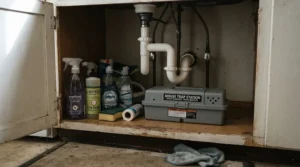
For homes with dogs, avoid placing any trap at nose height on open shelving; keep everything at floor level tucked against a wall or behind furniture legs where a dog would need to actively squeeze in rather than simply walk past. For homes with toddlers, cupboards with child locks are ideal locations precisely because they’re inaccessible to your child but still on a mouse’s likely route — under the sink and inside larder cupboards are two of the best dual-purpose spots.
In the first 30 days, check kill traps daily and humane traps at minimum every few hours during waking hours, resetting or re-baiting as needed. A common early mistake is over-baiting — a small dab of peanut butter about the size of a pea is genuinely more effective than a generous smear, since mice can otherwise nibble bait from the edge of the trigger plate without ever setting it off.

Real-World Scenarios: Matching Traps to Your Household
The young family with a toddler and a nervous cat. A three-bedroom terrace, one mouse spotted in the kitchen, a two-year-old who explores every cupboard within reach, and a cat who’s more interested in investigating new objects than actually hunting. This household is the clearest case for the TRATPER Mouse Tunnel Trap or Victor Covered Mouse Trap — both use fully enclosed housings that a cat’s paw genuinely cannot trigger, placed inside a child-locked under-sink cupboard where the toddler can’t reach at all.
The renter dealing with a light, one-off mouse. A single mouse spotted once, no ongoing signs of infestation, and a preference for not committing to reusable kit in a rented flat. Here, a disposable trap like the Big Cheese Sealed & Safe Mouse Trap or Tomcat Kill & Contain Mouse Trap makes far more sense than investing in reusable equipment for a problem that may never recur.
The animal-loving household managing a garden-adjacent infestation. A semi-detached house backing onto open ground, regular mouse activity across several rooms, and a firm household preference for no-kill methods regardless of scale. This is the scenario the KENNEAS Humane Mouse Trap (4-Pack) and Big Cheese Live Multi-Catch Mouse Trap were built for — multiple units deployed simultaneously across the affected rooms, checked on a strict schedule, with mice released well away from the property afterwards.
Solving Common Rodent Problems: Problem → Solution Guide
Problem: Mice keep avoiding the trap entirely. This is almost always a placement issue rather than a trap-quality issue. Move the trap directly onto the travel route (flush against a wall, near droppings or gnaw marks) rather than in the open middle of a room, and switch bait type if peanut butter isn’t drawing interest after several days.
Problem: The trap keeps getting triggered without catching anything. Over-baiting is the usual culprit — mice nibble bait from the trigger’s edge without committing fully. Reduce the bait to a pea-sized amount pushed right onto the trigger plate itself.
Problem: A pet keeps investigating the trap. Relocate to a genuinely inaccessible spot (inside a child-locked cupboard, behind heavy furniture) rather than assuming the trap’s covered housing alone will deter repeat investigation — persistent dogs in particular will keep testing a trap they’ve noticed.
Problem: You’ve caught one mouse but signs of activity continue. Multiple mice are very likely present. Increase the number of traps rather than relying on one, and place them at two-to-three-metre intervals along the same route, matching the spacing guidance STV International gives for its own multi-catch ranges.
Problem: A live-catch trap has held a mouse for what looks like too long. Release immediately, regardless of your planned schedule — welfare comes before convenience, and a stressed or dehydrated mouse is the clearest sign that checking frequency needs to increase going forward.
Long-Term Cost & Maintenance
Cost comparisons on mouse traps rarely account for the fact that a “cheap” disposable trap and an “expensive” reusable one are actually solving different problems. For a single mouse, a £6-£10 disposable trap is unambiguously the better value — there’s no maintenance, nothing to clean, and the cost per catch is simply the price you paid. For an ongoing infestation stretching across weeks or months, that maths flips: a £10-£15 reusable covered trap like the Victor Covered Mouse Trap, reset and rebaited a dozen times over a season, works out at a fraction of the equivalent spend on disposable units.
Maintenance itself is minimal but not zero. Reusable kill traps need a wipe-down with hot soapy water after each catch, partly for hygiene and partly because residual scent can actually deter the next mouse from approaching confidently. Humane traps benefit from the same treatment, plus an occasional check that ventilation holes haven’t become blocked with nesting material, which can happen if a trap sits unused for several weeks between catches.
The genuinely overlooked cost, though, is your own time. Humane trapping is not a “set and forget” method — the checking commitment (every couple of hours during the day) is a real, ongoing cost that doesn’t show up on the price tag but matters just as much as pounds and pence when you’re deciding what actually fits your household.
Trap Housing Design: Safety Regulations & Compliance in the UK
The UK’s regulatory landscape around rodent control has tightened noticeably in recent years, and it’s worth understanding the broad shape of it even if none of it directly restricts the mechanical snap traps and live-catch traps covered in this article (which fall outside chemical rodenticide regulation entirely).
Rodenticides — the poison-bait side of pest control, not the physical traps discussed here — are governed by the CRRU UK Code of Best Practice, which since 2026 requires professional users to hold current certification or be part of an approved Continuing Professional Development scheme before purchasing certain products. Physical traps like the ones on this list sit outside that framework, but the underlying principle — minimise the exposure of non-target animals and children to any rodent control method — is exactly the design philosophy behind covered and tunnelled trap housings.
More directly relevant is the Glue Traps (Offences) Act 2022, which made it a criminal offence in England to set a glue trap for catching rodents without a specific licence, following widespread evidence that glue boards cause prolonged, severe suffering and pose a genuine hazard to non-target pets and wildlife that encounter them. None of the seven products reviewed above are glue traps, and this legislation is a useful reminder of exactly why “housing design” matters so much when you’re choosing a trap: an open, unhoused capture method carries risk to more than just the mouse.
For anyone managing a more serious infestation professionally, the Health and Safety Executive’s guidance on rodenticide use and supply sets out the certification requirements in detail — genuinely useful background if your mouse problem escalates to the point where you’re considering bringing in professional pest control rather than relying on consumer traps alone.
Accidental Trapping Risk: Pet Proof Rodent Traps for Multi-Pet Homes
Households with more than one type of pet face a slightly different calculation than single-pet homes, because “pet safe” for a cat isn’t automatically the same threshold as “pet safe” for a boisterous Labrador puppy. Accidental trapping risk scales with both the animal’s curiosity and its physical ability to interfere with a trap’s housing.
Cats tend to investigate with a single exploratory paw and rarely commit their whole body to inspecting a new object, which means most covered traps on this list — even ones with relatively modest tunnel diameters — pose minimal genuine risk. Dogs, particularly younger or more food-motivated breeds, are a different proposition entirely: they’ll paw at, nose into, and sometimes attempt to chew a trap housing, especially if they can smell bait. For genuinely pet proof rodent trap performance in a dog-owning household, prioritise fully enclosed dual-tunnel designs like the TRATPER Mouse Tunnel Trap over lighter single-entry covered traps, and always place the unit somewhere the dog physically cannot reach unsupervised, rather than relying on the housing alone as the only line of defence.
Multi-pet households with both a cat and a dog should default to the most conservative option available — the most fully enclosed housing, placed in the least accessible location, checked most frequently — because the presence of one lower-risk pet doesn’t reduce the risk posed to the higher-risk one.
Frequently Asked Questions
❓ Are mouse traps safe to use with cats and dogs in the house?
❓ What is the safest type of mouse trap for a house with toddlers?
❓ Do humane mouse traps actually work?
❓ Are glue traps legal in the UK?
❓ How much do child and pet safe mouse traps cost?
Conclusion
There’s no single “best” trap in this list — there’s a best trap for your specific mix of children, pets, infestation size, and how much daily checking you can realistically commit to. If you want the problem gone quickly with zero contact, the covered disposable options from The Big Cheese and Tomcat are hard to beat. If your household includes a determined dog, the TRATPER Mouse Tunnel Trap‘s dual-tunnel housing is the more considered choice. And if killing anything is off the table regardless of infestation size, the Pest-Stop Trip-Trap, Big Cheese Live Multi-Catch, and KENNEAS traps all deliver a genuinely humane outcome, provided you’re disciplined about checking them.
What all seven share is the one non-negotiable feature that makes this whole category worth choosing over a traditional wooden snap trap: a housing designed with something other than the mouse in mind. Whatever you land on, place it thoughtfully, check it on schedule, and you’ll have solved the actual problem — the mouse — without creating a new one for the people and pets who share your home with it.
✨ Ready to sort your mouse problem properly?
Take a closer look at any of the seven traps above and check current pricing before you decide — your kitchen (and your curious cat) will thank you! 🐭🏠
Recommended for You
- Glue Traps for Mice: 7 Licensed Trade Picks (UK 2026)
- Reusable Mouse Traps: 7 Best Durable Picks for UK Homes 2026
- Mouse Traps for Garage and Shed: 7 Best Picks for 2026
Disclaimer: This article contains affiliate links. As an Amazon Associate, I earn from qualifying purchases. If you purchase products through these links, we may earn a small commission at no additional cost to you.
✨ Found this helpful? Share it with your friends! 💬🤗
