

In This Article
Picture a frosty November night. Your dryer has just finished warming a load of towels, and somewhere behind the garden wall a very small, very opportunistic lodger is eyeing a round hole in the brickwork like the entrance to a five-star hotel. Warm air, a loose flap, a gap the width of a pencil. That’s all it takes. A tumble dryer vent cover to stop mice is the cheap, unglamorous fix that slams that door shut.

The British Pest Control Association estimates that mice can squeeze through gaps of around 6mm, roughly the width of a pencil. So a bent, sagging or wedged-open flap on your outlet is a genuine invitation. Once a mouse is in the duct, it has a warm tunnel to your utility room and a free supply of soft lint for nesting.
Here’s the twist most guides skip: the wrong cover can be worse than no cover. Fine mesh clogs with lint, cheap flaps stick, and a restricted outlet is a fire-safety issue as well as an annoyance. So this guide does the sums for you. It compares seven real 100mm and 125mm options from Kair, Manrose and Blauberg, weighs plastic against stainless steel, and tackles the lint question head-on.
Where I couldn’t verify something, I’ll say so. For instance, I found no independent mouse-resistance testing for any of these products. Everything here applies to vented dryers only. Condenser and heat pump models collect their moisture internally and don’t need an outside outlet.
Quick Comparison: 7 Vent Covers at a Glance
| Product | Duct size | Material | Closure design | Best For |
|---|---|---|---|---|
| Kair White 100mm Gravity Wall Vent Grille | 100mm | Plastic (polypropylene) | Gravity shutter flaps | Budget swap on a sheltered wall |
| Manrose 100mm Tumble Dryer Venting Kit (41703) | 100mm | ABS and aluminium | Gravity grille | First-time installs needing hose and fixings |
| Kair 100mm Stainless Steel Gravity Wall Outlet (DUCSS102) | 100mm | Stainless steel | Gravity flaps | Long-life 100mm outlets |
| Kair 100mm Stainless Steel Cowled Outlet (DUCSS103) | 100mm | 304 stainless steel | Cowl with cushioned flap | Windy, exposed walls |
| Manrose 100mm Plastic Cowled Wall Grille with Backdraft Damper | 100mm | Plastic | Cowl with backdraft damper | Rain-prone budget swaps |
| Blauberg 125mm Back Draught Gravity Shutter Wall Vent Cover | 125mm | Plastic | Gravity shutter | 125mm utility-room runs |
| Kair 125mm Stainless Steel Gravity Wall Outlet (DUCSS122) | 125mm | Stainless steel | Four gravity flaps | Larger ducting, premium durability |
Looking at the table, the Kair White 100mm Gravity Wall Vent Grille is the simplest like-for-like swap for most UK dryers. If your wall takes a battering from wind and rain, the Kair 100mm Stainless Steel Cowled Outlet (DUCSS103) earns its higher price. Only the Blauberg 125mm Back Draught Gravity Shutter Wall Vent Cover and the Kair 125mm Stainless Steel Gravity Wall Outlet (DUCSS122) suit 125mm ducting, so measure before you fall in love with either.
💬 Just one click — help others make better buying decisions too!😊
7 Best Picks for a Tumble Dryer Vent Cover to Stop Mice: Expert Analysis
Prices below are ranges or relative tiers (£ budget, ££ mid, £££ premium), because retail prices move constantly. Check the live listing before you buy.
1. Kair White 100mm Gravity Wall Vent Grille — budget-friendly everyday guard
The idea is the simplest in the business: shutters that swing open when your dryer exhales and drop shut under their own weight when it stops. The listing data gives a 100mm round rear spigot, a 155mm square front and a weight of roughly 82g. In practice that means a push-fit swap onto a standard dryer outlet. The featherweight figure also tells you this is polypropylene, not metal.
Based on the spec comparison, it’s a sensible first rung on the ladder. It’s cheap enough to replace every few years, and louvred shutters are far kinder to lint than fine mesh. It suits someone whose existing cover is cracked, missing or stuck ajar. The trade-off is that plastic is softer than steel, so on a wall that mice and weather both attack, it has less in reserve.
Reviewers on the listing, as mirrored at the time of research, average around 4.5 stars across several thousand ratings. They commonly describe an easy like-for-like replacement with a smoothly moving flap.
Pros:
- ✅ Shutters close by gravity, no springs to fail
- ✅ Push-fit design for standard 100mm duct
- ✅ Far larger review pool than most rivals
Cons:
- ❌ Plastic may weather over many years
- ❌ Lighter flaps than steel alternatives
Price tier: £. Plastic gravity grilles generally sit at the budget end, which makes this good value as a first line of defence. Check the current price.

2. Manrose 100mm Tumble Dryer Venting Kit (41703) — everything in the box
If you’re starting a run from scratch, or your old hose has seen better decades, this kit packs the lot. Retailer listings describe an ABS and aluminium build with a 140mm vent face, a 100mm channel, wall plates, a gravity grille and clips. The hose length is listed as roughly 1m to 1.5m depending on the retailer, and the guarantee as two to three years.
The aluminium component matters, because dryer exhaust is warm and plastic-only systems can soften. What most buyers overlook is that a kit shines when the whole route needs replacing, but it’s overkill if you only want a new outside cover. For a tidy, short run from dryer to wall, it removes the guesswork of matching parts.
Retailer reviews I could verify are mixed and fairly old. One buyer praised the completeness, even enjoying a spare hose. Another found the design poor and had to improvise an inside-wall connector. Treat the sample as small.
Pros:
- ✅ Hose, plates, grille and fixings included
- ✅ Aluminium element suits warm exhaust air
- ✅ Two-to-three-year guarantee depending on retailer
Cons:
- ❌ Reviewers criticise thin instructions
- ❌ Inside-wall connection may need improvising
Price: around £15 on retail listings at the time of research. Good value for a full run, and poor value if you only need the outer cover.
3. Kair 100mm Stainless Steel Gravity Wall Outlet (DUCSS102) — the long-haul 100mm choice
This is the Kair White 100mm Gravity Wall Vent Grille idea rebuilt in stainless steel. It weighs about 290g, roughly three and a half times the plastic version. It fits 100mm spiral or rigid plastic ducting, and its flaps open automatically with airflow and close when it stops.
Here’s what the spec sheet won’t shout about: the listed temperature range is -15°C to 60°C. Check your dryer’s manual for its exhaust temperature rather than assuming, because I couldn’t verify one figure across all models. Seller guidance on related Kair listings also points buyers to the laundry-appliance maker for suitability.
On analysis alone, stainless suits damp, sunny or coastal walls, where plastic ages faster. Reviewers on retailer pages call it sturdy and neat, though some candidly add that long-term durability is still unproven.
Pros:
- ✅ Stainless steel resists weathering and UV
- ✅ Flaps close automatically when the dryer stops
- ✅ Tidy, low-profile look on brickwork
Cons:
- ❌ Listed 60°C maximum needs checking
- ❌ Typically dearer than plastic equivalents
Price tier: ££. Check the current price. It’s a fair premium if you plan to fit it once and forget it.
4. Kair 100mm Stainless Steel Cowled Outlet (DUCSS103) — best shelter for windy walls
A cowl is a little hood over the flap, so wind-driven rain has to turn a corner before it reaches the opening. This model is Grade 304 stainless with an integrated non-return damper, a rubber gasket and screws supplied. It measures 150 x 150mm, stands 126mm proud and weighs about 316g.
Its listed free area is 6,221mm². A 100mm round duct has a cross-section of roughly 7,855mm², so the outlet offers around 79% of the duct’s open area. That isn’t alarming, but it’s exactly why you keep it clean.
The damper hangs on a wire hinge and works by gravity, so it suits wall mounting only. One reviewer liked the smart look and the lack of UV damage compared with their old plastic cowl. They added that the flap makes some noise in wind, though less than the old one did.
Pros:
- ✅ Cowl shelters flap from wind-driven rain
- ✅ Cushioned flap tames clatter
- ✅ Rubber gasket seals the gap behind the flange
Cons:
- ❌ Wall mounting only, not for ceilings
- ❌ Open area is about 79% of the duct
Price tier: ££. Check the current price. The best-value pick for exposed north and west-facing walls.
5. Manrose 100mm Plastic Cowled Wall Grille with Backdraft Damper — simple weather-shedding budget swap
Manrose’s cowled grille fits 100mm round pipe and can be fixed to a wall or ceiling. The cowl keeps rain and gusts from blowing back up the duct, and the backdraft damper lets air out while blocking air coming in. It comes in grey and black, which helps it vanish against many UK brick and render colours.
In plain terms, it does the same job as the Kair cowl at a plainer, plastic level. It makes sense where a cover has simply gone missing and you want something sensible in place this weekend. I’d be cautious about expecting steel-like robustness from it.
The only rating I could verify was a single one-star score on one retailer. That sample is far too small to read anything into, so I’d call the review evidence thin rather than negative.
Pros:
- ✅ Cowl sheds wind and rain
- ✅ Fits standard 100mm round pipe
- ✅ Grey and black finishes available
Cons:
- ❌ Very thin review evidence
- ❌ Plastic flap is less robust than steel
Price tier: £. Check the current price. Reasonable value, though buyers wanting a deeper review pool may prefer the Kair White 100mm Gravity Wall Vent Grille.
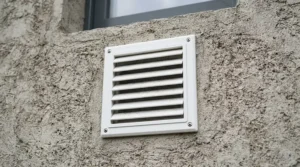
6. Blauberg 125mm Back Draught Gravity Shutter Wall Vent Cover — 125mm plastic option in neutral grey
This grey plastic cover connects to 125mm ducting. Blauberg positions it for utility rooms and laundry areas, where slightly larger fans and dryers sit. The brand’s brown sibling explicitly lists tumble dryers among its uses.
The catch is that most UK vented dryers are built around 100mm outlets. A 125mm cover only makes sense if your run has been stepped up or shared with a larger extractor. Check the spigot on your wall duct before buying.
If your duct is 125mm, the shutter design is the right closure type for dryer use. A 125mm duct has a cross-section of roughly 12,270mm², about 56% bigger than a 100mm one, so there’s room for lint to pass.
I couldn’t verify customer reviews for this specific model. I’d rather say so than guess.
Pros:
- ✅ Gravity shutter suits intermittent dryer airflow
- ✅ 125mm fit for larger duct runs
- ✅ Neutral grey blends with brickwork
Cons:
- ❌ No verified review data found
- ❌ Plastic body, less rugged than steel
Price tier: £ to ££. Check the current price. Sensible value only if your duct is genuinely 125mm.
7. Kair 125mm Stainless Steel Gravity Wall Outlet (DUCSS122) — premium durability for larger ducting
Think of this as the Kair 100mm Stainless Steel Gravity Wall Outlet (DUCSS102)‘s bigger sibling. It suits 125mm spiral or rigid plastic ducting and carries four gravity flaps, plus a weather seal against leaks and draughts. It stands about 180mm tall. Retail listings put it around the mid-£30s at the time of research.
On paper, four smaller flaps each carry less weight, so they may open with lighter airflow. That’s reasoning rather than a tested claim. The weather seal also tackles the gap-around-the-flange problem, which is where mice most plausibly exploit a poorly fitted cover.
It’s the most expensive item here, and justified only if your duct is 125mm and your wall is hard-worked. I couldn’t verify reviews for this exact model, though it shares a range with the better-documented 100mm Kair products.
Pros:
- ✅ Four flaps for broader closure coverage
- ✅ Stainless steel resists weather and wear
- ✅ Weather seal limits draughts and leaks
Cons:
- ❌ Priciest option in this list
- ❌ No verified review data found
Price: around the mid-£30s on retail listings. Check the current price. Strong value for 125mm runs you intend never to revisit.
Top 7 Compared: Value and Evidence
| Product | Size | Price (range or tier) | Review evidence | Best For |
|---|---|---|---|---|
| Kair White 100mm Gravity Wall Vent Grille | 100mm | £ (check current price) | Several thousand ratings, around 4.5 stars | Everyday budget swap |
| Manrose 100mm Tumble Dryer Venting Kit (41703) | 100mm | Around £15 | Small, mixed, older | Full-run installs |
| Kair 100mm Stainless Steel Gravity Wall Outlet (DUCSS102) | 100mm | ££ (check current price) | Small, positive | Long-term 100mm |
| Kair 100mm Stainless Steel Cowled Outlet (DUCSS103) | 100mm | ££ (check current price) | Small, positive, notes wind noise | Exposed walls |
| Manrose 100mm Plastic Cowled Wall Grille with Backdraft Damper | 100mm | £ (check current price) | One rating only | Sheltered budget swap |
| Blauberg 125mm Back Draught Gravity Shutter Wall Vent Cover | 125mm | £ to ££ (check current price) | None verified | 125mm utility runs |
| Kair 125mm Stainless Steel Gravity Wall Outlet (DUCSS122) | 125mm | Mid-£30s | None verified | Premium 125mm |
The pattern is clear: the best-documented buy is the plastic Kair White 100mm Gravity Wall Vent Grille, while the stainless Kair models trade a higher price for longevity. For a 100mm duct on a sheltered wall, that’s hard to beat. For wind-lashed brickwork, the Kair 100mm Stainless Steel Cowled Outlet (DUCSS103) is the more thoughtful spend. Whichever you choose, remember that review evidence thins out quickly beyond the Kair 100mm range.
What Is a Tumble Dryer Vent Cover to Stop Mice?
A tumble dryer vent cover to stop mice is an external wall outlet fitted over the end of your dryer’s exhaust duct. Warm air pushes its hinged flap or shutters open during a cycle, and gravity drops them shut afterwards, closing off the gap that rodents, draughts, rain and insects would otherwise use.
That’s the whole trick, and it’s why the closure type matters more than the logo. A flap or shutter opens under airflow and closes when it stops. A fixed grille, by contrast, stays open permanently and relies on holes being too small. Small enough for mice means small enough to clog with lint, as we’ll see.
Materials split into plastic and stainless steel. Plastic is cheap and light. Stainless is heavier, weathers better and gives gnawing teeth less to work with, although I found no independent gnaw testing for either.
Importantly, a cover is only one half of a mouse-proof outlet. The other half is the join between the cover and the wall. A well-fitted flap on top of a gappy flange is like fitting a deadbolt to a door that has a cat flap beside it.

How to Choose a Tumble Dryer Vent Cover to Stop Mice
- Measure your duct first. Most vented dryers use 100mm, but some runs are 125mm. A mismatch means gaps, and gaps are where mice come in.
- Choose flaps or shutters over fixed mesh. Moving closures stay clearer of lint than small holes and still block the opening between cycles.
- Match the material to the wall. Sheltered, shaded brick suits plastic. Sun, salt air or constant rain favours stainless steel.
- Check the temperature rating. Some Kair listings state a 60°C maximum, so compare that with your dryer manual before fitting.
- Consider a cowl for exposed sites. A hood shields the flap from wind-driven rain and keeps it from flapping noisily.
- Look at the open area. A cover that only exposes about three-quarters of the duct’s cross-section will need more frequent cleaning.
- Make sure you can reach it. Screws and a removable face make monthly lint checks painless, and checks you never do protect nothing.
Dryer Vent Guard With Flap: How the Gravity Flap Really Works
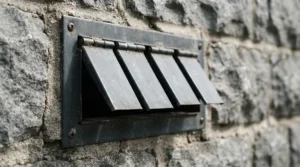
A dryer vent guard with flap is mechanically humble. The flap is hinged at the top. When warm air pushes against it, it swings outward. When the air stops, its own weight pulls it back against the frame.
Because it relies on gravity, it must be mounted on a wall in the correct orientation. Seller guidance on a Kair cowled outlet notes the wire-hinged damper is gravity-operated and suitable only for wall mounting. Fit it on a ceiling or upside down and it won’t close.
Flaps fail in predictable ways. Paint or render can glue them shut or half-open. Lint and fabric-softener residue can build up on the hinge. A bent flap leaves a mouse-sized gap, and a dryer vent guard with flap that’s wedged open by a twig is just a hole with decorations.
The good news is that all of this is visible from outside. A flap should swing freely when you nudge it and sit flush when it’s still. That single test, ten seconds long, tells you more about your outlet than any spec sheet.
Backdraught Shutters: What They Do and Where They Fall Short
Backdraught shutters are the multi-slat cousin of the single flap. Several small blades open together under airflow and drop closed together when it stops. The Blauberg 125mm Back Draught Gravity Shutter Wall Vent Cover and the Kair White 100mm Gravity Wall Vent Grille both work this way.
Their real strength is draught and odour control. A closed set of backdraught shutters stops cold air, damp air and smells flowing back down the duct. They also make the opening harder for small insects to use.
What they don’t do is act as a lock. Gravity closures are held shut by weight alone, and no manufacturer I found publishes mouse-push or gnaw testing. A determined rodent is more likely to exploit a gap around the flange than to shoulder through a closed blade, but that’s reasoning, not proof.
So treat backdraught shutters as a strong first layer and your sealing as the second. Check that every blade moves freely, because a shutter jammed open does nothing for anybody.
Extractor Fan Vent Rodent Cover: Can You Use the Same Cover?
Short answer: not safely. An extractor fan vent rodent cover for a bathroom or cooker hood faces a different problem. Those fans move air gently and produce almost no lint, so fixed fine mesh is perfectly sensible there. Rentokil’s mouse guide recommends covering external air vents with fine-gauge wire mesh, without blocking ventilation.
A dryer is another animal entirely. It blows a stream of lint-laden, often damp air, and mesh fine enough to stop a mouse will also stop lint. That’s why products such as the Kair Bull-Nose External Vent (stainless, with wire mesh), which is aimed at extractors and cooker hoods, aren’t what I’d put on a dryer outlet.
Dedicated outlets also shouldn’t be shared. A trade answer on one UK forum warns against venting a toilet extractor and a dryer together, because dryer moisture can back up into the bathroom and invite mould. Give your dryer its own 100mm run and its own cover.
If you’re buying one extractor fan vent rodent cover for a bathroom and another for the dryer, expect two different closures: fixed mesh for the fan, a moving flap for the dryer.
100mm and 125mm Vent Ducting: Getting the Size Right
100mm (4-inch) is the standard size for most UK vented dryers, and trade advice commonly describes a 100mm hole as fitting typical machines. Manrose’s 100mm duct system suggests a wall cut-out of around 112mm. 125mm is more common on larger extractors and some utility-room runs.
The numbers show why size matters. A 100mm round duct has an open area of about 7,855mm²; a 125mm duct has about 12,270mm². Pairing a 125mm run with a 100mm cover would squeeze airflow and encourage lint to settle, while pairing a 100mm run with a 125mm cover simply won’t fit.
Material counts too. Manrose notes that PVC flexible duct has a 60°C limit, and that aluminium duct tolerates higher temperatures where heat or fire behaviour is a concern. If your existing hose is flimsy PVC, a hardier replacement is worth considering at the same time as the cover.
So when you shop for 100mm and 125mm vent ducting, treat the cover as part of a system. Match the spigot, keep the run short and straight, and check your dryer manual for its own limits.
Will a Vent Cover Cause Lint Build-Up?
Will a vent cover cause lint build-up? A little, honestly. Any outlet adds some resistance, and lint tends to collect where air slows down: on the hinge, around the flap lip, along shutter edges. Wet lint, which sticks, is the worst offender.
Fixed small-mesh screens are the real troublemakers. Appliance-repair guidance recommends replacing screen-style outdoor hoods with louvred or floating-flap types because the screens clog rapidly. One building-inspection write-up showed a DIY wire screen, fitted to keep mice out, that clogged and made things worse. That’s the main reason this article favours moving flaps.
Fire services are blunt about the stakes. North Wales Fire and Rescue’s white goods guide advises keeping the vent pipe free of kinks, blockages and crushing, and cleaning the filter after every use. A cover that quietly strangles airflow undermines both.
Warning signs are longer drying times, a damp smell, a hot dryer casing, or a flap that no longer swings. If you see any of them, unplug the dryer, clear the filter and inspect the outlet.
The practical answer: a good flap cover plus a monthly glance won’t cause a lint crisis. A neglected one, or a mesh one, might.
Vent Cover vs DIY Mesh and Steel Wool
A DIY fix tempts everyone, because wire mesh costs pennies. The trouble is that the right material depends on where you put it. Steel wool and copper mesh excel at plugging static gaps, which is why pest controllers use them around pipes and cables. At a dryer’s moving, lint-laden mouth, they’re a liability.
| Option | Mouse protection | Lint risk | Upkeep | Best For |
|---|---|---|---|---|
| Gravity-flap vent cover | Good when flap closes fully | Low to moderate | Monthly check | Dryer outlets |
| Fixed fine-mesh louvre or flyscreen | Strong | High at dryers | Frequent cleaning | Extractor fans, not dryers |
| DIY wire mesh over outlet | Moderate to strong | High | Frequent cleaning | Avoid on dryers |
| Steel wool or copper mesh in gaps around the collar | Strong against gaps | None (not in airflow) | Check yearly | Sealing the cover’s edges |
The sensible combination is a flap cover on the opening and chew-resistant filler on the gaps around it. BPCA guidance suggests wire wool embedded in quick-setting cement for sealing entry points, and Rentokil advises steel wool or copper mesh secured with caulk. Both are for gaps, not for the dryer’s exhaust path itself. A flap cover paired with sealed edges outperforms either approach alone.
Fitting and Maintaining Your Vent Cover: A Practical Guide
Before you start: unplug the dryer and look inside the duct. If you suspect a mouse is living there, deal with that first, because fitting a closing flap over a trapped animal creates a different problem.
Fitting steps:
- Remove the old cover and clear lint from the last few inches of duct.
- Dry-fit the new cover and confirm the spigot sits snugly in the duct.
- Check orientation so the flap hangs and closes by gravity.
- Fix it with screws and, where supplied, the gasket.
- Fill any gap around the collar with steel wool or copper mesh, secured with sealant, keeping sealant off the hinge.
- Run an empty cycle and watch the flap swing open and close.
Maintenance schedule:
- After every load: clean the dryer’s own filter, as London Fire Brigade advises.
- Monthly: nudge the flap, wipe the hinge, clear visible lint.
- Annually: clean the whole duct run, including the hose behind the dryer.
Common first-30-day mistakes: painting over the flap, over-tightening screws until the frame warps, and forgetting to test the flap after a windy week. Fix them early and the cover will do its job quietly for years.
✨ Ready to Close the Door on Mice?
🔍 Take your utility-room defences to the next level with these carefully compared covers. Click on any highlighted product to check current pricing and availability. A well-chosen flap outlet will help you create a draught-free, mouse-resistant laundry space your family will love! 🐭
Real-World Scenarios: Which Cover Fits Your Home?
Scenario 1: The terraced house on a budget. You’re in a mid-terrace with a sheltered rear wall, a 100mm duct and a cracked old grille. The Kair White 100mm Gravity Wall Vent Grille is the logical swap. Spend the savings on steel wool and sealant for the gaps around it.
Scenario 2: The exposed cottage. A country home, a north-facing wall, wind that treats the garden like a wind tunnel. Plastic flaps rattle and age quickly here. The Kair 100mm Stainless Steel Cowled Outlet (DUCSS103) puts a hood over the flap, and stainless steel shrugs off weather. Expect to clean it a little more often given the open-area figure.
Scenario 3: The renter with a stubborn landlord. You can’t drill, but you can usually swap a cover. A like-for-like replacement such as the Kair 100mm Stainless Steel Gravity Wall Outlet (DUCSS102) or the Manrose 100mm Plastic Cowled Wall Grille with Backdraft Damper needs no new holes. Check your tenancy terms first, and tell the landlord if mice are already present.
Bonus: the 125mm utility room. If your run really is 125mm, the Blauberg 125mm Back Draught Gravity Shutter Wall Vent Cover covers the budget end, while the Kair 125mm Stainless Steel Gravity Wall Outlet (DUCSS122) covers the premium end. Measure twice, buy once.
Safety First: Fire Safety and Mouse Control Rules
The first rule is the one fire services keep repeating: never cover the vent. London Fire Brigade has noted that lint build-up in a tumble dryer can be a fire hazard, and advises cleaning the filter after every use. A flap that opens freely is part of that picture. A sealed or clogged one isn’t.
The second rule is to use proper ducting. North Wales Fire and Rescue advises recommended vent pipes rather than improvised ones, kept free of kinks and crushing.
Third, handle infestations properly. If you suspect mice are already living in your walls or duct, BPCA recommends contacting a professional pest control company. Rentokil’s guidance notes that mice can spread diseases such as salmonellosis through urine, droppings and nesting material, so wear gloves and wash your hands after clearing nesting debris. In England, the Glue Traps (Offences) Act 2022 restricts glue trap use by the public, so choose a different approach.
Finally, if you’re drilling a new hole, one trade answer cautions that a load-bearing wall means calling a builder first. Never vent into a cavity, loft or room, because lint and moisture are problems wherever they land.
FAQ
❓ Can a mouse push open a tumble dryer vent flap?
❓ Do vent covers stop birds nesting in tumble dryer outlets as well?
❓ How often should I clean my tumble dryer vent cover?
❓ Do I need an outside vent cover for a condenser or heat pump dryer?
❓ Can I swap my vent cover myself without hiring a builder?
Conclusion
The best tumble dryer vent cover to stop mice is a moving flap or shutter, matched to your duct size, tight in the wall, and cleaned often enough that lint never gets a foothold. For most UK homes with a 100mm duct on a sheltered wall, the Kair White 100mm Gravity Wall Vent Grille is the sensible, well-documented starting point. For a full new run, the Manrose 100mm Tumble Dryer Venting Kit (41703) keeps everything in one box.
If wind and weather are the real enemies, the Kair 100mm Stainless Steel Cowled Outlet (DUCSS103) and the Kair 100mm Stainless Steel Gravity Wall Outlet (DUCSS102) buy longevity. The Manrose 100mm Plastic Cowled Wall Grille with Backdraft Damper offers a budget cowl, albeit with thin review evidence. On 125mm ducting, the Blauberg 125mm Back Draught Gravity Shutter Wall Vent Cover and the Kair 125mm Stainless Steel Gravity Wall Outlet (DUCSS122) are the options to compare.
Skip fixed mesh at the dryer’s mouth, seal the gaps around the cover, and give the flap a nudge once a month. That small routine keeps mice out and airflow healthy.
Recommended for You
- Rodent-Proof Air Brick Cover: 7 Proven Picks For UK Homes (2026)
- Rat-Proof Pipe Collar For Waste Pipes: 7 Proven UK Fixes (2026)
- Door Brush Strip To Keep Mice Out: 7 Proven Picks (2026)
Disclaimer: This article contains affiliate links. As an Amazon Associate, I earn from qualifying purchases. If you purchase products through these links, we may earn a small commission at no additional cost to you.
✨ Found this helpful? Share it with your friends! 💬🤗
