
In This Article
Most people shopping for outdoor mouse bait stations fixate on the poison. That’s backwards. The box is the safety system, the legal requirement and the part that has to survive a British winter. The bait is just what goes inside.
That matters in 2026. Mice don’t respect the boundary of your kitchen. They shelter in shed insulation, under decking and in the gap behind the water butt, then make raids on bird feeders, compost bins and any door left ajar. When they settle in, the problem needs exterior pest control, not another trap under the sink. Garden rodent bait stations exist for that job. Choosing them well is a question of construction, locking, placement and a healthy respect for wildlife.
This guide compares seven real products from the UK Amazon store. It reads their listed specifications against the regulatory picture, so you know what each one is good for and where it falls short. You’ll also get a practical perimeter baiting strategy, a plain-English look at weather resistant bait boxes and UV-resistant materials, and a section on wildlife protection. That last one is not a footnote, because the UK rules have tightened considerably.
One thing up front: a bait station is a container, not a treatment. Some products here arrive pre-baited, but most are sold empty.
Quick Comparison: 7 Outdoor Mouse Bait Stations at a Glance
| Product | Pack (as listed) | Bait included | Weather claim (as listed) | Best For |
|---|---|---|---|---|
| Roshield 5x Pre-Baited Mouse Bait Box Kit | 5 stations | Yes (brodifacoum blocks) | Not specified | Ready-to-go around a single property |
| Roshield 10x Mouse Bait Boxes (Empty) | 10 stations, 2 keys | No | Not specified | Large plots, multiple outbuildings |
| Roshield 5x Black Tamper-Resistant Mouse Bait Boxes | 5 stations, 1 key | No | Not specified | A typical house and shed |
| The Big Cheese Rat & Mouse Bait Station Compact | 1 station | No | Damp-proof, all-weather | One exposed hotspot |
| Pest-Stop Lockable Mouse Bait Station | 1 station | No | Weather-proof in frost or heat | Knock-prone spots |
| Mice&Co 2x Large Professional Bait Boxes | 2 stations, 2 keys | No | Weather-resistant polypropylene | Wall-runs and larger sites |
| Roshield Pro Quality Tamper-Resistant Bait Box (2 Pack) | 2 stations | No | Not specified | Easy inspection and record-keeping |
Two patterns stand out. Only the Roshield 5x Pre-Baited Mouse Bait Box Kit arrives loaded, so every other option needs a separate, label-compliant bait purchase. And only the The Big Cheese Rat & Mouse Bait Station Compact, the Pest-Stop Lockable Mouse Bait Station and the Mice&Co 2x Large Professional Bait Boxes carry an explicit weather claim in the listing. That doesn’t mean the others fail outdoors. It means you’re taking construction on trust, so check the product page.
💬 Just one click — help others make better buying decisions too!😊
What Are Outdoor Mouse Bait Stations?
Outdoor mouse bait stations are lockable, tamper-resistant boxes that hold rodent bait where mice can reach it but children, dogs, pets and most wildlife cannot. They protect bait from rain and frost, restrict access through small entry points, and require a key to open. They are containers, not poisons.
The regulator is direct about the reason. HSE says rodenticides can carry a higher risk than many other biocides, because how they look and smell makes children, pets and non-target animals more likely to be harmed, as set out on HSE’s rodenticides guidance. It also advises considering non-chemical options, such as good hygiene, physical barriers and traps, before reaching for anticoagulant products. Amateur products are commonly restricted by pack size and by where they can be used, for example only inside a bait box.
In practice, that means a bait station is the minimum viable safeguard, not an optional extra. Loose bait in a garden is a hazard and, depending on the product label, may be unlawful. The box also brings two practical benefits. It keeps bait dry and fresh, which matters because damp bait tends to go mouldy and mice ignore it. And it gives mice a covered, enclosed feeding spot, which suits their cautious habits.
Top 7 Outdoor Mouse Bait Stations: Expert Analysis
A note on method. The specifications below come from product listings and third-party comparison pages, cross-checked against UK guidance. I couldn’t verify a large, reliable body of customer reviews for every product at the time of research. Where I say what reviewers report, it’s aggregated sentiment. Where I couldn’t confirm it, I say so rather than guess.
1. Roshield 5x Pre-Baited Mouse Bait Box Kit — arrives loaded, ready to place
This is the only kit here that removes the “which bait?” decision. You get five lockable, tamper-resistant stations supplied with blocks that the listing states contain brodifacoum, plus a key so they can be re-baited. The listing describes UK manufacture and states the boxes can take a range of rodenticide formats.
On paper, that convenience is the appeal, and also the catch. Brodifacoum is a second-generation anticoagulant, and UK rules have restricted this class of product to use inside and around buildings since July 2024. Treat this kit as a near-the-house solution, not something for a hedge line at the bottom of the garden. It suits a homeowner with a confirmed mouse problem at a shed, garage or outbuilding who wants to start quickly.
I couldn’t verify a robust set of independent reviews for this kit, so judge it on the listing and label. Follow the label to the letter, and expect to remove the bait once control is achieved.
Pros:
- ✅ Supplied pre-baited, so it works straight away
- ✅ Five stations cover a typical house perimeter
- ✅ Key included for re-baiting and inspection
Cons:
- ❌ Bait choice is made for you, brodifacoum-based
- ❌ Weather resistance isn’t explicitly stated in the listing
Price range: typically the £20-£40 range at the time of research; check current price. Verdict: strong convenience, but only if you want the bait it ships with.

2. Roshield 10x Mouse Bait Boxes (Empty) — biggest pack for whole properties
Ten boxes and two keys make this the volume option. The listing states the rear chambers hold two 20g blocks or two to three 10g pasta sachets. That tells you what to buy for the inside: a compatible block or sachet, not loose grain. The boxes are black plastic and listed as manufactured in the UK and used within the professional pest control industry.
The real-world meaning of ten boxes is coverage. Mice feed at several sources, and Defra’s rodent control guidance is that you need an adequate number of bait points where rodents live and move. A single box at one corner rarely tells the whole story. Ten stations let you cover multiple outbuildings, a long wall line and a greenhouse, and still hold a few spare for hotspots.
The trade-off is that bulk only pays off if you have the space and the patience to inspect them all. More boxes means more checking, and unchecked boxes are exactly how baiting drifts into the “permanent” territory the rules discourage.
Pros:
- ✅ Ten stations suit larger gardens and several outbuildings
- ✅ Listed capacity clarifies which bait formats fit
- ✅ Two keys make sharing inspection duties easy
Cons:
- ❌ No bait included, so you buy that separately
- ❌ Overkill for a single house and shed
Price range: roughly the £30-£50 range; check current price. Verdict: good per-box value for big plots, wasteful for small ones.
3. Roshield 5x Black Tamper-Resistant Mouse Bait Boxes — compact five-pack for one home
This is the same family of box as the ten-pack, in a size that suits a single house. The listing gives the capacity as two 20g blocks or two to three 10g pasta sachets and states a weight of 150 grams per box. Black plastic, one key, no bait.
The 150g weight has a practical meaning. It’s light enough to move quickly, but it also means you should anchor the box, because a tap from a spade or a curious fox could send it skidding. On a paved yard or along a wall it’s fine. On sloped, soft ground, peg it or wedge it against a fixed edge.
For most households this is the sweet spot. Five boxes cover the back door, the shed, the garage, the compost area and the side return without leaving you with surplus stock. Reviewer sentiment for this specific listing wasn’t verifiable in my research, so treat build quality as unconfirmed beyond the listing, and inspect the lid and lock on arrival.
Pros:
- ✅ Right-sized pack for a typical house
- ✅ Light and easy to reposition
- ✅ Same listed capacity as the larger pack
Cons:
- ❌ Only one key supplied
- ❌ Light weight needs anchoring outdoors
Price range: around the £20-£35 range; check current price. Verdict: the sensible default for a single household.
4. The Big Cheese Rat & Mouse Bait Station Compact — single, all-weather lockable lid
Sometimes you only need one good box in one bad spot. This single station has a lockable lid and is listed as damp-proof and all-weather, taking blocks, pasta or sachets. Bait is sold separately.
The listing language matters here. “All-weather” is a claim, not a certification, but at least it’s a claim about the exact condition your outdoor placement will face. Damp is what kills bait quality, so a lid that seals matters more than a fancy shape.
The Big Cheese name is widely recognised among UK pest control brands, and this compact format is the option to buy one of, for one place outside. It suits a specific known runway, such as the gap under a shed or the corner behind a bin store. The limitation is obvious: one station is one bait point, so it won’t protect a perimeter alone.
I couldn’t confirm a verified review pool for this exact listing, so use the standard checks: does the lid close firmly, does the lock turn cleanly, and does the box sit level?
Pros:
- ✅ Listed as damp-proof and all-weather
- ✅ Lockable lid for tamper resistance
- ✅ Takes blocks, pasta and sachets
Cons:
- ❌ Single station only, so coverage is limited
- ❌ Bait not included
Price range: typically under £15; check current price. Verdict: a neat targeted fix, not a whole-garden solution.
5. Pest-Stop Lockable Mouse Bait Station — bait bars that resist knocks
The standout here is the listed bait bars, which the listing says hold the bait so it can’t be shaken out. Add a single lockable station, a listing that states weather-proof plastic in frost or high heat, and use indoors and out, and you have a straightforward budget option.
Why the bars matter: outdoor boxes get kicked, dragged by foxes, knocked by lawnmowers and bounced by children’s footballs. If bait rattles loose inside, it can end up outside the intended feeding chamber, and that defeats the point of the box. Bars that pin the bait in place reduce that risk.
This suits a busy family garden where boxes might get jostled, or a spot by a path or gate. It doesn’t suit anyone needing several stations at once, because it’s sold singly. Expect to buy multiples if you’re building a perimeter, so check whether the per-box cost stays competitive against the multi-packs.
Independent review sentiment wasn’t something I could verify, so lean on the listing details and inspect on arrival.
Pros:
- ✅ Bait bars hold blocks securely
- ✅ Listed as weather-proof in frost or high heat
- ✅ Budget-friendly single unit
Cons:
- ❌ Sold singly, so multiples add up
- ❌ Bait bought separately
Price range: usually under £15; check current price. Verdict: a smart pick for knock-prone spots.
6. Mice&Co 2x Large Professional Bait Boxes — polypropylene with a two-entrance tunnel
Two polypropylene boxes, two keys and a two-entrance tunnel make this a more considered design. The listing says it takes blocks, grain or paste on an internal metal rod, and states weather-resistant construction for indoor and outdoor use. Bait isn’t included, and the listing is emphatic about that.
The two-entrance tunnel has a practical meaning. Mice travel along walls and prefer to keep moving, so a station they can pass through feels more like part of a natural run than a dead end. That can encourage entry. Polypropylene is also a sensible material: it’s tough, holds its shape, and is generally a good candidate for outdoor use, though the listing doesn’t specify UV stabilisation, and it’s worth knowing the difference (more on that below).
These larger boxes suit wall-lines, the edges of sheds and places where you want a sturdy, permanent-feeling station. Check the sizing: a large box can dominate a tight gap.
Reviewer feedback for this exact listing wasn’t verifiable in my research.
Pros:
- ✅ Two-entrance tunnel suits natural mouse runs
- ✅ Metal rod secures blocks, grain or paste
- ✅ Two keys included
Cons:
- ❌ Large size doesn’t fit tight spaces
- ❌ No bait supplied
Price range: around the £15-£30 range; check current price. Verdict: robust and thoughtful for wall-runs and bigger sites.
7. Roshield Pro Quality Tamper-Resistant Bait Box (2 Pack) — inspection window, key-only access
The premium-feeling feature is the inspection window paired with key-only access. The listing states it takes wax blocks, wheat bait, pasta sachets and traps, and says the boxes are made in the UK from recycled plastics. No bait is included.
Here’s why the window matters. The guidance on rodent control keeps returning to one point: you have to check the boxes. Defra’s code notes that if baits are already in tamper-resistant boxes, you need the key to assess whether they’re properly used and whether bait is being taken. A window shortens the routine, since you can glance before you unlock. That supports the record-keeping that keeps a baiting programme short and controlled.
The traps compatibility is a real bonus. If you’d rather avoid poison, the same box can house a snap trap, which is a very different risk profile.
No verified review pool was available to me for this listing, so the assessment stands on the listing and the design logic.
Pros:
- ✅ Inspection window reduces unnecessary opening
- ✅ Holds blocks, wheat, sachets and traps
- ✅ Key-only access for tamper resistance
Cons:
- ❌ Two-pack only, so limited coverage
- ❌ Bait not included
Price range: typically the £15-£30 range; check current price. Verdict: the best fit if monitoring and flexibility matter most.
Top 7 Comparison: Specs, Price Bands and Who Each Suits
| Product | Price band (indicative) | Access / lock | Standout | Best For |
|---|---|---|---|---|
| Roshield 5x Pre-Baited Mouse Bait Box Kit | £20-£40 | Key | Pre-baited | Quick start near buildings |
| Roshield 10x Mouse Bait Boxes (Empty) | £30-£50 | Key (2 supplied) | Ten-box coverage | Large plots |
| Roshield 5x Black Tamper-Resistant Mouse Bait Boxes | £20-£35 | Key (1 supplied) | 150g compact box | Typical homes |
| The Big Cheese Rat & Mouse Bait Station Compact | Under £15 | Lockable lid | All-weather listing | One hotspot |
| Pest-Stop Lockable Mouse Bait Station | Under £15 | Lockable | Bait bars | Knock-prone spots |
| Mice&Co 2x Large Professional Bait Boxes | £15-£30 | Keys (2 supplied) | Two-entrance tunnel | Wall-runs |
| Roshield Pro Quality Tamper-Resistant Bait Box (2 Pack) | £15-£30 | Key-only, window | Inspection window | Monitoring and traps |
Prices are indicative bands at the time of research and may vary. The clearest value split is between single stations and multi-packs. For one hotspot, the The Big Cheese Rat & Mouse Bait Station Compact or Pest-Stop Lockable Mouse Bait Station is enough. For a whole perimeter, the Roshield 5x Black Tamper-Resistant Mouse Bait Boxes or Roshield 10x Mouse Bait Boxes (Empty) give a lower per-box cost. If inspection discipline is your priority, the extra thought behind the Roshield Pro Quality Tamper-Resistant Bait Box (2 Pack) window earns its place.
Perimeter Baiting Strategy: A Practical Setup Guide
A perimeter baiting strategy sounds like a ring of boxes around the house. It shouldn’t be. The best version is a targeted, temporary and survey-led arrangement, not a fence of permanent poison.
Step 1: Survey first. Look for droppings, gnaw marks, greasy rub lines and burrows. The rodent control code of best practice puts a thorough site survey ahead of any treatment, and it decides how many boxes you actually need.
Step 2: Place stations on runs, not in open ground. Mice hug walls, fences and the edges of structures. Put boxes flush against these lines, with the entry holes facing the wall. A station in the middle of a lawn is a station in the wrong place.
Step 3: Space with purpose. Mice have small home ranges, so a scattered approach beats a uniform ring. Cluster stations where activity is clear, such as the shed door, the compost bin and the corner behind the water butt.
Step 4: Anchor and shelter. Sit each box level and stable, ideally under an overhang, eave or shelter panel. This protects the lid seal and reduces weather exposure.
Step 5: Inspect on a schedule. Check every few days at first, then weekly. Note whether bait is being taken. Consumption, not elapsed time, is the signal.
Step 6: Stop when control is achieved. CRRU’s code says that in most cases anticoagulant bait should achieve control within about 35 days. Then remove the bait. Permanent perimeter baiting is exactly what the stewardship regime now discourages, particularly around the outside of rural buildings.
Real-World Scenarios: Which Station Suits Which Garden?
Matching the box to the situation prevents wasted money. Here are three realistic profiles.
Scenario 1: The suburban terrace with a shed. Small garden, one shed, a bin store and a neighbour with a bird feeder. Mice are using the gap behind the shed. Here the Roshield 5x Black Tamper-Resistant Mouse Bait Boxes cover the shed, back door and bin store, and you keep one or two spare. Budget: modest. Frequency: inspect every few days initially.
Scenario 2: The rural smallholding. Several outbuildings, a feed store, hay and wandering wildlife. Coverage is the priority, and so is caution about wildlife. The Roshield 10x Mouse Bait Boxes (Empty) deliver the numbers, while the inspection-friendly Roshield Pro Quality Tamper-Resistant Bait Box (2 Pack) suit the busiest spots. This is also the scenario where a professional contractor working under the stewardship regime deserves serious consideration.
Scenario 3: The family garden with a trampoline. Children, a dog and a lawn that gets used. A single exposed hotspot near the back fence is the issue. The Pest-Stop Lockable Mouse Bait Station with its bait bars handles the knocks, and the lock is non-negotiable. If the family would rather avoid rodenticide entirely, a trap inside a box such as the Roshield Pro Quality Tamper-Resistant Bait Box (2 Pack) is a lower-risk alternative.
Across all three, the underlying logic is the same. Count where you’ve seen activity, buy for that number, and pick a box that fits the site rather than the biggest pack on the page.
Problem → Solution: Fixing Common Bait Station Headaches
Problem: bait isn’t being touched. Mice are cautious, and a new box can trigger suspicion. Give it a few days. Check the placement is on a run, and that fresh bait hasn’t gone damp or mouldy. If an entry hole faces open ground rather than the wall, turn the box.
Problem: the box keeps getting moved. Foxes, cats and mowers all have opinions about loose objects. Anchor it against a fixed edge or peg it down. A heavier station like the Mice&Co 2x Large Professional Bait Boxes resists this better than a light 150g box.
Problem: damp inside. Condensation and driving rain ruin bait. Choose a box with a good lid seal, such as the The Big Cheese Rat & Mouse Bait Station Compact, and place it under shelter. Replace any bait that has gone soft or discoloured.
Problem: you can’t tell whether bait is being taken. Without opening the box, you can’t. That’s why Defra’s code stresses having the key handy for checks. A window, as on the Roshield Pro Quality Tamper-Resistant Bait Box (2 Pack), helps you triage quickly. The full Defra code of practice is written for poultry units, but the principles carry over.
Problem: mice keep coming back. Bait removes the rodents that are here. It does nothing about the gap they came through. Seal entry points and remove food sources before you conclude the boxes have failed.
How to Choose Outdoor Mouse Bait Stations
Use these six steps to narrow the field quickly.
- Confirm baiting is the right answer. If you have children, pets or lots of wildlife, consider traps and proofing first. Bait stations are a container for a hazardous product, so the decision to use one deserves thought.
- Check it locks. The published label standard requires a station to resist entry by dogs and be lockable or sealable so children can’t access the bait compartment. Simple clips don’t count.
- Look for a genuine weather claim. Outdoors, the box must resist weakening from typical non-catastrophic weather. Listings that say weather-proof or all-weather are at least addressing this. Read the specific wording on CRRU UK’s bait station standard.
- Match capacity to bait format. Blocks on a rod, sachets in a chamber and loose grain all need different internal layouts. Buy the box for the bait you intend to use.
- Count your stations. Survey first, then buy for the activity you found. A single box in one corner is not a plan.
- Decide on pre-baited or empty. Pre-baited convenience means the bait choice is made for you. Empty boxes give control, but you take on the responsibility of picking a compliant product.
Weather Resistant Bait Boxes and UV-Resistant Materials: What Actually Matters
British weather is a slow, patient destroyer of plastic. Rain, frost cycles and summer sun all take a toll, so weather resistant bait boxes need more than a black lid and good intentions.
Water. Drainage and lid fit matter most. A box that lets water in wastes bait and can create a mouldy, unappealing feeding chamber. Look for a snug lid, raised base or drainage provision, and shelter the box regardless.
Frost. Cheap plastics can turn brittle in cold snaps. Listings such as the Pest-Stop Lockable Mouse Bait Station that mention frost and high heat are at least pointing at the right stress tests.
UV. Sunlight breaks down many plastics over time, making them chalky, brittle and prone to cracking. Boxes made with UV-resistant materials, or plastics with added UV stabilisers, tend to last longer in exposed spots. Here’s the honest caveat: none of the listings I reviewed explicitly states UV stabilisation. Polypropylene, as used in the Mice&Co 2x Large Professional Bait Boxes, is a sensible outdoor material, but “polypropylene” and “UV-stabilised” are not the same thing.
What to do about it. Site boxes in shade or under an eave where you can. Inspect the plastic each time you open the lid, and replace any box that cracks or warps. Colour also plays a role in visibility, so a black box in full sun will also run hotter.
Being sceptical about marketing helps. “Weatherproof” on a listing is a promise. A box that survives its first winter is the evidence.
Wildlife Protection: Keeping Hedgehogs, Pets and Owls Safe
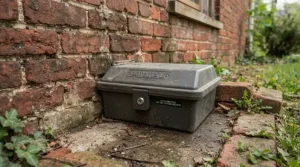
If there’s one section to read twice, it’s this one. Wildlife protection is now central to how rodenticides are regulated in the UK.
Here’s the mechanism. Bait can harm non-target animals directly, by an animal eating it, or indirectly, when a predator eats a poisoned rodent. Research has found second-generation anticoagulant rodenticide exposure to be widespread in hedgehogs and foxes, and barn owls and kestrels are regularly affected. The Barn Owl Trust’s rodenticide guidance sets out how the stewardship scheme was tightened, including restricting sales of certain second-generation products for use in open areas from July 2024.
For a gardener, four principles follow:
- Keep bait inside a locked station, always. Loose bait is the worst-case scenario.
- Stay close to buildings. Second-generation products are restricted to use inside and around buildings. Open garden, hedgerow and field-edge baiting is not appropriate.
- Limit the duration. Remove the bait once control is achieved, rather than leaving it out for months.
- Search for and remove dead rodents. Bodies can carry residues and may turn up several days after feeding, sometimes some distance from the station.
A further wrinkle: non-target small mammals, such as wood mice and bank voles, can enter bait boxes and feed, which is one route by which owls and kestrels become contaminated. That’s why entry design, placement and short treatment periods matter so much. If your garden is wildlife-rich, traps inside a box are worth serious consideration.
Exterior Pest Control: Bait Stations in the Wider Picture
Exterior pest control is a system, not a single product. Bait stations tackle the rodents that are already there. They don’t stop new ones arriving.
Think in three layers. First, exclusion: seal gaps around pipes, air bricks and door thresholds, and fit brush strips to shed doors. Second, sanitation: store bird seed and pet food in sealed metal bins, keep compost bins closed, and clear fallen fruit. Third, control: only then do bait stations or traps come into play.
This matters because bait alone rarely settles a problem. Mice live in small social groups and visit multiple food sources, so removing the food and the shelter shrinks the population before the box even opens. For garden rodent bait stations, this layered approach also shortens the time bait needs to be out, which is better for wildlife and better for your patience.
If the survey finds more than a small or moderate problem, a contractor working under the stewardship regime is often the more effective and lower-risk route.
Outdoor Mouse Bait Stations vs Traps and Proofing
Bait stations aren’t the only tool, and often they aren’t the first one to reach for. Here’s how the options compare.
| Approach | Strength | Weakness | Best For |
|---|---|---|---|
| Outdoor mouse bait stations, such as the Roshield 5x Black Tamper-Resistant Mouse Bait Boxes | Covers multiple points, low daily effort | Toxic bait, wildlife risks, legal limits | Confirmed infestations near buildings |
| Snap traps in a box, such as the Roshield Pro Quality Tamper-Resistant Bait Box (2 Pack) | No rodenticide, immediate result | Needs frequent checking | Households with pets or wildlife |
| Proofing and sanitation | Addresses the cause | Slower, needs effort | Prevention and long-term control |
| Professional contractor | Expertise, stewardship compliance | Cost | Larger or persistent infestations |
The table makes one thing clear: the cleverest setup often combines approaches. Proof first, trap where you can, and use bait stations as a targeted last resort rather than a first response. HSE’s own guidance points the same way, asking users to consider other methods before anticoagulants.
Where a bait station does earn its keep is speed and coverage. If mice are established in an outbuilding and trapping isn’t keeping pace, a locked, well-placed station can shorten the problem considerably. The catch is discipline, meaning short treatment windows, regular checks and removal afterwards.
Long-Term Cost and Maintenance
The purchase price of a bait station is small. The real cost sits in bait, time and replacement.
| Item | Typical cost pattern | What drives it |
|---|---|---|
| Single station (e.g. The Big Cheese Rat & Mouse Bait Station Compact) | Under £15 | Bought one at a time |
| Multi-pack (e.g. Roshield 5x Black Tamper-Resistant Mouse Bait Boxes) | £20-£35 range | Lower per-box cost |
| Bulk pack (e.g. Roshield 10x Mouse Bait Boxes (Empty)) | £30-£50 range | Best per-box value |
| Bait refills | Varies by product | Format and label limits |
Prices are indicative and may vary; check current listings. Across a few years, boxes are a one-off cost if they survive, so durability drives value. A cheaper box that cracks in a winter costs more than a sturdier one that lasts. Because none of the listings certifies UV stabilisation, treat the first year as a test and budget to replace any unit that warps or splits.
For maintenance, build a simple routine. Wipe the interior between bait changes, check the lock still turns freely, and store keys somewhere memorable. Keep a note of dates and consumption. That record doubles as evidence that you’re keeping the treatment short and controlled. When the job is done, take the bait out, clean the boxes and store them dry. That’s cheaper than buying replacements, and it stops old bait becoming a hazard.
Frequently Asked Questions
❓ Do outdoor mouse bait stations need to be locked?
❓ How many garden rodent bait stations do I need?
❓ Are weather resistant bait boxes really rainproof?
❓ How long should I leave bait in an outdoor station?
❓ Can I use a bait station box for traps instead?
Conclusion: Choose the Box, Then Use It Sparingly
Outdoor mouse bait stations are the safety layer that makes rodenticide use responsible, not the treatment itself. Get the box right and everything else gets easier, including inspection, weather protection and wildlife protection.
If you want a household default, the Roshield 5x Black Tamper-Resistant Mouse Bait Boxes cover a typical home and shed. For a large plot, the Roshield 10x Mouse Bait Boxes (Empty) give you the coverage. If you’d rather start fast, the Roshield 5x Pre-Baited Mouse Bait Box Kit arrives loaded, though it commits you to brodifacoum and to keeping it close to buildings. For a single hotspot, the The Big Cheese Rat & Mouse Bait Station Compact or the Pest-Stop Lockable Mouse Bait Station do the job neatly, and if you value inspection or the option of traps, the Roshield Pro Quality Tamper-Resistant Bait Box (2 Pack) stands out. The Mice&Co 2x Large Professional Bait Boxes suit sturdier wall-line duty.
Whichever you pick, keep the strategy tight: survey, place on runs, inspect often, stop early and proof afterwards. A short, controlled treatment protects your garden and the hedgehogs, owls and pets that share it.
✨ Ready to Secure Your Garden?
🔍 Take your exterior pest control to the next level with these carefully selected products. Click on any highlighted item to check current pricing and availability. The right box, placed sensibly, will help you tackle mice safely and responsibly!
Recommended for You
- Pet Safe Mouse Bait Stations: 7 Best Locking Picks UK (2026)
- Mouse Poison for Garden Shed: 7 Proven Picks for UK Sheds (2026)
- Ready to Use Mouse Bait Kits: 7 Best Picks for UK Homes (2026)
Disclaimer: This article contains affiliate links. As an Amazon Associate, I earn from qualifying purchases. If you purchase products through these links, we may earn a small commission at no additional cost to you.
✨ Found this helpful? Share it with your friends! 💬🤗
