In This Article
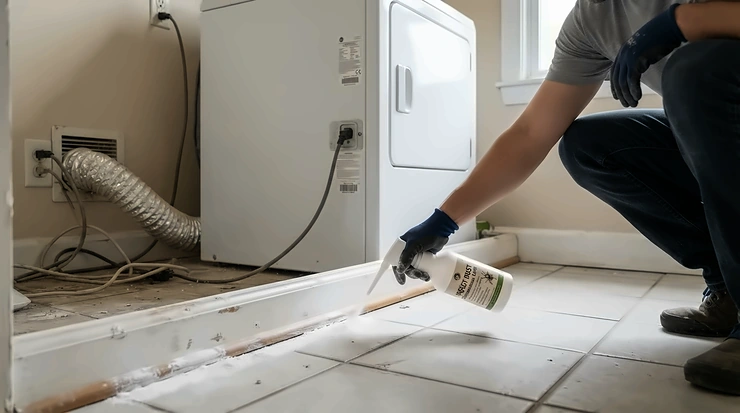
Pull the fridge out. Go on. If you’ve spotted one cockroach bolting across the lino at 2am, the rest of the family is probably camped behind that appliance, huddled against the warm motor like tiny, unwelcome commuters. Pest control specialists warned in May 2026 that cockroaches can multiply unseen behind appliances, under sinks and inside wall cavities, and that some species squeeze through gaps of around 3mm.
That’s why boric acid cockroach powder for behind appliances is such a popular search. A dry dust seems like the perfect fit for gaps no spray can reach. There’s a snag British readers should hear early, though. As far as I could establish from HSE and University of Hertfordshire records, boric acid isn’t authorised in Great Britain as a general-public insecticide, and its listed biocide approval sits in a different product type (wood preservatives). Imported US powders appear on marketplaces, but they weren’t designed for the UK rulebook.
So this guide does two jobs. First, it explains the legal and safety picture without the scare tactics. Second, it compares seven dry dusts that British shoppers can actually buy for the same job: the insecticidal powders and the desiccant dust options, including diatomaceous earth powder for cockroaches. Every product gets honest analysis, not a rewritten label. Prices are ranges, and review comments are summarised from what I could verify.
Quick Comparison: 7 Dry Dusts for Behind Appliances
| Product | Active type | Format | Claimed protection | Price range | Best For |
|---|---|---|---|---|---|
| Raid Ant & Cockroach Killer Powder | Deltamethrin 0.05% | 250g squeeze bottle | Up to 12 weeks (label) | Under £6 | Budget, everyday kitchens |
| Nippon Ant Killer Powder | Permethrin | 400g puffer | Up to 6 months (maker’s claim) | Roughly £4-£14 | Big value pack, long runs |
| Pest Expert Formula ‘P’ Cockroach Powder | Permethrin dust | 300g puffer | “Long-lasting” residual | Around £7 | Roach-specific treatment |
| Rentokil Ant & Crawling Insect Killer Powder | Pyrethrum-based (check label) | 150g/300g puffer | Not stated | £5-£8 range | Mixed crawling pests |
| Rentokil Insectrol Insect Killer Powder | Pyrethrum extract + PBO | 150g | Not stated | £6-£8 range | Fast knockdown, small jobs |
| InsectoSec Crawling Insect Killer | Diatomaceous earth | 150g/1kg | While kept dry | £6-£15 range | Chemical-averse households |
| Oa2ki Organic Diatomaceous Earth Insect Powder | Diatomaceous earth | 400g puffer | While kept dry | Check current price | Desiccant dust, dry application |
Look at the table by active type rather than brand name. The three pyrethroid-style powders (Raid Ant & Cockroach Killer Powder, Nippon Ant Killer Powder and Pest Expert Formula ‘P’ Cockroach Powder) promise the longest labelled protection. The two diatomaceous options trade speed for a physical mode of action. Budget buyers should note that Raid Ant & Cockroach Killer Powder has the lowest entry cost, while Nippon Ant Killer Powder gives the most grams per pound.
💬 Just one click — help others make better buying decisions too!😊
Top 7 Dry Cockroach Powders for Behind Appliances: Expert Analysis
1. Raid Ant & Cockroach Killer Powder — long residual claim at a bargain price
The headline here is the 12-week protection claim, unusually specific for a supermarket-shelf powder. The active ingredient is deltamethrin at 0.05%, a pyrethroid, and the label says insects start dying within 30 minutes of about 60 seconds’ contact. In practice that suggests a fast-moving dust you only need to lay thinly across gap edges and hinge points. The label also notes you should turn off aquarium air filters during use, which tells you how seriously to take placement near fish tanks.
My read, based on the spec sheet: this suits a standard kitchen with moderate sightings, where you want something affordable you can reapply quarterly. Retail listings reported an average of roughly 4.4 out of 5 across more than 2,000 ratings at the time of research, though check the current figures. Reviewer comments mostly praise speed, and opinions on odour are split (some say odourless, others report a lingering smell).
Pros:
- ✅ Fast kill claim, within 30 minutes
- ✅ Clear 12-week reapplication guidance
- ✅ Very low entry cost
Cons:
- ❌ Squeeze bottle is less precise than a puffer
- ❌ Toxic to aquatic life; keep away from fish tanks
Price: under £6 at the time of research. Verdict: the sensible first purchase for light-to-moderate problems.
2. Nippon Ant Killer Powder — biggest tub, boldest longevity claim
Nippon’s “up to six months” promise is the longest in this roundup. The active is permethrin, and retail listings put the strength at roughly half a per cent. The 400g puffer pack is the practical hook: a puffer delivers a fine, controllable cloud into gaps, so one tub can treat several appliance runs without running dry.
Honest analysis: the branding is ant-first, with cockroaches listed as secondary targets, so don’t expect cockroach-specific guidance on the pack. Manufacturer claims of six months should be treated as a best case on clean, dry, undisturbed surfaces; behind a dishwasher with condensation, I’d plan on shorter intervals. Listings also warn against use on soft furnishings.
Review evidence is thin. Mirror listings showed few reviews, and I couldn’t verify a meaningful body of cockroach-specific feedback.
Pros:
- ✅ Largest quantity for the money
- ✅ Puffer pack gives controlled application
- ✅ Long protection claim on dry surfaces
Cons:
- ❌ Ant-focused labelling, cockroach guidance minimal
- ❌ Price varies widely between sellers
Price: roughly £4-£14 depending on seller and pack size. Verdict: strong value if you’re treating multiple spots.
3. Pest Expert Formula ‘P’ Cockroach Powder — the roach-specific permethrin dust
Unlike the generalists, this 300g puffer pack is positioned squarely at cockroaches. It’s a permethrin insecticidal dust, which the maker pitches for places where a spray isn’t suitable: the nooks behind cookers, under plinths and around pipework. The brand also sells a spray and smoke fumers designed to work alongside, which signals a whole-treatment mindset rather than a one-puff fix.
What the spec sheet won’t tell you is how much that matters. Cockroaches live in networks, so a dust used alongside monitoring traps tends to reveal whether you’re making progress. If you’re comfortable with a multi-product approach, this is the most coherent system here.
Review evidence: the comments I found sat on the seller’s own site, including a 2019 reviewer who said it seemed more effective than a competing powder. That’s useful colour but not independent, so I’d weigh it lightly.
Pros:
- ✅ Cockroach-specific positioning and guidance
- ✅ Puffer pack suits tight gaps
- ✅ Part of a wider treatment range
Cons:
- ❌ Reviews are seller-hosted, not independent
- ❌ Amazon UK availability can vary by seller
Price: around £7. Verdict: best fit for confirmed, active cockroach problems.
4. Rentokil Ant & Crawling Insect Killer Powder — trusted name, flexible sizes
Rentokil’s general-purpose powder comes in 150g and 300g puffer bottles for ants, cockroaches, woodlice and other crawlers around the home. One important wrinkle: some listings say the current formula contains chrysanthemum (pyrethrum) extract, while an older listing cites bendiocarb. Formulations change, so read the label on the pack you receive, not the listing you clicked.
Analytically, this is a convenience pick. A known brand and a puffer format make it easy to use, and the 150g size suits a single appliance. The generalist positioning means you’ll get less cockroach-specific advice than with a dedicated roach dust.
I couldn’t verify a robust set of independent reviews for the current formulation, so I won’t pretend otherwise.
Pros:
- ✅ Recognised UK pest-control brand
- ✅ Two pack sizes for small or larger jobs
- ✅ Puffer bottle for precision
Cons:
- ❌ Formulation has changed; stock may differ
- ❌ General-purpose rather than roach-focused
Price: £5-£8 range. Verdict: solid for mixed pests, less specialist for cockroaches.
5. Rentokil Insectrol Insect Killer Powder — quick-hit pyrethrum for small jobs
This one pairs chrysanthemum-derived pyrethrum extract with piperonyl butoxide, which Rentokil pitches against fleas, ants, moths, carpet beetles, cockroaches and wasps. It’s made in the UK, and retailer guidance says to vacuum up all the powder after use, which changes how you should plan treatment: it’s built for tidy knockdown, not months of parked residue.
That makes it a decent “first strike” before you deploy something longer-lasting. A 150g tub is enough for one fridge or one cooker, but not a whole-house campaign. If your issue is a few sightings behind one appliance, the maths works.
Verified review volume was low, so I can’t offer a meaningful sentiment summary.
Pros:
- ✅ Broad pest coverage in one tub
- ✅ UK-made by a major brand
- ✅ Handy size for a single appliance
Cons:
- ❌ Needs vacuuming after use
- ❌ No stated long residual period
Price: £6-£8 range. Verdict: a neat spot-treatment, not a long-haul solution.

6. InsectoSec Crawling Insect Killer — approved diatomaceous earth for the chemical-wary
This is the pick for people searching diatomaceous earth powder for cockroaches. It comes as natural diatomaceous earth in 150g and 1kg sizes, and the seller says it’s legally approved in the UK. As diatomaceous earth powder, it works physically: insects pick it up and lose moisture through the cuticle. That’s why it can be useful against insects that resist chemical actives.
Here’s the practical reality: the 1kg bag is excellent value, but it’s a bulk powder, so you’ll want a small duster or puffer for tidy application. Pair it with careful drying of surfaces first, because moisture neutralises the effect.
Reviews I could verify were mostly on the seller’s own site: about ten, with nine at five stars. Most describe garden and houseplant use, so cockroach feedback specifically is unverified.
Pros:
- ✅ Physical action, no conventional insecticide
- ✅ Bulk 1kg option for large jobs
- ✅ Seller states UK legal approval
Cons:
- ❌ Needs separate applicator for neat dusting
- ❌ Little cockroach-specific review evidence
Price: £6-£15 range by size. Verdict: ideal if you prioritise low-chemical control.
7. Oa2ki Organic Diatomaceous Earth Insect Powder — puffer-format desiccant dust
Oa2ki is a UK-sold diatomaceous powder from Pestfix, in a 400g puffer, which makes dry application unusually straightforward. The maker describes it as a desiccant powder that works wherever it’s applied and stays effective as long as it remains dry. Retail copy lists cockroaches among target insects.
My analysis: the puffer solves DE’s biggest practical problem, which is delivering a fine, even film into cracks. Because it relies on physical action, expect slower results than a pyrethroid, particularly in humid kitchens. Pestfix also sells bulk sizes, handy if you plan to treat several flats.
I couldn’t verify a meaningful sample of independent UK reviews for this exact size, so treat claims as manufacturer-level.
Pros:
- ✅ Puffer designed for dry application
- ✅ No conventional chemical insecticide
- ✅ Bulk sizes available for larger jobs
Cons:
- ❌ Slower than pyrethroid dusts
- ❌ Loses effect when damp
Price: check current price. Verdict: great for sensitive households.
How to Dust Behind Appliances: Dry Application, Step by Step
Dry application sounds simple, but technique decides everything. Based on label guidance across these products, here’s a sensible sequence.
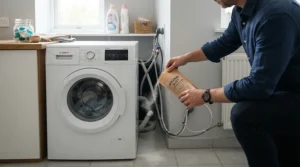
- Switch off and unplug. Pull the appliance out gently, taking care with water and gas connections.
- Vacuum first. Remove crumbs, grease and old egg cases so the powder isn’t sitting on food debris.
- Dry everything. Damp surfaces clump powder and weaken desiccant dust.
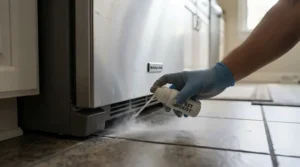
- Apply a thin, barely visible film. Heaps look dramatic but tend to clump, and roaches can walk around them. Aim for a light veil along skirting edges, hinge points and the back panel’s perimeter.
- Mind the electrics. Keep powder away from plugs, sockets and motor housings.
- Reapply on schedule. Follow label timings (for example, 12 weeks for Raid Ant & Cockroach Killer Powder) and sooner if the area gets wet.
- Monitor. Sticky traps with a food lure, which the British Pest Control Association recommends for proactive monitoring, show whether activity is falling.
Wash your hands after treating, and keep children and pets away until the label says it’s safe. The shortest path to better results is the least glamorous: clean first, dry second, dust lightly third.
Problem → Solution: Fixing the Usual Powder Pitfalls
Problem: the powder clumps. Damp is almost always the culprit. Fix the leak or condensation first, then reapply to dry surfaces. Desiccant powders such as InsectoSec Crawling Insect Killer and Oa2ki Organic Diatomaceous Earth Insect Powder are especially fussy here.
Problem: roaches seem to avoid it. Heavy piles are the usual reason. Switch to a lighter, wider film, and treat their travel routes rather than their destination.
Problem: sightings continue after several weeks. Check you’ve treated every harbourage (behind the dishwasher, under the sink, around boiler pipework). If activity persists, the infestation may be well established, and a professional is the sensible next step.
Problem: dust is escaping into the room. Use a puffer, not a shake-and-tip approach, and avoid aiming into airflow from fans or extractors. Nippon Ant Killer Powder and Pest Expert Formula ‘P’ Cockroach Powder both use puffer-style packs for this reason.
Problem: you’ve got pets or small children. Choose placement behind sealed or fixed appliances, out of reach, and read the label closely before choosing between a chemical dust and a diatomaceous alternative.
Real-World Scenarios: Which Powder Fits Your Home?
The flat-dweller on a budget. You’ve got a fridge, a cooker and a worrying number of 11pm sightings. Raid Ant & Cockroach Killer Powder is the economical starting point, and a sticky trap shows progress. If the building shares walls, tell your landlord, because cockroaches rarely respect tenancy agreements.
The family with a toddler and a cat. Here, placement matters more than product. A diatomaceous option like InsectoSec Crawling Insect Killer appeals, but dust still needs keeping out of reach. Treat only behind fixed appliances and sealed gaps, and talk to a professional if sightings continue.
The shared student house. Several kitchens’ worth of problem calls for volume. Nippon Ant Killer Powder brings the most grams per pound, and Pest Expert Formula ‘P’ Cockroach Powder adds roach-specific focus. Agree one reapplication date for the whole house.
The tidy kitchen with an odd visitor. A single sighting behind one appliance suits Rentokil Insectrol Insect Killer Powder. Treat, vacuum, monitor, and see whether it stays quiet.
What Is Boric Acid Cockroach Powder for Behind Appliances?
Boric acid cockroach powder for behind appliances is a fine, dry insecticidal dust, traditionally based on boric acid, applied thinly into dark gaps behind fridges, cookers and dishwashers where cockroaches shelter. Insects pick it up on their bodies, ingest it while grooming and carry it into hidden harbourages. British shoppers should check what’s legally sold.
Boric acid works as a stomach poison, and the University of Hertfordshire’s database describes it as a multi-site stomach poison and recognised irritant. The same record notes it is not approved under GB COPR, which helps explain why UK shelves carry pyrethroid, pyrethrum and diatomaceous powders instead. The reason people love the idea still holds: dry, hard-to-reach, slow-acting dusts that cockroaches carry back to the nest.
Is Boric Acid Cockroach Powder Legal in the UK? Regulations and Safety
Short answer: treat it cautiously. In Great Britain, biocides, meaning products that control pests by chemical or biological action, are regulated under the GB Biocidal Products Regulation, and HSE’s expiry-postponement tables list boric acid under product type 8 (wood preservatives). I couldn’t find an insecticide (product type 18) approval for it in the material I reviewed, so I’d avoid imported boric acid insecticide powders.
The rulebook for diatomaceous earth looks different. Retained legislation shows silicon dioxide kieselguhr approved for product type 18, and trade press has warned that unauthorised diatomaceous products sold as insecticides are a problem. That’s why this guide only includes diatomaceous options where the seller states legal approval or where I’m flagging that you should check the label.
HSE’s guidance is blunt: read and understand the label, and members of the public must not use products intended only for professionals. Look for authorisation details on the pack, and if you can’t find them, don’t buy.
Desiccant Dust and Dry Application: Why Powder Beats Spray in Hidden Gaps
Sprays are great on open surfaces and clumsy in cavities. Liquid pools, drips and leaves wet films that cockroaches can avoid, and it can’t reach inside a skirting void. A fine dry dust drifts into crevices and clings to legs and antennae, which is why professionals love it for hidden harbourages.
The term desiccant dust describes powders that kill by drying out an insect’s protective outer layer, rather than by poisoning the nervous system. Diatomaceous earth is the classic example, and the physical mode of action matters for people who dislike conventional insecticides. The catch is moisture. A damp desiccant dust is a spent one, which is why dry application onto dry surfaces is non-negotiable.
Pyrethroid powders like Raid Ant & Cockroach Killer Powder also depend on dry conditions, but they act chemically, which usually means faster results. If speed matters, choose a chemical powder. If low-chemical matters more, choose InsectoSec Crawling Insect Killer or Oa2ki Organic Diatomaceous Earth Insect Powder and accept the slower pace.
Cockroach Killer Powder for Wall Voids: What You Can (and Can’t) Do Yourself
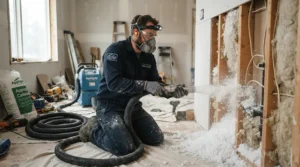
This is the section the internet glosses over. Wall voids are inaccessible by definition, and a cockroach killer powder for wall voids is often a professional job. The same Pest Magazine warning says infestations can grow inside wall cavities before anyone notices.
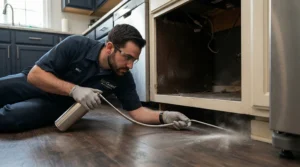
As an amateur, stick to what the label permits: crack and crevice treatment in accessible spots. That means gaps behind kickboards, around pipe entries and along skirting edges. Don’t drill walls, and don’t push powder into electrical boxes or cavities near wiring.
If you suspect roaches are living deep inside walls, shared ducts or neighbouring properties, a professional approach is wiser. BPCA experts note that professionals have access to products not available to the public, which is exactly the gap wall voids expose. Use consumer powders as a stopgap and a monitoring aid, not as a substitute for expertise.
Diatomaceous Earth Powder for Cockroaches: Does It Really Work?
It can, with caveats. Diatomaceous earth is fossilised algae ground into a fine powder. Manufacturers describe insects picking it up and dehydrating as it absorbs the waxy layer from their cuticle. The mechanism is physical, so resistance to conventional insecticides is, in theory, less of a concern.
The limitations are practical. It needs bone-dry conditions, it acts more slowly, and the dust shouldn’t be inhaled, so wear a mask when applying. Some marketing talks about “food-grade” powders being fine for pest control, which is a trap: using a product as an insecticide that isn’t authorised for that purpose is a legal issue, whatever the food-grade label says.
For British shoppers, the safest approach is authorised, labelled products like InsectoSec Crawling Insect Killer, with seller-stated approval, or Oa2ki Organic Diatomaceous Earth Insect Powder, where you should confirm the current label details. Honest verdict: a reasonable supporting player, and a fair main treatment for light problems if you’re patient.
How to Choose Boric Acid Cockroach Powder for Behind Appliances (and Its Alternatives)
- Check the legal status first. Look for authorisation details and the “Use biocides safely” wording on the pack. If it’s missing, skip it.
- Decide how fast you need results. Pyrethroid powders act in minutes to hours, while diatomaceous options take longer.
- Match the format to the gap. A puffer reaches behind an oven far better than a tub you scoop from.
- Consider who shares the space. Pets, fish tanks and children shape your product and placement choices.
- Read the residual claim critically. “Up to six months” is a ceiling, not a promise, and damp shortens it.
- Count the grams. A single appliance needs 150g, but a whole flat may need a 400g pack.
- Know when to stop. If activity continues after consistent treatment, it’s time for a professional.
Long Lasting Residual: How Long Does a Dust Really Last?
A long lasting residual is the marketing promise everyone chases. The truth depends on conditions. Dusts persist when surfaces stay dry, dust-free and undisturbed, and they fade when you mop, wipe or get steam from a dishwasher. Raid Ant & Cockroach Killer Powder states 12 weeks, Nippon Ant Killer Powder claims up to six months, and the diatomaceous options last while they stay dry.
| Product | Residual claim | Price range | Cost reading |
|---|---|---|---|
| Raid Ant & Cockroach Killer Powder | Up to 12 weeks | Under £6 | Cheapest entry; ~4 reapplications a year |
| Nippon Ant Killer Powder | Up to 6 months | £4-£14 | Best grams per pound |
| Pest Expert Formula ‘P’ Cockroach Powder | Long-lasting (unspecified) | Around £7 | Mid-priced, roach-focused |
| InsectoSec Crawling Insect Killer | While dry | £6-£15 | 1kg lasts across many jobs |
On cost-per-use, Nippon Ant Killer Powder and the 1kg bag of InsectoSec Crawling Insect Killer look best on paper, provided you’ll actually use the volume. Raid Ant & Cockroach Killer Powder wins on low commitment, while Pest Expert Formula ‘P’ Cockroach Powder earns its price when you want a roach-specific tool. Whatever you choose, schedule reapplication in your calendar.
✨ Don’t Miss These Exclusive Deals!
🔍 Ready to take your cockroach control to the next level? Click on any highlighted product above to check current pricing and availability on Amazon UK. These dusts will help you build a calmer, cleaner kitchen your whole household will thank you for!
Boric Acid vs Pyrethroid vs Diatomaceous Earth: Benefits Compared
| Approach | Speed | Residual | Legal status for UK public use | Best For |
|---|---|---|---|---|
| Boric acid (imported US powders) | Slow, stomach poison | Long if dry | Not authorised as insecticide as far as I could establish | Not recommended |
| Pyrethroid dusts | Minutes to hours | Weeks to months | Authorised products widely sold | Raid Ant & Cockroach Killer Powder, Nippon Ant Killer Powder |
| Pyrethrum dusts | Fast knockdown | Shorter | Authorised products widely sold | Rentokil Insectrol Insect Killer Powder |
| Diatomaceous earth | Days | While dry | Check authorisation | InsectoSec Crawling Insect Killer, Oa2ki Organic Diatomaceous Earth Insect Powder |
Reading across the rows, the table tells a simple story. Boric acid’s appeal (cheap, slow, long-lasting) is real, but the legal gap makes it hard to recommend. Pyrethroid and pyrethrum options win on speed, while diatomaceous powders suit people prioritising low-chemical control. Choose by your priority, not by internet folklore.
Common Mistakes When Buying and Applying Cockroach Powder
Buying the wrong product for the wrong reason. Imported boric acid powders can look appealing, but authorisation matters. Stick to labelled, authorised products.
Piling it on. More powder is not better powder. Heaps clump, repel and waste product.
Applying to dirty or damp surfaces. Grease and moisture are the enemies of any dry dust.
Treating only where you’ve seen them. Cockroaches hide in clusters around pipes, stoves, refrigerator motors and sinks, according to BPCA’s technical manager. Treat the whole harbourage zone.
Ignoring the neighbours. In flats and terraces, cockroaches travel along pipes and shared walls. If your block has a wider issue, individual powders won’t solve it.
Skipping monitoring. Without sticky traps, you can’t tell whether the powder is working.
Mixing products carelessly. Don’t combine powders from different chemical families without reading labels, and never decant products into unlabelled containers.
FAQ
❓ Is boric acid cockroach powder legal to buy in the UK?
❓ How long does a desiccant dust last behind a fridge?
❓ Can I put diatomaceous earth powder into wall voids?
❓ How often should I reapply dry powder behind a cooker?
❓ Is cockroach powder safe around pets?
Conclusion
Searching for boric acid cockroach powder for behind appliances usually starts with one sensible instinct: hit the hidden gaps with something dry, slow and thorough. The instinct is right. The shopping advice needs a British twist, because the legal landscape favours pyrethroid, pyrethrum and diatomaceous options rather than imported boric acid.
If you want the simplest start, Raid Ant & Cockroach Killer Powder gives clear reapplication guidance at a low price. For volume, Nippon Ant Killer Powder is hard to beat, and Pest Expert Formula ‘P’ Cockroach Powder is the most roach-focused. Rentokil Ant & Crawling Insect Killer Powder and Rentokil Insectrol Insect Killer Powder suit smaller or mixed jobs. If you’d rather avoid conventional insecticides, InsectoSec Crawling Insect Killer and Oa2ki Organic Diatomaceous Earth Insect Powder offer a physical alternative, provided you keep them dry and are patient.
Whichever you choose, clean first, dry the surface, apply a thin film, and monitor with traps. And if sightings carry on, call a professional. There’s no shame in bringing in backup against an enemy that can squeeze through a 3mm gap.
✨ Ready to Reclaim Your Kitchen?
🔍 Click on any highlighted product above to check current pricing and availability on Amazon UK, and give those dark corners behind your appliances the dry, patient treatment they deserve. A calmer kitchen is closer than you think! 🪳
Recommended for You
- Sticky Cockroach Traps For Monitoring Activity: 7 Best Picks (2026)
- Cockroach Spray For Cracks And Crevices: 7 Best UK Picks (2026)
- Cockroach Bait Stations For Rental Flats: 7 Smart Picks (2026)
Disclaimer: This article contains affiliate links. As an Amazon Associate, I earn from qualifying purchases. If you purchase products through these links, we may earn a small commission at no additional cost to you.
✨ Found this helpful? Share it with your friends! 💬🤗
