
In This Article
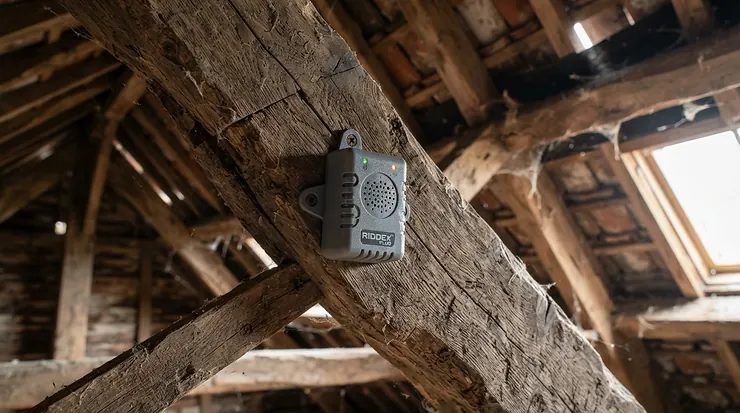
Warm, dark, undisturbed and lined with fluffy bedding? As far as a house mouse is concerned, your loft is a five-star hotel, with room service on the floors below. That is why a mouse repellent for loft use is one of the most-hunted purchases every autumn. Council pest advice notes that mice are particularly keen to move indoors as the weather turns.
Here’s the honest bit up front. Rentokil’s mouse guidance says mice can squeeze through gaps as small as 6 mm. It also says strong smells alone aren’t potent enough to clear an active infestation. So no repellent is a magic wand. The smart play is layering: seal the gaps, add a deterrent, monitor, and escalate if the scratching continues. A well-chosen mouse repellent for loft spaces is one layer in that stack, not the whole cake.
This guide compares seven real products: four electronic repellers, one peppermint spray and two steel-wool blockers. Each is judged against the realities of a British roof space: no sockets, awkward hatches, itchy insulation and cabling you’d rather not see gnawed. Along the way we cover attic pest deterrent options, a sensible loft rodent control strategy, what makes an insulation-safe repeller, and how to spot nesting in insulation. We also cover cable damage prevention and how to cope with access difficulty when every trip up the ladder feels like a chore.
Research reflects the market as of October 2026. Prices are ranges only, so check the current price before you buy.
Quick Comparison: Best Mouse Repellent for Loft Picks at a Glance
| Product | Type | Power | Price range | Best For |
|---|---|---|---|---|
| STV820 | Ultrasonic | 3 × AA (not included) | Under £15 | Socket-free lofts on a budget |
| Mini-Sonic 3-Pack | Ultrasonic | Check listing | £30-£40 | Long or partitioned lofts |
| Pest-Stop 2000 | Ultrasonic + electromagnetic | Mains | £25-£35 | Lofts with wiring worries |
| Green Gardener Repeller | Ultrasonic | Mains or battery | £15-£25 | Flexible power setups |
| Peppermint Refresher Spray | Scent | Spray bottle | Under £10 | Supporting entry points |
| Wire Wool Blocker Kit | Physical exclusion | None | £10-£15 | Plugging gaps first |
| SWISSINNO Rodent Stop | Physical exclusion | None | £10-£20 | Pipe and vent gaps |
Looking at the table above, the cheapest route to a working mouse repellent for loft use is the STV820, because it needs no socket. If your loft is long or split by partitions, the Mini-Sonic 3-Pack gives you more coverage zones per pound. The two exclusion products do something no repeller can: they physically close the door. That makes them the unglamorous heroes of this lineup.
💬 Just one click — help others make better buying decisions too!😊
Top 7 Mouse Repellent for Loft Options: Expert Analysis
A quick reality check before the products. Ultrasonic devices are the most popular choice for loft use, yet the evidence for them is thin. Orkin’s pest library says mice typically become accustomed to ultrasound within days or weeks. Treat the electronic units below as a cheap deterrent layer rather than a cure. Reviews for most of them are sparse on the retailer pages checked, so where I couldn’t verify review data, I say so instead of guessing.
1. Big Cheese Anti Mouse Battery Powered Repeller (STV820) — best budget pick for sockets-free lofts
The standout here is independence from the mains, which matters because most UK lofts have a single bulb and no sockets. The maker describes a continuous ultrasonic output, powered by three AA batteries (not included) that should last over three months. In practice, that means a quarterly loft climb, so access difficulty becomes a running cost. A neat trick is to tie battery swaps to the clocks changing in spring and autumn.
On paper, a single unit treats a single space. Ultrasound travels in straight lines and is blocked by joists, boxes and insulation. So this works best in a reasonably clear loft with an unobstructed line of sight to the likely mouse routes. Position it near the hatch end or the eaves where droppings turned up. I couldn’t verify meaningful review volumes on the retailer pages checked, so there’s no sentiment to report. Broader owner reports on ultrasonic devices are mixed.
Pros:
- ✅ No mains socket needed in the loft
- ✅ Cheap enough to trial risk-free
- ✅ Silent to humans and non-rodent pets
Cons:
- ❌ Line-of-sight limits in cluttered lofts
- ❌ Batteries need changing roughly quarterly
Expect to pay under £15. It’s the best low-risk experiment in this list, as long as you treat it as a supporting act.
2. Big Cheese Mouse Out Mini-Sonic 3-Pack — three zones for long or L-shaped lofts
Instead of one device straining to cover everything, you get three. The maker says each Mini-Sonic unit covers a single room and that larger or irregular spaces may need more than one. Terraced and semi-detached lofts are often divided by party walls, tanks and purlins. Those cast “sound shadows” where one unit would struggle.
A sensible layout puts one unit near the hatch, one at the far gable end and one beside the water tank or chimney breast. Mouse traffic tends to hug those obstacles. The makers also claim a two-year guarantee and inaudibility to humans, cats and dogs. One caveat: listings differ on whether the units are plug-in or battery-operated, so check the exact listing before assuming they’ll work in a socket-free loft.
For review evidence, the single-unit Argos listing averaged just over 3 out of 5 across 36 reviews at the time of research. That’s a lukewarm verdict. It suggests keeping expectations modest.
Pros:
- ✅ Three units tackle sound shadows
- ✅ Inaudible to people and household pets
- ✅ Two-year guarantee claimed by the maker
Cons:
- ❌ Lukewarm review average on the single-unit listing
- ❌ Power-source details vary between listings
Budget around £30-£40. It’s better value per unit than buying singles, provided your loft genuinely needs multiple zones.
3. Pest-Stop 2000 — ultrasonic plus an electromagnetic wiring mode
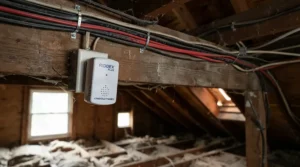
This is the only unit in the lineup that tries to reach places ultrasound can’t. The maker says it has been sold in the UK since 1999 (previously as the PestClear 2000). It combines ultrasound with dual electromagnetic settings that use the building’s electrical cables to carry a signal. The maker claims pests detect it up to one metre from any cable, even inside wall and ceiling spaces.
If that works as described, it speaks directly to cable damage prevention in roof voids. Plug the unit into a downstairs socket and the signal travels along the circuit rather than needing a loft socket. That also helps with access difficulty. But the electromagnetic claim comes from the manufacturer, and I found no independent trial evidence. Treat it as a bonus, not a guarantee. Also remember that the ultrasonic function shouldn’t be used where bats could be roosting.
I couldn’t verify review data for this unit, so there’s no sentiment to quote.
Pros:
- ✅ Targets wiring routes, not just open space
- ✅ Can work from a lower-floor socket
- ✅ Long-running UK product line
Cons:
- ❌ Electromagnetic claims lack independent evidence
- ❌ Ultrasound still blocked by solid objects
Expect £25-£35. Reasonable value if wiring worries are your main concern.
4. Green Gardener Ultrasonic Mouse Repeller — UK-made with mains or battery power
Flexibility is the hook. This UK-made unit can run from the mains or batteries (not included). The maker says it’s about 20% more powerful on the mains and covers up to roughly 90 sqm (1,000 sq ft) of unobstructed space. A loft with one socket near the hatch can use mains power, while a socket-free loft can fall back on batteries.
Note that “unobstructed” is doing heavy lifting. A loft full of suitcases, Christmas decorations and rolled-up carpet is rarely unobstructed. Treat the quoted area as a best case. The maker is also explicit that the unit shouldn’t be used in areas occupied by bats, a point worth taking seriously (see our bats section below).
The retailer page carries only a single positive comment about the UK manufacture, which isn’t enough to generalise from. Check current Amazon availability before planning around it.
Pros:
- ✅ Runs on mains or battery
- ✅ UK-made with a two-year warranty claimed
- ✅ Humane, with no poison or traps
Cons:
- ❌ Quoted coverage assumes no obstructions
- ❌ Not suitable where bats may roost
Plan on £15-£25. A solid, versatile mid-range option.
5. Big Cheese Anti Mouse Peppermint Refresher Spray — scent support for entry points
Peppermint is the classic “natural” deterrent, and this 500 ml spray is the cheapest way to try it. The maker says the mint-oil blend disrupts pheromone trails and neutralises rodent odours. The listing positions it for attics, garages and sheds, alongside traps and baits.
Treat that last point as the key to using it well. Rentokil’s guidance is that strong smells aren’t enough to eliminate an active infestation, so the spray works best as a supporting actor. Apply it to timber, plastic and entry points, not onto loft insulation. Soaked insulation can clump and lose performance. A lightly sprayed wire-wool plug is a smarter target. This is as close as the list gets to an insulation-safe repeller, as long as you spray surfaces rather than the quilt itself.
No verified review data was available, so there’s no sentiment to report.
Pros:
- ✅ Very cheap way to test scent deterrence
- ✅ Handy for refreshing sealed entry points
- ✅ Poison-free and easy to apply
Cons:
- ❌ Scent fades and needs reapplying
- ❌ Not strong enough alone for active infestations
Expect under £10. Good value as an add-on, poor value as a standalone fix.
6. Big Cheese Mouse Out Wire Wool Rodent Blocker Kit — plugs the holes mice actually use
Exclusion beats persuasion. The kit includes eight rust-resistant wire wool pads, a tamper and a peppermint oil spray. The idea is to cut a pad to size, spray it and pack it tightly into gaps around pipes, vents and brickwork.
This pairs well with Rentokil’s advice not to rely on expanding foam alone, since mice can gnaw through it. Steel wool packed into the gap first gives the foam something nasty to chew on. It matters for loft rodent control because a repeller without sealing just nudges mice from one gap to another. The maker also recommends combining it with the brand’s barrier foam.
I couldn’t verify review data for the kit itself, so there’s no sentiment quote here.
Pros:
- ✅ Physically blocks entry instead of hoping
- ✅ Includes tamper and peppermint spray
- ✅ Non-toxic and permanent when fitted well
Cons:
- ❌ Only eight pads for larger jobs
- ❌ Finding every gap takes effort
Budget £10-£15. For the money, it’s arguably the highest-impact item on this list.
7. SWISSINNO Rodent Stop Steel Wool — rust-proof stainless-and-polyfibre mesh
The standout is the material. The maker describes a close-meshed blend of stainless steel and polyfibre that doesn’t rust like conventional steel wool and can’t be eaten through. In a damp roof void with condensation, that rust resistance matters. Ordinary wire wool can corrode and stain over time.
Reviewer feedback aggregated on a retailer listing is broadly positive about plugging small pipe gaps. One reviewer reported no signs of mice since fitting it. The recurring complaints are that the pack is small for big holes and that the mesh can be awkward to cut. A decent pair of snips is part of the true price.
Pros:
- ✅ Rust-resistant, so durable in damp voids
- ✅ Flexible enough for irregular gaps
- ✅ Chew-resistant per the maker
Cons:
- ❌ Small quantity for larger gaps
- ❌ Needs good snips to cut
Expect roughly £10-£20; check current price. A smart long-term choice for permanent sealing.
Here’s how the seven stack up on the evidence I could actually verify.
| Product | How it works | Coverage claim | Review signal | Best For |
|---|---|---|---|---|
| STV820 | Ultrasonic | Single space | None verified | Trial run, no socket |
| Mini-Sonic 3-Pack | Ultrasonic | One room per unit | Just over 3/5 (single unit, Argos) | Multi-zone lofts |
| Pest-Stop 2000 | Ultrasonic + electromagnetic | Whole house (maker) | None verified | Wiring-focused protection |
| Green Gardener Repeller | Ultrasonic | About 90 sqm clear space | One positive comment | Mains-or-battery flexibility |
| Peppermint Refresher Spray | Scent | Spot treatment | None verified | Supporting sealed gaps |
| Wire Wool Blocker Kit | Steel wool plugs | Per gap | None verified | First-line sealing |
| SWISSINNO Rodent Stop | Stainless mesh | Per gap | Broadly positive, small pack | Damp voids, pipe gaps |
The pattern is clear: the electronic units come with big coverage claims but thin evidence, while the exclusion products are modest in claims and strong in logic. That’s why the best loft rodent control plan starts with the Wire Wool Blocker Kit or SWISSINNO Rodent Stop, then layers an electronic unit on top. Spend your first £15 on blocking gaps, and the second on deterrence.
How to Install a Mouse Repellent for Loft: A Practical Usage Guide
Fitting a mouse repellent for loft use is a 45-minute job if you do it in the right order. Here’s the sequence that avoids wasted effort.
1. Prepare safely. Take a head torch, gloves, a dust mask and a board to kneel on. Never step between joists. Mice can spread illnesses through their urine, droppings and nesting materials, so don’t handle things bare-handed.
2. Inspect first. Rentokil’s loft guidance suggests looking for shredded materials, gnaw marks on beams and droppings. Mouse droppings are small, dark and rice-sized, around 3-6 mm. Note where they cluster.
3. Check for bats. Rentokil suggests a gloved crumble test to tell mouse droppings from bat droppings. If you suspect bats, stop and read the safety section below before installing anything.
4. Seal before you repel. Pack the Wire Wool Blocker Kit or SWISSINNO Rodent Stop into gaps around pipes, cables and eaves. Spray the plugs lightly with the Peppermint Refresher Spray.
5. Place your repeller. Mount electronic units at joist height with a clear line of sight along mouse routes. Avoid burying them behind boxes.
6. Set a maintenance rhythm. Check batteries every three months, re-inspect after any storm and re-spray scent points monthly during autumn and winter.
Common first-30-day mistakes: blocking gaps while mice are still inside, soaking insulation with spray, and assuming silence means success. Monitor with a few traps or tracking evidence for at least a month.
✨ Ready to Loft-Proof Your Home?
🔍 Choose a mix of sealing and deterrent products from this list, and click any highlighted product name to check current pricing and availability. A layered setup gives you a calmer, quieter roof space!
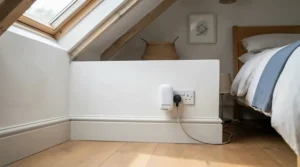
Mouse Repellent for Loft Problem-Solver: 5 Common Problems and Fixes
Even a well-planned mouse repellent for loft setup throws up problems. Here are the five I’d expect, with specific fixes.
Problem 1: You still hear scratching after two weeks. Mice may be nesting beyond the device’s reach, or habituation is setting in. Fix: add a second unit such as a Mini-Sonic 3-Pack unit in the quiet corner, and seal any remaining gaps with the Wire Wool Blocker Kit.
Problem 2: Batteries die early. Constant ultrasonic output is a drain. Fix: use lithium AAs, or choose the Green Gardener Repeller on mains power if a socket is within reach. This cuts access difficulty because there’s no quarterly climb.
Problem 3: There’s no loft socket. Fix: choose battery models like the STV820, or consider the Pest-Stop 2000 plugged in below, since its electromagnetic mode is claimed to travel along the building’s wiring.
Problem 4: A musty or peppermint smell lingers. Over-spraying is the usual culprit. Fix: use the Peppermint Refresher Spray sparingly on plugs and timber, and ventilate.
Problem 5: Mice return after a few weeks. That’s classic habituation, or a missed gap. Fix: rotate positions, re-inspect for new gnawing and consider professional help if signs persist.
Real-World Scenarios: Matching Products to Your Roof Space
Scenario A: The terraced loft on a £30 budget. Long and narrow, no sockets, rarely visited. Spend about £12 on the Wire Wool Blocker Kit, then put roughly £15 into an STV820 near the hatch. Check batteries when the clocks change.
Scenario B: The boarded loft with a socket. A storage loft you visit monthly, with a socket by the hatch. The Green Gardener Repeller on mains power makes sense. Add a SWISSINNO Rodent Stop pack for pipe gaps. Total spend sits around £30-£40.
Scenario C: The holiday-let loft nobody climbs into. This is pure access difficulty. Choose products that need no visits: mains-powered devices and permanent exclusion materials. Plug the Pest-Stop 2000 into a downstairs socket and fit SWISSINNO Rodent Stop at entry points. Visit the loft only for an annual check, ideally before autumn.
What Is Mouse Repellent for Loft Protection?
A mouse repellent for loft use is any non-lethal product or barrier designed to discourage mice from entering, nesting in or gnawing within a roof space. The main types are ultrasonic and electromagnetic devices, scent deterrents such as peppermint, and physical exclusion materials such as steel wool. None replaces sealing entry points.
That definition covers a surprisingly broad toolkit. Electronic repellers aim to make a space uncomfortable. Scent products try to mask food trails and mark territory as unwelcome. Exclusion materials simply refuse mice entry. Many people searching for an attic pest deterrent really want all three working together.
Where does this fit within loft rodent control? Think of it as the quiet, humane layer. Traps and professional treatment handle active infestations, while repellents and exclusion reduce the chance of recolonisation. Understanding this division saves money and prevents the common mistake of expecting a £15 gadget to do a pest controller’s job.
How to Choose a Mouse Repellent for Loft Use
- Check for power first. Most lofts lack sockets. A battery unit like the STV820 avoids rewiring, while a mains unit needs a socket nearby. Match power to your reality.
- Measure your obstructions. Ultrasound doesn’t penetrate solid objects. A cluttered loft needs several units, not one big one.
- Rule out bats. If there’s any chance of bats, avoid ultrasonic devices entirely. This is a legal as well as ethical point.
- Prioritise sealing. Spend your first pounds on exclusion. A repeller can’t stop mice entering through a gap you haven’t plugged.
- Think about maintenance. If every climb is a hassle, favour mains power and permanent materials.
- Set honest expectations. Mice can habituate to ultrasound, so treat electronic units as a deterrent layer and combine them with monitoring.
Insulation-Safe Repeller Choices and Nesting in Insulation
Mice love loft insulation for the same reason you love a duvet: it’s soft, warm and shreddable. Nesting in insulation is the most common sign of a loft problem, along with tunnelling, droppings and a stale smell. It’s also why choosing an insulation-safe repeller matters.
What does insulation-safe mean in practice? Ultrasonic and electromagnetic devices never touch the insulation, so they’re inherently safe for it. Liquid products need more care. Soaked mineral wool can clump and lose its insulating effect, so spray timber, plugs and entry points instead of the quilt itself. Steel mesh products sit in gaps rather than on insulation, so they’re safe too.
If you find existing nesting in insulation, wear gloves and a mask. Contaminated sections may need replacing, since urine and droppings aren’t something to leave in a roof space. Rentokil also recommends removing cardboard, paper and other nesting materials. Reducing nesting in insulation makes any attic pest deterrent more effective, because mice have fewer reasons to stay.
Cable Damage Prevention in the Loft
Rodents gnaw constantly, and loft cabling is an easy target. Rentokil notes that rodent gnawing on electrical cabling is a fire risk. That alone makes cable damage prevention a priority, not an afterthought.
The best approach is layered. First, physically block routes towards cable runs using steel mesh around cable entries. Second, remove nesting materials near wiring. Third, consider a deterrent that targets wiring zones. The Pest-Stop 2000 claims an electromagnetic function that uses building cables, though independent evidence is lacking.
Don’t handle damaged cables yourself. If you see exposed copper, chewed insulation or scorch marks, switch off the circuit and call a qualified electrician. Cable damage prevention is far cheaper than repair, and an annual inspection is a sensible habit. For a thorough loft rodent control plan, add “check cables” to the autumn checklist.
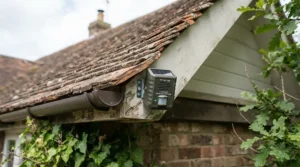
Access Difficulty: Designing for a Loft You Hate Climbing Into
Let’s be honest: most lofts are miserable to reach. Hatches are narrow, ladders wobble, and boards are patchy. That access difficulty shapes which products are realistic for you.
If you visit rarely, favour set-and-forget options: mains power via the Green Gardener Repeller, or permanent sealing with SWISSINNO Rodent Stop. If you visit quarterly, a battery unit like the STV820 is manageable if you schedule swaps. If you can’t visit at all, hire a professional for inspection.
Put your essentials near the hatch. Place the first repeller within arm’s reach of the opening, so even a head-and-shoulders visit lets you check it. Keep spare batteries and the Peppermint Refresher Spray in a small bag by the hatch. Tackling access difficulty up front stops good intentions fading by December.
Mouse Repellent for Loft vs Traditional Alternatives
How does a mouse repellent for loft use compare with traditional methods? Here’s the trade-off.
| Approach | Main benefit | Main drawback | Loft suitability | Best For |
|---|---|---|---|---|
| Electronic repeller (e.g. STV820) | Humane, low effort | Limited evidence | Good with clear space | Prevention |
| Steel wool exclusion (e.g. Wire Wool Blocker Kit) | Permanent barrier | Finding every gap | Excellent | First-line defence |
| Snap traps | Proven results | Regular checking | Awkward in hard lofts | Active infestations |
| Poison baits | Strong effect | Regulated, risk to wildlife | Poor near bats and pets | Professional use |
| Professional treatment | Expert diagnosis | Higher cost | Excellent | Persistent problems |
The table shows why repellents and exclusion belong in the prevention column, not the cure column. For a real infestation, traps or professional treatment are the proven tools, and Rentokil’s own approach is built on exclusion, restriction, destruction and monitoring. Used before trouble starts, an attic pest deterrent plus sealing makes the most sense, because it’s cheap, humane and low-risk. Used after trouble starts, repellents alone can simply push mice into other parts of the house. Strong loft rodent control combines both.
Long-Term Cost and Value: Loft Rodent Control on a Budget
Upfront price is only half the story. Batteries, reapplication and time all add up.
| Product | Upfront | Running costs | Value verdict | Best For |
|---|---|---|---|---|
| STV820 | Under £15 | Roughly £5-£10 a year in AA cells | Good trial | Tight budgets |
| Mini-Sonic 3-Pack | £30-£40 | Depends on power type | Fair | Multi-zone lofts |
| Pest-Stop 2000 | £25-£35 | Small electricity use | Fair | Wiring concerns |
| Green Gardener Repeller | £15-£25 | Low on mains | Good | Flexible power |
| Peppermint Refresher Spray | Under £10 | Reapply regularly | Fair | Supporting role |
| Wire Wool Blocker Kit | £10-£15 | None | Excellent | Sealing gaps |
| SWISSINNO Rodent Stop | £10-£20 | None | Excellent | Durable plugs |
The exclusion products have no running costs, so they win on long-term value. The electronic units are cheap to buy but carry hidden costs in batteries and time spent up the ladder. If I had £40, I’d split it roughly: £25 on sealing materials, £15 on one repeller. Remember that preventing a gnawed cable or a ruined bag of insulation costs far more than any product here. Prices change, so check current prices before you buy.
Safety, Bats and the Law
Before installing any electronic mouse repellent for loft use, consider bats. GOV.UK guidance states that all bat species and their roosts are fully protected, and that intentionally or recklessly disturbing a bat in its shelter is an offence. It also lists insulating or converting a loft among activities that can affect bats. If you suspect a roost, the guidance points to the National Bat Helpline for free advice.
In practical terms, that means three things. First, don’t install ultrasonic units where bats may roost, which is exactly what the Green Gardener Repeller maker warns. Second, avoid sticky traps, which council guidance says must never be used where bats could be present. Third, don’t seal gaps until you’re sure no bats are using them.
For electrical safety, look for UKCA or CE marking on any mains unit, and don’t plug anything into damaged sockets. If you’re unsure, a pest controller or bat helpline call costs nothing and avoids legal trouble.
Common Mistakes When Buying a Mouse Repellent for Loft Use
- Buying before sealing. A repeller can’t fix an open door. Block the gaps first.
- Trusting coverage claims blindly. “Up to 1,000 sq ft” assumes empty space. Real lofts are cluttered.
- Ignoring bats. This is the costliest mistake, legally and ethically.
- Over-spraying insulation. Liquid soaked into the quilt can reduce its performance. Spray surfaces, not the insulation.
- Forgetting maintenance. A dead battery is just a plastic box. Schedule reminders.
Avoid these five and your mouse repellent for loft purchase will go much further.
Frequently Asked Questions
❓ Does a mouse repellent for loft use also work on rats?
❓ Can I use a mouse repellent for loft if I have bats?
❓ How many repellers does a loft need?
❓ Is peppermint oil safe to spray near loft insulation?
❓ Will an attic pest deterrent stop mice chewing cables?
Conclusion
Finding the right mouse repellent for loft use isn’t about chasing the most expensive gadget. It’s about stacking sensible layers. Start with sealing, because the Wire Wool Blocker Kit and SWISSINNO Rodent Stop give the best long-term value and no running costs. Add a deterrent suited to your loft: the STV820 for socket-free budgets, the Mini-Sonic 3-Pack for multi-zone spaces, the Green Gardener Repeller for flexible power, or the Pest-Stop 2000 if wiring is your worry. Use the Peppermint Refresher Spray as a supporting actor.
Keep your expectations honest. Ultrasonic and electromagnetic claims lack strong independent evidence, mice can habituate, and strong smells won’t clear an active infestation. Pair every product with monitoring, protect your insulation and cabling, and check for bats before you install anything. If scratching persists after a month of layered effort, bring in a professional.
Handle loft rodent control as a seasonal habit, not a one-off panic buy, and your roof space will stay what it should be: boring, quiet and mouse-free.
Recommended for You
- Plug In Mouse Repeller: 7 Honest Picks For UK Homes (2026)
- Electronic Mouse Deterrent For Home: 7 Honest Picks (2026)
- Ultrasonic vs Electronic Mouse Repellents: 7 Picks (2026)
Disclaimer: This article contains affiliate links. As an Amazon Associate, I earn from qualifying purchases. If you purchase products through these links, we may earn a small commission at no additional cost to you.
✨ Found this helpful? Share it with your friends! 💬🤗
