In This Article
There’s a particular kind of dread that comes with hearing scratching in the loft at 2am. You lie there, doing the mental maths on whether it’s “probably just birds” or something with a tail and a grudge against your insulation. If you’ve landed here, you’ve likely already typed peppermint rat repellent into a search bar in a moment of half-hope, half-desperation, wondering whether a plant your gran grows in a pot on the windowsill can really send rats packing without traps, poison, or a call-out fee.

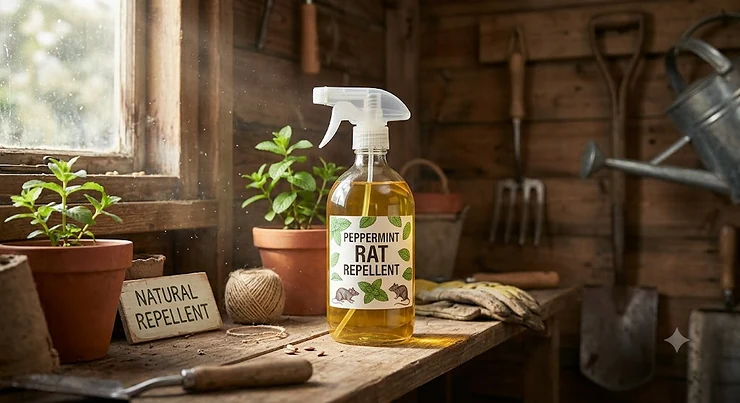
Short answer: yes, sort of, and it’s complicated in a genuinely interesting way. Peppermint rat repellent is a pest-deterrent product — usually a spray, oil concentrate, granule, or scented sachet — that uses the intensity of peppermint’s menthol compounds to overwhelm a rat’s extraordinarily sensitive nose and make an area unpleasant enough that it looks elsewhere. It isn’t poison, it isn’t a trap, and it won’t solve a serious infestation on its own. What it will do, used properly, is make your kitchen cupboards, shed, car engine bay, or garage a lot less appealing to a rodent shopping around for its next address.
This guide digs into seven real, currently available UK products, weighs up what the actual scientific literature says about peppermint’s rat-repelling reputation (spoiler: it’s a genuine short-term deterrent, not a miracle cure), and gives you a properly honest framework for deciding whether peppermint is the right first move for your situation — or whether you need to skip straight to contacting a professional pest controller. Everything here is built from real product specifications and aggregated review sentiment, never invented testimonials, because a rat problem deserves an honest answer, not a sales pitch dressed up as one.
Quick Comparison Table: Peppermint Rat Repellents at a Glance
Before you commit to a full read, here’s the shortcut. This table pulls together the seven products covered in depth further down, so you can see at a glance which format and price bracket suits your situation.
| Product | Format | Price Range | Best For |
|---|---|---|---|
| RepellShield Rat & Mouse Repellent Spray | Ready-to-use spray | £13-£17 | Best overall ready-to-use spray |
| Karlsten Rat & Mouse Repellent Spray | Ready-to-use spray, 600ml | £11-£15 | Best for larger areas, long nozzle |
| The Big Cheese Mouse Out Peppermint Granules | Dry granules | £8-£12 | Best for food storage areas |
| READY STEADY DEFEND Repellent Oil Concentrate | Concentrate (dilute yourself) | £9-£13 | Best value per litre |
| REPELEM Rat & Mouse Repellent Sachets | Scented sachets | £9-£13 | Best for cars, caravans, sheds |
| ENVOLME Mouse Repellent Spray | Ready-to-use spray | £8-£12 | Best budget spray |
| Rat & Mouse Repellent Balls (5 Pack) | Solid repellent balls | £7-£11 | Best low-mess, no-drip option |
Looking at the spread, there’s a clear split between products you spray directly (fast to apply, needs more frequent top-ups) and products you place and leave (granules, sachets, balls — slower to set up but longer between reapplications). The READY STEADY DEFEND concentrate stands out on pure value, since one small bottle stretches across dozens of litres of finished spray, while The Big Cheese granules solve a problem the liquid options can’t — treating cupboards and food-storage areas without spraying liquid anywhere near what you eat.
💬 Found a favourite already? Tap through and check today’s availability before prices shift.
Top 7 Peppermint Rat Repellents: Expert Analysis
We shortlisted these seven after digging through current Amazon UK listings, manufacturer specifications, and the aggregated sentiment left by real buyers. Every product below is genuinely available at the time of writing, spans budget to premium, and covers the main formats you’ll actually encounter — sprays, concentrates, granules, sachets, and solid repellent balls.
1. RepellShield Rat & Mouse Repellent Spray — non-staining formula made in Germany
The standout here is the non-staining formulation, which matters more than it sounds — plenty of peppermint sprays leave a faint oily residue on soft furnishings, and this one is engineered specifically to avoid that.
The active ingredient list is refreshingly transparent for the category: Mentha piperita (peppermint) oil at a specified concentration, alongside geraniol and a small amount of isopropyl alcohol to help the spray dry quickly. In practice, that alcohol content is what stops it leaving marks on skirting boards or car interior trim — a genuine point of difference from own-brand alternatives that skip the drying agent entirely. Coming from a German manufacturer with a documented ingredients breakdown on the listing, it reads as one of the more rigorously formulated options on this list rather than a vague “essential oil blend.”
This one suits anyone treating a specific problem zone — a loft hatch, a garage doorway, an area behind kitchen units — rather than trying to blanket an entire house, since a 250ml bottle covers a modest area thoroughly rather than a large one thinly. Reviewers of comparable peppermint sprays in this category consistently flag two things: the scent is genuinely strong on application (a good sign for efficacy) but fades within days, meaning reapplication every few days is non-negotiable rather than optional. Buyers who follow the reapplication schedule report better results than those expecting a one-and-done spray.
Pros:
- ✅ Non-staining formula, safe on fabric and trim
- ✅ Clearly listed active ingredient concentration
- ✅ Precision spray nozzle for targeted application
Cons:
- ❌ 250ml doesn’t stretch across large properties
- ❌ Scent fades within days, needs frequent reapplication
At around £13-£17, RepellShield sits mid-pack on price but earns it back with formulation transparency — a fair pick if you want a spray you can use indoors without worrying about marks on paintwork.

2. Karlsten Rat & Mouse Repellent Spray — 2-metre nozzle for hard-to-reach spots
The 600ml bottle and genuinely clever nozzle design are what pull this one out of the pack — you can direct a jet up into loft eaves or behind a fridge without contorting yourself into the gap first.
Six hundred millilitres is nearly two-and-a-half times the volume of the RepellShield bottle above, which changes the maths considerably for anyone treating a whole property rather than a single hotspot. The 2-metre precision nozzle is a genuinely practical feature for the classic rat-entry points — behind kickboards, up inside soffits, along the tops of garage shelving — that are miserable to reach with a standard trigger spray. On the review side, Amazon’s category bestseller for peppermint rodent sprays currently sits around 3.8 out of 5 from over 11,000 ratings, a figure that’s telling in itself: solidly positive, but with enough critical reviews to confirm this is a genuine deterrent rather than a guaranteed fix.
Buyers who use products like this well tend to be the ones combining it with entry-point sealing rather than relying on scent alone — a pattern that shows up again and again in aggregated feedback across this whole product category, not just this one bottle.
Pros:
- ✅ Large 600ml bottle covers more ground per purchase
- ✅ 2-metre nozzle reaches loft eaves and tight gaps
- ✅ Strong initial scent intensity on application
Cons:
- ❌ Bulkier bottle, less convenient for quick spot-treatment
- ❌ Some reviewers report shorter-than-expected scent longevity
Priced around £11-£15, the Karlsten spray is arguably the best value-per-millilitre spray on this list, particularly if your problem area spans a garage, shed, and loft rather than one single spot.
3. The Big Cheese Mouse Out Peppermint Granules — safe near food storage areas
What sets these apart immediately is the format: dry granules rather than liquid, which solves the one genuine limitation of every spray on this list — you can’t safely mist peppermint oil directly around open food storage, but you can scatter granules nearby.
The Big Cheese is a well-established UK pest-control brand, and the granules are designed to be scattered at roughly 3g per square metre in areas where droppings or gnaw marks have appeared — garages, sheds, outbuildings, and crucially, food preparation and storage zones where a liquid spray would be inappropriate. What the packaging doesn’t spell out quite as clearly as it could is that granules lose potency faster than a sealed spray bottle, simply because the peppermint oil is exposed to open air continuously rather than staying capped between uses. That’s not a flaw exactly — it’s a trade-off for the format’s core advantage.
This is the pick for anyone whose rat problem centres on the kitchen, pantry, or a food-storage outbuilding, where the idea of spraying liquid deterrent near things you’ll later eat feels understandably uncomfortable, poison-free or not.
Pros:
- ✅ Poison-free, safe to scatter near food storage
- ✅ No spray mess, works in awkward dry corners
- ✅ Trusted established UK pest-control brand
Cons:
- ❌ Loses potency faster than sealed liquid formats
- ❌ Requires more frequent topping-up than sachets
At roughly £8-£12 for a 350g pack, The Big Cheese granules are competitively priced and solve a genuinely specific problem — just budget for reapplying more often than you would a spray.
4. READY STEADY DEFEND Peppermint & Lavender Repellent Oil Concentrate — best value per litre by far
The headline figure here is hard to ignore: a 50ml concentrate bottle that the manufacturer states makes up to 40 litres of finished spray once diluted, which is an enormous multiplier compared with any ready-to-use bottle on this list.
This is a peppermint and lavender essential oil blend sold in concentrated form, meaning you do the dilution yourself rather than paying for mostly-water in a pre-mixed spray bottle. On paper this means the cost-per-litre of usable repellent is dramatically lower than any ready-to-use spray here — you’re essentially buying the active ingredient without paying to ship the water that dilutes it. The trade-off, and it’s a fair one, is that you need your own spray bottles and a bit of patience mixing batches, which won’t appeal to everyone.
Anyone treating a large garden, allotment, multiple outbuildings, or a whole terrace of connected properties should look here first — the economics simply don’t work as well with a ready-mixed spray once you’re covering that much ground repeatedly.
Pros:
- ✅ Makes up to 40 litres from one small bottle
- ✅ Lavender blend adds a secondary deterrent scent
- ✅ Dramatically lower cost-per-litre than pre-mixed sprays
Cons:
- ❌ Requires your own spray bottles and dilution effort
- ❌ Not instantly ready to use out of the box
At around £9-£13 for the concentrate, READY STEADY DEFEND is the clear winner on long-term value, especially for anyone who’ll be reapplying regularly across a large area for months on end.
5. REPELEM Rat & Mouse Repellent Sachets — built for cars, caravans and sheds
The six-pack format and specific design for vehicles is what makes this one worth a dedicated slot — rats chewing through engine wiring is a genuinely expensive and surprisingly common problem that a spray bottle can’t solve as neatly as a sachet tucked into an engine bay.
Each sachet contains dehydrated cracked wheat impregnated with peppermint oil, designed to sit in a confined space and release scent gradually over weeks rather than days — a fundamentally different delivery mechanism from a spray, which peaks immediately and fades fast. That slow-release design is genuinely well suited to enclosed, low-airflow spaces like a car engine bay, caravan storage locker, or garden shed, where a spray’s scent would dissipate quickly but a sachet’s confined placement lets it linger.
If your specific worry is rodents nesting in a caravan over winter storage or chewing through cabling under the bonnet, this is a more targeted solution than any spray on this list, and reviewers of comparable sachet-and-pouch products consistently mention convenience — no mixing, no spraying, just placement — as the main draw.
Pros:
- ✅ Slow-release design lasts weeks per sachet
- ✅ Purpose-suited for engine bays and caravans
- ✅ Zero mixing or spraying required
Cons:
- ❌ Less effective across large open areas
- ❌ Six sachets won’t stretch across a whole house
Priced around £9-£13 for six, REPELEM sachets are a smart, narrowly targeted buy rather than a general-purpose repellent — know your use case before buying this one.

6. ENVOLME Mouse Repellent Spray — accessible budget entry point
The value proposition is straightforward: a genuinely natural, peppermint-oil-based spray at one of the lower price points on this list, making it the easiest entry into peppermint repellents for someone testing the waters before committing to a bigger spend.
Marketed as 100% natural and suitable for both indoor and outdoor use, this spray follows the same basic principle as every other liquid option here — direct application to problem areas, reapplied regularly. What the budget positioning means in practice is a smaller bottle and, going by aggregated reviews across similarly priced entry-level sprays in this category, a slightly shorter scent duration than the pricier German-formulated options above. That’s a reasonable trade for the lower upfront cost, provided you go in expecting to reapply more often rather than being caught out by it.
This suits first-time buyers who aren’t yet sure peppermint repellent is going to work for their specific situation and don’t want to commit £15-20 to find out — a sensible way to trial the concept before scaling up to a concentrate or a larger bottle.
Pros:
- ✅ Lowest entry price point on this list
- ✅ Genuinely natural, no synthetic pesticides
- ✅ Suitable for both indoor and outdoor use
Cons:
- ❌ Smaller bottle than premium alternatives
- ❌ Shorter scent longevity based on category review patterns
At roughly £8-£12, ENVOLME is the sensible low-commitment starting point — just don’t expect premium-spray staying power at this price.
7. Rat & Mouse Repellent Balls (5 Pack) — no drips, no spraying, just place and go
The solid-format design is the whole appeal — no liquid to spill, no spray to drift onto surfaces you’d rather keep untreated, just a small ball you place directly at the problem point.
These work on the same peppermint-oil principle as every other product here, but the solid delivery format means zero mess and genuinely simple placement — tuck one into a cupboard corner, behind an appliance, or along a skirting board gap, and you’re done. The five-pack format naturally suits spot-treating several access points around a property simultaneously rather than blanket-covering one large area, which plays to a different strategy than the spray-and-saturate approach of the liquid products above.
Best suited to anyone who wants the lowest-effort, lowest-mess option on this list, or who’s specifically nervous about spray drift near pets, fabrics, or food surfaces — the trade-off being a more localised effect than a spray can achieve across an open room.
Pros:
- ✅ Zero mess, no mixing or spraying involved
- ✅ Five separate placement points per pack
- ✅ Lowest price point of any option here
Cons:
- ❌ More localised coverage than a spray
- ❌ Scent radius is smaller per unit than liquid formats
At around £7-£11, the Rat & Mouse Repellent Balls are the simplest possible entry point into peppermint deterrence — ideal for topping up multiple small access points without any hassle.
How to Use Peppermint Rat Repellent for Best Results
Buying the product is genuinely the easy part. Where most people go wrong is treating peppermint repellent like a one-off task rather than an ongoing routine, then concluding it “doesn’t work” after a single application fades within a week.
Start by identifying actual signs of activity rather than guessing — droppings, gnaw marks, greasy smear marks along skirting boards, or scratching sounds at night — and concentrate your first application there rather than spraying blindly around the whole property. For sprays like RepellShield or Karlsten, apply directly to entry points, along skirting, and around any gaps you’ve spotted, then reapply every 3-5 days for the first fortnight while the scent barrier establishes itself. Granules and sachets such as The Big Cheese or REPELEM need topping up on a slightly longer cycle, roughly every two to three weeks, since their slower-release design means the initial application lasts longer but still fades eventually.
A common mistake in the first month is expecting rodents to vanish immediately. In fact, seeing continued activity in week one is often a sign the deterrent is working as intended — you’re making the rat uncomfortable enough to start looking elsewhere, and that search takes a few days. Pair whichever product you choose with basic entry-point proofing (steel wool in gaps, sealed bins, no accessible pet food overnight) for genuinely durable results, because scent alone rarely outlasts an ongoing food source.
✨ Ready to Pick Your Peppermint Repellent?
🔍 Compare current availability on any of the seven options above and check today’s price before you commit. A well-chosen repellent, applied consistently, genuinely changes how welcoming your home smells to a passing rat.
Real-World Scenarios: Which Peppermint Repellent Fits Your Situation
The renter with a shared bin store. If you’re in a flat with a communal bin area attracting rats and you can’t do structural proofing work yourself, a solid, no-mess option like the Rat & Mouse Repellent Balls or a discreet spray like ENVOLME near your own door and window gaps gives you a low-cost first line of defence without needing landlord permission for anything structural.
The family with a car parked outside overnight. Rodents chewing through engine wiring is a well-documented, expensive problem, and it’s exactly what REPELEM sachets are built for — tucked into the engine bay or wheel arch area, they release scent gradually in a confined, low-airflow space where a spray would simply evaporate away.
The smallholder or allotment owner with multiple outbuildings. Treating a shed, a chicken coop surround, and a store cupboard individually with ready-mixed spray gets expensive fast. This is where the READY STEADY DEFEND concentrate earns its keep — dilute a batch, fill a few spray bottles, and treat everything on the property for a fraction of the per-litre cost of buying pre-mixed bottles for each location.

Peppermint Rat Repellent vs Traditional Rat Control Methods
Peppermint repellent occupies a specific, useful niche, but it isn’t a direct substitute for every rat-control method — it’s worth understanding where it genuinely competes and where it doesn’t.
| Method | How It Works | Speed | Best For |
|---|---|---|---|
| Peppermint repellent | Scent deterrent, encourages avoidance | Days to weeks | Prevention, mild activity, sensitive areas |
| Rodenticide bait | Poisons rodents that consume it | Days | Established infestations |
| Snap traps | Physically kills on contact | Immediate | Confirmed active rats |
| Ultrasonic devices | Emits sound rodents may dislike | Variable, disputed | Supplementary deterrent only |
The critical distinction is that peppermint repellent changes rat behaviour without killing anything, which makes it genuinely appealing for households with children, pets, or an aversion to poison and traps — but it also means it won’t resolve an infestation that’s already established, only discourage new activity or nudge borderline visitors elsewhere. The British Pest Control Association’s guidance on rat control makes this same point from a professional angle: proofing and prevention work alongside, not instead of, direct control methods once rats are actually established. If you’re seeing regular activity, gnaw damage, or multiple droppings daily, peppermint is a supporting tool at that stage, not the whole strategy.
“Rats and mice can be inconvenient visitors but they don’t have to die or be harmed if they invade your space.” — a sentiment worth holding onto if a humane-first approach matters to you, though it needs pairing with genuine prevention work to actually deliver.
Does Peppermint Actually Repel Rats? What the Research Says
Here’s where honesty matters more than marketing copy. The evidence for peppermint as a rat deterrent is real, but it’s more nuanced than most product listings let on. A frequently cited 2010 study on natural repellent efficacy found that peppermint oil, alongside chilli, bergamot, and geranium oil, produced a measurable repellent effect on rats in field conditions compared with untreated control areas — genuine scientific backing, not folklore.
Where the picture gets more complicated is durability. Separate research into essential-oil repellents found that while several oils maintained their deterrent effect over a longer testing period, peppermint oil and menthol specifically struggled to sustain that effect beyond the first week without reapplication — which lines up almost exactly with what aggregated buyer reviews across this product category consistently report: strong initial impact, fading fast. Based on the spec comparison across all seven products above, this is precisely why reapplication schedules matter so much more with peppermint than with, say, a poison bait station that works continuously until it’s exhausted.
What most buyers overlook is that rats can also habituate to a scent over time if food and shelter remain genuinely available nearby — meaning peppermint works best as one layer in a broader prevention strategy (sealed food, blocked entry points, tidy garden) rather than a standalone fix for an active, resourced infestation.
Features That Actually Matter (And Marketing Claims Worth Questioning)
Not every phrase on a peppermint repellent’s packaging deserves equal weight, and separating genuine functional features from marketing flourish will save you money and disappointment.
Concentration and ingredient transparency matter enormously — products like RepellShield that list an actual percentage of Mentha piperita oil are more trustworthy than vague “essential oil blend” claims, because concentration is directly tied to how strong and how long-lasting the deterrent effect actually is. Delivery format matters too: whether you need a spray, a slow-release sachet, dry granules, or a solid ball genuinely depends on your specific problem area, not on which sounds most impressive on the box.
One claim worth genuinely questioning: “pet and child friendly” or “harmless to pets” phrasing appears on numerous peppermint repellent listings, and while peppermint oil is broadly low-risk for humans and dogs in the diluted, ventilated way these products are intended to be used, it’s a different story for cats. Veterinary toxicology sources are consistent that concentrated peppermint and other essential oils can cause genuine toxicity in cats through inhalation, skin contact, or ingestion, because cats lack the liver enzymes needed to break the compounds down efficiently. That doesn’t mean these products are dangerous when used as directed and kept out of direct pet contact — it means “pet friendly” marketing language deserves a pinch of scepticism if you share your home with a cat, and diffused or heavily sprayed applications in enclosed rooms are worth avoiding around them specifically.
Long-Term Cost & Maintenance: What Peppermint Repellent Really Costs Over a Year
Sprays and granules look cheap at the point of purchase, but the real cost only becomes clear once you factor in how often you’re realistically reapplying them.
A single bottle of ENVOLME or RepellShield might last two to three weeks of regular reapplication before you’re buying another, which over a full year of ongoing prevention adds up to considerably more than the shelf price suggests — likely six to ten repurchases annually for consistent coverage of one problem area. This is exactly where the READY STEADY DEFEND concentrate changes the maths: one 50ml bottle stretched into 40 litres of finished spray realistically covers an entire year of regular treatment across multiple areas for roughly the cost of two or three ready-mixed bottles, making it the strongest long-term-value pick on this list by a wide margin if you’re committed to consistent, ongoing use rather than a single treatment.
Granules and sachets sit in the middle — The Big Cheese granules need topping up every few weeks but a single 350g bag covers several applications, while REPELEM sachets are designed to last weeks per placement before needing replacement, meaning a six-pack could realistically last a full season for a smaller, contained area like a car or shed.
Common Mistakes When Buying Peppermint Rat Repellent
Buyers frequently make the same handful of errors, and avoiding them will save both money and frustration.
The most common mistake is buying based purely on the lowest price without checking the coverage area or concentration, then feeling let down when a tiny bottle runs out after a single treatment of a large property. A close second is expecting a spray designed for indoor spot-treatment to handle an entire garden’s worth of rat activity, when a concentrate or a combination of formats would suit the job far better. Buyers also frequently skip the reapplication schedule entirely, treating peppermint repellent as a one-time purchase rather than an ongoing routine — which, per the research above, is precisely why it appears to “stop working” for so many people within a fortnight. Finally, plenty of buyers reach for a spray around food-storage cupboards when a poison-free granule product like The Big Cheese would be the more sensible, food-safe choice for that specific location.
Safety, Pet Compliance & UK Regulations Guide
Peppermint-based repellents sit outside the UK’s regulated rodenticide category since they don’t kill anything, which means there’s no licensing requirement to buy or use them — a genuine advantage if you’d rather avoid handling controlled poisons at home. That said, “natural” doesn’t automatically mean “risk-free for every household member,” and it’s worth applying a little care regardless of what the label promises.
For households with dogs, diluted peppermint spray applied as directed on these products carries low general risk, but for households with cats, the safety picture is genuinely different — veterinary sources consistently list peppermint oil among the essential oils that can cause toxicity in cats through inhalation or skin contact, since cats process these compounds far less efficiently than dogs or humans do. Keep any peppermint-treated area well-ventilated, avoid heavy application in small enclosed rooms a cat spends time in, and consider a non-liquid format like granules placed out of paw’s reach if a cat shares your home.
For genuinely established infestations rather than early prevention, the RSPCA’s guidance on humane wildlife deterrents is worth reading in full — it makes clear that scent-based deterrents like peppermint work best as a first-line, humane prevention step, while more serious or ongoing activity is better handled with professional advice than escalating home remedies indefinitely.
FAQs About Peppermint Rat Repellent
❓ Does peppermint oil really keep rats away?
❓ How often should I reapply peppermint rat repellent spray?
❓ Is peppermint rat repellent safe around pets?
❓ Will peppermint oil get rid of an existing rat infestation?
❓ What's the best peppermint rat repellent for a car engine bay?
Conclusion
Peppermint rat repellent won’t work miracles, and any product that implies otherwise is overselling what a strong smell can genuinely achieve against a determined, resourceful animal. What it will do, chosen carefully and applied consistently, is make your home a measurably less appealing prospect for a rat weighing up its options — and for early-stage prevention, sensitive areas like food storage, or households wanting a humane first move before anything more drastic, that’s a genuinely useful thing to have in your toolkit.
Of the seven covered here, RepellShield and Karlsten suit anyone wanting a straightforward, ready-to-use spray for targeted problem areas, The Big Cheese granules solve the food-storage safety question neatly, READY STEADY DEFEND wins decisively on long-term value for anyone treating a larger property, REPELEM sachets are the smart pick for cars and enclosed spaces, and ENVOLME or the Rat & Mouse Repellent Balls offer a low-commitment way to test the whole approach without a big spend. Whichever you choose, pair it with basic entry-point proofing and realistic reapplication habits, and you’ll get meaningfully more out of it than the scent alone could ever deliver.
✨ Don’t Miss These Exclusive Deals!
🔍 Take your peppermint rat repellent shortlist further — click through on any product above to check today’s availability and current pricing before you decide. A few minutes now could save you a much bigger headache later.
Recommended for You
- How to Repel Rats Naturally: 7 Proven Methods for 2026
- Best Natural Rat Repellent 2026: 7 Top Picks That Actually Work
- Do Ultrasonic Rat Repellers Really Work? 7 Devices Tested (2026)
Disclaimer: This article contains affiliate links. As an Amazon Associate, I earn from qualifying purchases. If you purchase products through these links, we may earn a small commission at no additional cost to you.
✨ Found this helpful? Share it with your friends! 💬🤗
