
In This Article
An electronic mouse deterrent for home use is a plug-in or battery-powered device that emits ultrasonic sound, and sometimes electromagnetic pulses through your wiring, to make a space unpleasant for mice. It kills nothing, uses no poison and runs around the clock. Its real-world results are hotly debated, so it works best as one layer in a wider plan.

As autumn arrives, that debate stops being academic. Pest professionals note that mice move indoors between October and March, chasing warmth and an easy meal, and the scratching in the loft usually arrives right on cue. So people go shopping. Amazon UK is stuffed with tiny white plugs promising “whole house” protection for pennies.
Here’s the catch. Electronic pest control has a contested track record, and independent testers and UK pest controllers are sceptical. I won’t pretend otherwise. What I can do is help you buy sensibly: which units make believable claims, how far each one really reaches, what the wiring implications are, and how to pair a device with proofing so your money isn’t wasted.
Below you’ll find seven real products, honest analysis of what their spec sheets mean, and practical guides for setting them up.
Quick Comparison Table: Electronic Mouse Deterrent for Home Options
| Product | Type | Stated coverage | Best For |
|---|---|---|---|
| Pest Stop Small House | Mains, ultrasonic + electromagnetic | Up to 232 m² (maker’s claim) | Homes wanting a wiring-based add-on |
| Pest Stop Large House | Mains, same product line | Check the spec sheet | Bigger properties with several circuits |
| Rentokil Beacon Dual Action | Plug-in, dual output | Check the listing | Buyers who prefer a known pest brand |
| STV Plug-In Rodent Repeller | Mains sonic | About 37 m² (400 sq ft), single room | One problem room |
| AMZ Brand 2 Pack | Mains, 3 modes | Check the listing | Flats and two-room trials |
| K&J 6 Pack | Mains multipack | Per-unit claims vary | Budget room-by-room coverage |
| Spielgoed Ultrasonic Pest Repeller | Mains ultrasonic | Up to 115 m² (claimed) | Open-plan spaces and garages |
Look at that coverage column with a raised eyebrow. Sound doesn’t pass through walls, so a figure quoted in square metres describes an empty field, not your terraced house. The STV Plug-In Rodent Repeller is refreshingly honest about being a single-room device, while the Pest Stop Small House offers the boldest reach and the only wiring-level function in this group. For most homes, coverage per room matters more than the headline number.
💬 Just one click — help others make better buying decisions too!😊
Top 7 Electronic Mouse Deterrent for Home Picks: Expert Analysis
Before the list, a note on method. I haven’t handled these units, and I won’t invent stories about them. What follows is analysis built from published specs, retailer information and what independent testers and pest professionals report about the category. Where I couldn’t verify aggregated Amazon UK review data for a specific listing, I say so. Check the live star rating and recent reviews before you buy.
1. Pest Stop Small House Ultrasonic Pest Repeller (RR010) — the wiring-level option
The standout here is the electromagnetic function alongside ultrasound. The maker says it stops rodents nesting in wall voids where wiring runs, something ultrasound alone can’t reach.
It’s a mains plug-in, inaudible to humans, with a claimed reach of up to 232 m² and a two-year manufacturer’s warranty. The maker suggests one unit per circuit for the strongest electromagnetic effect, for example upstairs and downstairs ring mains. It also says ultrasound is blocked by solid objects and needs line of sight to the pest.
Based on the spec comparison, that last caveat undermines the 232 m² headline. Treat it as a per-room device, and treat the wiring claim as an intriguing extra rather than a proven one, because I found no independent testing of it. I couldn’t verify aggregated review sentiment for this exact model, and category-wide, testers report mixed results.
Pros:
- ✅ Combines ultrasonic and electromagnetic outputs
- ✅ Two-year manufacturer’s warranty
- ✅ Simple direct plug-in design
Cons:
- ❌ Wiring-level effect lacks independent evidence
- ❌ Sound shadows limit real coverage
Price: high-£30s at a specialist supplier at the time of research; check current price. Reasonable value if you like the electromagnetic angle, but don’t expect miracles.

2. Pest Stop Large House Ultrasonic Pest Repeller — bigger sibling for larger properties
The hook is scale. This is the step-up model in the same line, listed by the same UK supplier at roughly £15 to £20 more than the small unit.
I couldn’t pull a verified coverage figure for it, so check the spec sheet before buying. The useful question isn’t what the box says but whether one bigger unit beats two smaller ones. Ultrasound loses to walls, furniture and soft furnishings, so a single stronger source still leaves dead zones. If your home has a long open hallway or a big open-plan ground floor, the Pest Stop Large House may earn its premium. If it’s a warren of small rooms, two Pest Stop Small House units placed in different areas would likely cover more useful ground for similar money.
That’s the kind of reasoning worth doing before you buy. Independent reviews for this exact unit weren’t verifiable at the time of research. Category-wide, testers report that any benefit tends to be short-lived, especially where mice already have food and warmth.
Pros:
- ✅ Positioned for larger homes
- ✅ Same mains plug-in simplicity
- ✅ Available through UK pest-control suppliers
Cons:
- ❌ Premium over the small model
- ❌ Coverage figure needs checking
Price: mid-£50s at the time of research; check current price. Worth it only if your layout suits one stronger source.
3. Rentokil Beacon Mouse & Rat Repeller Dual Action (RKLFM89) — the household-name choice
The standout is brand familiarity. Rentokil’s Beacon range is widely stocked in UK garden centres and hardware shops, and this dual-action model is listed on Amazon UK.
“Dual action” normally means two output types, but I couldn’t fetch the listing text, so confirm which two on the page. For context, the Beacon plug-in sonic sibling is stated to protect about 46 m² (495 sq ft), while the battery version runs on a 9V battery lasting up to six months, a handy option for lofts and sheds without sockets.
Here’s what buyers overlook: a familiar name is reassurance, not proof of effectiveness. One buyer of a battery Beacon-type unit on a third-party eBay listing reported an empty plastic case. It’s a single anecdote, but a fair prompt to buy from a reputable seller.
Pros:
- ✅ Recognised UK pest-control brand
- ✅ Range includes battery options for lofts
- ✅ Widely stocked, easy to compare
Cons:
- ❌ Dual-action details need checking
- ❌ Counterfeit and third-party seller risk
Price: check current price on the listing. Best for cautious shoppers who value a familiar name.
4. STV Plug-In Rodent Repeller — the honest single-room claim
The hook is honesty. STV, a long-standing UK pest-control brand, describes its plug-in sonic repeller as protecting a single room of up to 400 square feet, roughly 37 m². It plugs into a standard three-pin socket.
That single-room framing matches the physics better than “covers 2,500 sq ft” boasts elsewhere. Sound spreads outward, bounces off hard surfaces, gets absorbed by soft ones and stops at walls. A claim scoped to one room is one you can actually plan around.
Here’s my take on who it suits. If you’ve heard scratching in a specific kitchen, utility room or garage, one dedicated unit there is a low-stakes experiment. Independent review data for this specific unit wasn’t verifiable at the time of research. Category-wide, testers say results vary and mice can adapt within days when food is available.
Pros:
- ✅ Coverage claim scoped to one room
- ✅ Standard three-pin plug fits UK sockets
- ✅ Established UK brand behind it
Cons:
- ❌ Single-room only, so multiples cost more
- ❌ Limited independent evidence
Price: budget bracket; check current price. A sensible, modest first purchase.
5. AMZ Brand Ultrasonic Pest Repeller 2 Pack — three modes to fight adaptation
The standout is the 3 working modes and wide frequency range. Variable output is the industry’s answer to habituation: studies since the 1960s show mice grow used to steady ultrasound, so manufacturers try switching things up.
Does it work? University research reviewed by pest-control sources found rodents habituate within days to a fixed tone. Varying frequency is the logical response, but I found no independent test proving it beats that problem in real homes. On its listings the brand positions the unit as a complement to traps and other methods rather than a standalone fix, which is the most defensible way to sell it.
A two-pack suits a small flat: one unit for the kitchen, one for the hallway or bedroom. Verified Amazon UK review data wasn’t available to me, so read recent reviews for mentions of mice returning after a few weeks, the classic failure mode reported for this category.
Pros:
- ✅ Three modes vary the output
- ✅ Two units for room-by-room use
- ✅ Positioned as a complement to other methods
Cons:
- ❌ Variable frequency remains unproven in independent tests
- ❌ Two units won’t cover a larger home
Price: check current price on the listing. Good for flats and trial runs.

6. K&J 6 Pack Ultrasonic Pest Repeller (2025 Upgraded) — six rooms, one purchase
The hook is multipack economics. Six units let you put one in every room that matters, which is how ultrasonic devices need to be used.
The maths is easy: a multipack lowers your cost per room but not your risk. If the technology’s benefit is modest, buying six modestly effective devices doesn’t make it strong. Your electricity cost is small, though. At a typical draw under 5 watts, a unit uses roughly 44 kWh a year, which is around £11 to £13 at 25p to 30p per kWh (your tariff will differ). Six units come to roughly £66 to £79 a year.
The listing mentions upgraded 2025 hardware, but “upgraded” on Amazon marketplace listings is often just a new model number. Sanity-check the manufacturer’s contact details and instructions, and read recent reviews before committing.
Pros:
- ✅ Enough units for several rooms
- ✅ Low running cost per unit
- ✅ Easy trial across the whole home
Cons:
- ❌ Lesser-known marketplace brand
- ❌ Six sockets occupied at once
Price: check current price on the listing. A budget test of room-by-room coverage.
7. Spielgoed Ultrasonic Pest Repeller — big number, sensible instructions
The standout is the claimed coverage of up to 115 m², paired with the listing’s own instruction to use one unit per room because ultrasound can’t pass through walls or solid objects. It also warns that it takes some days to work.
Read those two statements together and you get the honest reading: 115 m² is a best-case open-space figure, not what you’ll get in a cluttered semi. The multi-pest list (mice, mosquitoes, cockroaches, ants, bedbugs) is where I’d push back. Pest-control specialists point out there’s no single frequency that repels every pest, and tests on ants, spiders and cockroaches show little effect.
For an open-plan ground floor, a garage or a workshop, this could be a fair trial. Aggregated review data wasn’t verifiable to me here either. Check recent reviews on the live listing.
Pros:
- ✅ Honest one-per-room guidance in the listing
- ✅ Large open-space coverage claim
- ✅ Plug-in operation, no batteries
Cons:
- ❌ Multi-pest claims aren’t credible
- ❌ Results take days and may fade
Price: check current price on the listing. Suits open-plan spaces, with limited expectations.
| Product | Power | Price bracket | Key caution |
|---|---|---|---|
| Pest Stop Small House | Mains | High-£30s (specialist supplier) | Wiring claim unproven |
| Pest Stop Large House | Mains | Mid-£50s (specialist supplier) | Check coverage spec |
| Rentokil Beacon Dual Action | Plug-in | Check current price | Confirm outputs; buy from reputable sellers |
| STV Plug-In Rodent Repeller | Mains | Budget bracket | Single room only |
| AMZ Brand 2 Pack | Mains | Check current price | Variable modes unproven |
| K&J 6 Pack | Mains | Check current price | Lesser-known brand |
| Spielgoed Ultrasonic Pest Repeller | Mains | Check current price | Multi-pest claims overblown |
The table makes the trade-off plain. The Pest Stop Small House is the only mains powered mouse deterrent here that leans on wiring-level action, and it costs a bit more for that. The K&J 6 Pack and AMZ Brand 2 Pack suit anyone treating this as a cheap, room-by-room experiment. Ratings aren’t listed because I couldn’t verify aggregated figures, so check the live pages.
How to Choose an Electronic Mouse Deterrent for Home
Picking the right unit takes a few honest questions rather than a spec-sheet chase.
- Count the rooms, not the square metres. Ultrasound stops at walls, so budget one unit per problem room.
- Decide whether wiring-level action matters to you. An electromagnetic pest repeller adds a claimed effect in wall voids, but independent evidence is thin. Pay extra only if that idea appeals.
- Check the power source. Mains units suit heated rooms with sockets; battery models suit lofts, sheds and garages.
- Look for CE or UKCA marking, plus the maker’s address. Anything without them is a red flag.
- Read instructions for pets. Pet hamsters, guinea pigs and rats can hear these frequencies.
- Buy from reputable sellers. Counterfeit and empty-case complaints exist.
- Plan the rest of the strategy first. Proofing and traps do the heavy lifting.

Do Electronic Mouse Deterrents Actually Work? What to Expect
Let’s be straight. Independent evidence says mostly no, or not for long. Mice show mild aversion to ultrasound at first, then habituate within days, and if they find a reliable food source they’ll walk right up to the speaker. A pest-control firm’s review of the research notes that convincing effects need specialist, controlled equipment that isn’t sold off the shelf.
There are practical limits too. Ultrasound is absorbed by furniture and soft furnishings, creating dead zones where mice simply avoid the sound. And a device can appear to work simply because activity drops seasonally, or because the buyer also tidies up and seals food away.
So what should you expect? At best, a short-term nudge for mice that haven’t settled. At worst, a false sense of security while a nest grows behind the skirting. A mains powered mouse deterrent is a cheap gamble, not a solution. Use it to complement proofing, never to replace it.
Electromagnetic Pest Repeller: What the Wiring Trick Actually Does
An electromagnetic pest repeller uses your home’s electrical wiring as an antenna, sending a signal along the circuit that is claimed to irritate rodents nesting near cables. It’s the pitch behind the Pest Stop Small House, which recommends one unit per circuit.
The theory is appealing because mice love wall voids, which is where sound can’t reach. But I found no independent, peer-reviewed testing showing that these signals move mice out of cavities, and the wider literature on electronic repellers remains sceptical. Encyclopaedic overviews describe radio-frequency ideas as showing promise in principle while acknowledging that consumer claims of effectiveness are questioned.
My honest take is that an electromagnetic pest repeller is a bonus feature to weigh lightly, not a reason to pay double. If the price gap is small, the extra function does no harm. If it’s large, put the difference into steel wool and a snap trap.
Mains Powered Mouse Deterrent vs Traditional Alternatives
A mains powered mouse deterrent has real practical appeal: plug it in, forget it. But compare it fairly against the alternatives.
| Method | How it works | Evidence | Best For |
|---|---|---|---|
| Electronic deterrent | Sound or electromagnetic output | Weak and inconsistent | Light, early-stage worries |
| Proofing (steel wool, mesh) | Blocks entry gaps of 6 mm or more | Strongest for prevention | Every home |
| Snap or humane traps | Removes mice already inside | Reliable on contact | Active infestations |
| Professional treatment | Inspection, proofing, control | Most reliable overall | Persistent or heavy problems |
The written analysis is simple. Proofing is the only thing that prevents the next mouse, traps deal with the ones already inside, and electronics sit in the “cheap extra” column. Mice need only a gap of about 6 mm, roughly a pencil’s width, to get in, so sealing beats sound every time.
✨ Don’t Miss These Exclusive Deals!
🔍 Take your mouse-proofing to the next level by pairing a plug-in unit with sealing materials and traps. Click any highlighted product above to check current pricing and availability. A layered plan gives your family the best chance of a mouse-free winter!
Coverage Per Room: Why “Whole House” Claims Need Maths
Coverage per room is the number that actually matters. Manufacturers quote areas because they’re big and impressive, but those figures assume an empty space with nothing to absorb or block sound.
Here’s a real-world way to think about it. Picture a home with a kitchen, lounge, dining room, hall, three bedrooms, a bathroom and a loft. That’s eight or nine acoustic zones, and doors, walls and furniture make each one separate. One unit in the hall protects the hall.
A useful rule: aim for one unit in every room where you’ve seen droppings, heard scratching or found gnawing, plus the kitchen and utility areas. Skip bathrooms and rooms with no signs of activity at first.
Whole House Rodent Deterrent: A Realistic Plan
A whole house rodent deterrent sounds like one purchase. In practice it’s a system. Here’s how to build one without wasting money.
Start by mapping activity. Note where you’ve found droppings, smears or chewed packaging. Mice follow walls and runs, so these signs cluster.
Next, choose your units. A K&J 6 Pack covers a mid-sized home room by room on a modest budget, while the STV Plug-In Rodent Repeller works as a dedicated single-room add-on. If you want the wiring angle, add a Pest Stop Small House on each floor’s main circuit, as the maker suggests.
Finally, layer proofing and traps. The most effective mouse strategy uses a layered approach: seal first, then trap as insurance for any mice already inside. That’s the honest meaning of a whole house rodent deterrent: not a single gadget, but a coordinated plan.
Wiring Safety and UK Compliance Guide
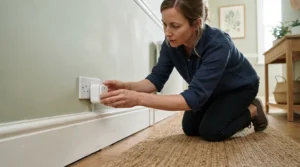
Any plug-in device raises wiring safety questions, and it’s worth spending a few minutes on them. Start with the basics: plug units directly into a standard socket, don’t daisy-chain adaptors, and don’t bury them behind furniture where heat can build up.
For compliance, GOV.UK explains that both CE and UKCA marking are accepted on products placed on the GB market as long as the legal requirements are met. Electrical equipment should also carry the manufacturer or importer’s name and address plus clear English instructions. Missing marks or details on a cheap marketplace unit are a reason to walk away.
Good wiring safety habits also include checking for recalls, and Electrical Safety First publishes safety notices for electrical products. Unplug any unit that feels hot, buzzes oddly or smells of burning. If a circuit trips after you add a device, call a qualified electrician.
Two extra cautions. Electromagnetic pest repeller units interact with your circuits, so if anyone in the household has an implanted medical device, read the manufacturer’s guidance and ask their clinician. And never run extension leads into a loft just to power a unit; use a battery model instead.
Combined Pest Deterrence: Layering Devices With Proofing
Combined pest deterrence works best as a sequence. Electronics come last, not first.
Step one: seal. Pack steel wool into gaps, then hold it in place with caulk or cement. The British Pest Control Association advises focusing on low-level gaps first, around pipes, windows and other entry points, since those are the likeliest routes.
Step two: starve. Move food, including pet food, into sealed containers, wipe crumbs and pull bins away from walls.
Step three: trap. Place snap or humane traps along walls where mice travel, to catch any that were already inside.
Step four: add electronics. Use a plug-in unit as a low-cost extra in problem rooms. Note that some multi-pest devices are marketed for combined pest deterrence across mice, insects and spiders, but specialists say no single frequency does it all. Keep insect problems on separate, targeted solutions.
Practical Usage Guide: Setup and Your First 30 Days
Here’s how to set up a plug-in unit so it has the best possible chance.
Day one. Plug the unit into a socket with clear line of sight across the room, ideally at skirting height and not behind a sofa or curtains. Keep it away from fish tanks and small-pet cages.
Week one. Watch for droppings and scratching. Some listings warn it can take days or weeks for an effect. Don’t declare victory too early.
Weeks two to four. Keep traps and proofing in place. If droppings persist, the device isn’t the answer. If activity drops, it may be seasonal, so keep everything in place through winter.
Common mistakes in the first 30 days. Relying on one unit for the whole house, removing traps too soon and ignoring entry points. A tidy kitchen and sealed gaps do more than any gadget.
Maintenance. Dust the unit monthly, check the plug and cable and replace batteries on schedule for battery models.
Real-World Scenarios: Three UK Households
The renter in a one-bed flat. She’s heard scratching behind the kitchen units and can’t drill or seal much. An AMZ Brand 2 Pack in the kitchen and hall costs little, and she pairs it with sealed food storage and a snap trap. Her landlord handles proofing.
The family in a three-bed semi. Droppings in the utility room and under the stairs. A K&J 6 Pack covers the key rooms, a STV Plug-In Rodent Repeller goes in the utility, and dad seals the gaps around pipes with steel wool.
The owner of a detached house with a workshop. Multiple circuits and a large garage. He tries a Pest Stop Small House on each main circuit, a Spielgoed Ultrasonic Pest Repeller in the open-plan garage and a battery Rentokil Beacon Dual Action-family unit in the loft. If activity continues after four weeks, he calls a BPCA-certified pest controller.
Common Mistakes When Buying an Electronic Mouse Deterrent for Home
The first mistake is trusting the biggest coverage number. Coverage per room is what counts. The second is buying multi-pest devices for insects, since testing on ants, spiders and cockroaches shows little effect.
Third, skipping proofing. One professional guide bluntly says trapping without sealing just resets the clock. Fourth, ignoring pets. Small pet rodents can hear ultrasound and may become distressed. Fifth, buying from unknown sellers, which risks counterfeit units and missing safety marks.
Sixth, expecting instant results. Even sellers say it takes days. And last, keeping the device as your only defence. An electronic mouse deterrent for home use is a supporting player, not the lead.
Long-Term Cost and Maintenance
Running costs are trivial. At under 5 watts, one unit uses roughly 44 kWh a year, around £11 to £13 at typical rates (check your tariff). Six units run to about £66 to £79 annually, so multipacks aren’t free to run.
Purchase price is the bigger factor. A single unit sits in the budget bracket, the Pest Stop Small House in the high-£30s and the Pest Stop Large House in the mid-£50s. Add proofing materials and traps, and a sensible starter kit is still cheaper than one professional call-out, where mouse control from a BPCA-certified firm starts from around £160 plus VAT for two visits.
Value verdict: buy a couple of units as a low-risk experiment, but budget the real money for proofing and traps. Replace units if they buzz, overheat or stop lighting up, and keep warranty details, such as the two-year cover on Pest Stop models.
Frequently Asked Questions
❓ Is a mains powered mouse deterrent safe to leave plugged in overnight?
❓ How many units make a proper whole house rodent deterrent?
❓ Does an electromagnetic pest repeller work through walls?
❓ Can electronic mouse deterrent for home use harm my pets?
❓ What is combined pest deterrence for mice?
Conclusion
An electronic mouse deterrent for home use is cheap, easy and appealing, and the evidence says it shouldn’t be trusted alone. Mice adapt, sound stops at walls and the strongest results come from proofing and trapping.
If you want to try one, choose sensibly. The Pest Stop Small House is the pick if the wiring angle intrigues you. The STV Plug-In Rodent Repeller is the honest single-room option. The AMZ Brand 2 Pack and K&J 6 Pack suit budget room-by-room trials, the Spielgoed Ultrasonic Pest Repeller fits open spaces, the Pest Stop Large House suits bigger layouts and the Rentokil Beacon Dual Action appeals to brand-conscious buyers.
Whatever you choose, seal every gap the width of a pencil, keep food locked away and call a professional if the scratching continues. Your best defence is a layered one.
Recommended for You
- Ultrasonic vs Electronic Mouse Repellents: 7 Picks (2026)
- Ultrasonic Mouse Repeller: 7 Best UK Picks That Actually Help (2026)
- Mouse Repellers Under £30: 7 Best Budget Picks (2026)
Disclaimer: This article contains affiliate links. As an Amazon Associate, I earn from qualifying purchases. If you purchase products through these links, we may earn a small commission at no additional cost to you.
✨ Found this helpful? Share it with your friends! 💬🤗
