In This Article
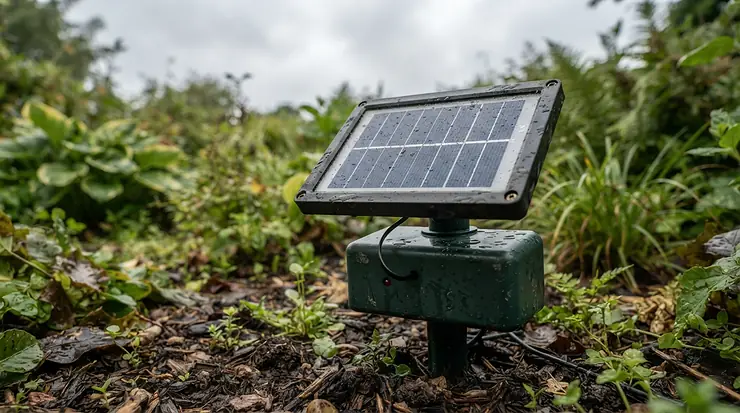
A solar mouse repeller for garden use is a stake-mounted, sun-charged device that emits ultrasonic pulses, ground vibrations, or both. The aim is to make a patch of outdoor space feel unwelcome to mice, rats, moles and other small animals. It needs no mains power, keeps working after dark on stored energy, and contains no poison. That is the pitch, anyway. Whether a solar mouse repeller for garden duty delivers is a more interesting question than most product pages admit.
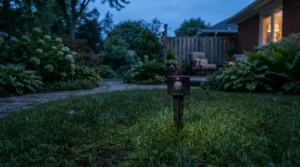
Here is the awkward truth up front. Independent pest-control sources and extension researchers keep finding little to no verified long-term effectiveness for ultrasonic rodent devices. Rodents can get used to a constant sound, and ultrasound is line-of-sight, so it does not bend round sheds or pass through dense planting. There is a wildlife angle too. Oxford researchers found that hedgehogs can hear ultrasound, which means a repeller aimed at mice is not necessarily aimed only at mice.
So this guide does not sell you a miracle. It shows you what seven real products offer on paper, what reviewers genuinely say, and where each one fits. We also cover the features that matter for a British garden: the weatherproof rating, battery backup for grey winters, and wildlife-safe frequencies. Some of these devices are sold mainly through garden retailers or seasonal supermarket ranges, so check the live amazon.co.uk listings for current availability before you buy.
Quick Comparison: Solar Mouse Repeller for Garden Options at a Glance
| Product | Main Method | Power | Best For |
|---|---|---|---|
| Broox Solar Animal Repellent | Ultrasound, alarm, LED | Solar + USB | Defined zones with cats and foxes |
| Cooper’s of Stortford Ultrasonic Pest Repeller Solar | Ultrasound + LED strobe | Solar + AA cells | Veg plots and flower beds |
| Green Gardener Solar Outdoor Pest Repeller | Ultrasound + LED | Solar + USB | Larger detection range |
| Velleman SON202S | 13.5–23.5 kHz ultrasound | Solar + 800 mAh cell | Wider open lawns |
| Parkside Solar Powered Animal Repellent | Ultrasound + light | Solar | Budget experimenting |
| Leaper Solar Ultrasonic Garden Rat Repeller | Ultrasound | Solar | Simple, no-fuss stake |
| Solar Powered Ultrasonic Rat Repeller 4-Pack (Octagonal) | Ground vibration + sound | Solar | Lawns with burrowing pests |
Looking at the comparison, the first three are motion-triggered models that suit a zone, such as a bed or a path. The last two are always-on stakes that suit burrowing animals. Weighing coverage against wildlife risk matters more than any single spec, and we unpack that below. Prices move constantly, so treat every figure in this article as an at-the-time-of-research range and check current prices.
💬 Just one click — help others make better buying decisions too!😊
Top 7 Solar Mouse Repeller for Garden Picks: Expert Analysis
1. Broox Solar Animal Repellent — widest-reaching motion-triggered option
The Broox Solar Animal Repellent stacks three deterrents into one stake: an ultrasonic pulse, an audible alarm and a flashing LED. The listing describes a 110° infrared sensor, a 20–25 ft (roughly 6–7.5 m) detection range and an IP65 claim. Power comes from a solar panel plus three NiMH cells, with a USB top-up as a fallback.
Motion triggering matters in practice. A unit that fires only when something wanders past is less likely to be ignored than one humming all night, and it spares your neighbours constant noise. IP65 means dust-tight and resistant to water jets, which is ample for a British downpour. Based on the spec comparison, it suits a bed, shed corner or bin store better than a whole lawn. The LED and alarm are aimed at larger visitors such as cats, foxes and squirrels more than mice. The listing also admits it won’t affect animals that can’t hear ultrasound, snakes included.
Reviewer sentiment is split. Independent roundups praise its versatility and the solar-plus-USB flexibility, while some buyers say it did not scare anything away. The listing we reviewed was an international one, so check the UK listing for the current model.
Pros:
- ✅ IP65 weatherproofing claim for wet British winters
- ✅ Solar charging with USB battery backup
- ✅ Motion-triggered, so less noise nuisance
Cons:
- ❌ Aimed more at cats and foxes than mice
- ❌ Mixed reviews on real-world results
Price was not verified at the time of research, so check the current price. Good value only if your problem is surface-roaming animals.
2. Cooper’s of Stortford Ultrasonic Pest Repeller Solar — easy-install bed protector with strobe
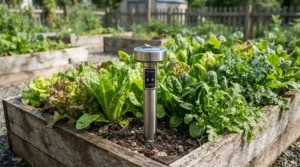
The Cooper’s of Stortford Ultrasonic Pest Repeller Solar is a motion-activated stake that detects movement within about 7 m across a 70° arc. It then fires a burst of high-frequency sound and a bright LED strobe. It can be wall-mounted or freestanding, stands about 41 cm tall with its ground stake, and ships with four rechargeable AA batteries.
The narrow 70° arc is a feature, not a flaw. A tight detection cone lets you aim at a vegetable bed while keeping the sound away from a hedge base or fence gap where hedgehogs often travel. The rechargeable AAs are a quiet advantage too, because they are standard cells you can replace in minutes rather than a sealed pack that ends the device’s life.
Review sentiment on the retailer’s own page averages around 3.8 out of 5 across more than 200 reviews. Buyers mostly describe cats, squirrels and foxes being kept out of beds, with a few reporting that wood pigeons stayed away. Reports about mice are far thinner, so treat it as a surface-pest tool first. We could not verify Amazon-specific review data for this listing.
Pros:
- ✅ Narrow 70° arc lets you aim precisely
- ✅ Standard AA cells are easy to replace
- ✅ Wall-mount or stake options
Cons:
- ❌ Few reviews mention mice specifically
- ❌ Only moderate average review score
Price not verified, so check the live listing. Fair value as a targeted bed-guard.
3. Green Gardener Solar Outdoor Pest Repeller — longest stated detection range
The Green Gardener Solar Outdoor Pest Repeller triggers when it senses movement up to 9 m away, releasing an ultrasonic burst while a flashing LED unsettles night-time visitors such as deer and badgers. It runs on solar charging, with an included USB cable for dull spells.
That 9 m figure is generous, and a sensible buyer treats stated ranges as best case. Ultrasound loses strength quickly in open air and gets absorbed by foliage, so expect the practical zone to be shorter than the headline number. What the longer sensor does give you is early triggering along a long path or the length of a fence. The USB cable is the practical star here. In a UK December, with only a few weak daylight hours, a solar charger alone will struggle, so a cable you can plug into a power bank is real battery backup.
The retailer’s reviews we found were uniformly positive, though they were a small number and sit on the seller’s own site, so they carry less weight than a large independent sample. None mentioned mice specifically.
Pros:
- ✅ Stated 9 m detection range
- ✅ USB cable for winter top-ups
- ✅ LED adds a visual deterrent
Cons:
- ❌ Small, seller-hosted review sample
- ❌ No verified mouse-specific results
Price not verified, so check the current price. A sensible mid-tier pick for long borders.
4. Velleman SON202S — wide coverage claim on a stake
The Velleman SON202S is a solar ultrasonic repeller with an 800 mAh rechargeable battery. It emits sound between 13.5 and 23.5 kHz and claims 120° dispersal over roughly 65 m². It includes a ground stake and targets mice, rats, cats, martens and birds.
The frequency range is the interesting detail. The upper part is firmly ultrasonic, but the lower end sits near the edge of what some younger people can hear, so children may notice faint noise nearby. The sweep helps against habituation, since a varied sound is harder to ignore than a single tone. Still, a 65 m² claim should be read cautiously. Coverage depends heavily on obstacles, and ultrasound will not wrap around a shed or dense shrubs.
We could not verify consumer reviews. The manufacturer’s own page lists it as a trade-oriented product that cannot be bought as a private individual, so availability for home gardeners depends on retailers that stock it. If you can’t find it for sale, that rules it out; it is not a reflection on performance.
Pros:
- ✅ Swept 13.5–23.5 kHz range
- ✅ Wide 120° dispersal angle
- ✅ Rechargeable cell avoids battery swaps
Cons:
- ❌ Consumer availability may be patchy
- ❌ No verifiable review data
Price not verified; check current listings. Worth considering only if you can buy it easily.
5. Parkside Solar Powered Animal Repellent — budget supermarket experiment
The Parkside Solar Powered Animal Repellent is the budget curiosity here. It has appeared in seasonal supermarket garden ranges and resale listings, marketed against dogs, cats, birds, rodents and foxes. A garden-forum user described five settings for pets, deer, rats and mice, plus a flashing light that triggers on movement.
Settings are the useful bit. A switch for target animal lets you choose a lower-impact mode instead of a one-size-fits-all blast. That said, the details we found came from a user post rather than a full spec sheet, so confirm the current model’s specs before buying. Because it appears seasonally, you may find it only in spring and summer, or via resale listings where condition and warranty are uncertain.
The sentiment we could find is anecdotal: one allotment user reported mice vanishing from a polytunnel and a rat run being abandoned. That is a single story, not a trend, and could easily reflect other factors.
Pros:
- ✅ Target-animal settings
- ✅ Light flashes on movement
- ✅ Usually priced for casual trials
Cons:
- ❌ Seasonal availability, resale risk
- ❌ Limited verifiable specs and reviews
Price varies by source, so check current prices. Best treated as a low-risk trial, not a long-term plan.
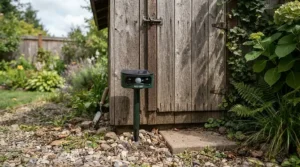
6. Leaper Solar Ultrasonic Garden Rat Repeller — no-fuss ABS stake
The Leaper Solar Ultrasonic Garden Rat Repeller is a simple solar stake in ABS plastic, measuring about 6.5 × 6.5 × 26.5 cm. It is marketed as waterproof for year-round outdoor use and as a deterrent for rats, moles, snakes and insects.
Simplicity is its appeal. With no motion sensor, strobe or settings, there is less to fail. The trade-off is that a constantly running device invites habituation, the very problem researchers highlight, and it will keep running whether or not an animal is nearby. The multi-species claim also deserves scepticism. A single ultrasonic output cannot be tuned to suit every animal, and snakes in particular are not known for responding to airborne ultrasound.
The listing gives no specific weatherproof rating, only the word waterproof, so I would not leave it somewhere that floods. We could not verify reviews for this model.
Pros:
- ✅ Compact, low-profile stake
- ✅ Few moving parts to fail
- ✅ Easy to blend into borders
Cons:
- ❌ No stated weatherproof rating
- ❌ Always-on sound invites habituation
Price not verified, so check the current price. Reasonable for a basic trial, with modest expectations.
7. Solar Powered Ultrasonic Rat Repeller 4-Pack (Octagonal) — vibration approach for burrowers
The Solar Powered Ultrasonic Rat Repeller 4-Pack (Octagonal) takes a different route. Each ABS unit vibrates and emits a sound roughly every 20 seconds, aiming to disturb animals at ground level, including moles. One retailer listing put the four-pack in the mid-£30s range at the time of research.
Sensible instructions come with it. The makers say compact soil conducts the signal better, advise testing your soil first, and suggest removing the units during heavy rain or flooding. That last point is a real limit for a British garden. A “rainproof” unit that must be pulled in during downpours is not a fit-and-forget device. Four units also give you flexibility, since burrowing animals often need coverage at several points along a lawn.
This is a mole-first design, so for mice it is more of a gamble. We could not verify reviews, and the listing’s copy contains some sloppy wording, so cross-check any final specs before buying.
Pros:
- ✅ Four units covers several lawn spots
- ✅ Targets ground-level burrowing animals
- ✅ Solar-charged, no batteries to buy
Cons:
- ❌ Must be removed in heavy rain
- ❌ Weaker case for above-ground mice
Mid-£30s for four at the time of research is fair value for moles and a weaker proposition for mice.
Top 7 Spec Comparison
| Product | Detection / Coverage (stated) | Weather Claim | Backup Power | Best For |
|---|---|---|---|---|
| Broox Solar Animal Repellent | 110°, 20–25 ft | IP65 | USB charge | Cats, foxes, squirrels |
| Cooper’s of Stortford Ultrasonic Pest Repeller Solar | 7 m, 70° | Not verified | Rechargeable AAs | Veg beds |
| Green Gardener Solar Outdoor Pest Repeller | Up to 9 m | Not verified | USB cable | Long borders |
| Velleman SON202S | 65 m², 120° | Not verified | 800 mAh cell | Open lawns |
| Parkside Solar Powered Animal Repellent | Not verified | Not verified | Not verified | Budget trial |
| Leaper Solar Ultrasonic Garden Rat Repeller | Not verified | “Waterproof” | Not verified | Basic stake |
| Solar Powered Ultrasonic Rat Repeller 4-Pack (Octagonal) | Ground vibration | Rainproof, remove in floods | None stated | Lawn burrowers |
The table makes the pattern clear: only the Broox Solar Animal Repellent states a recognised weatherproof rating, and only a few list a genuine backup power route. If you value transparency, that points you towards the Broox Solar Animal Repellent, the Cooper’s of Stortford Ultrasonic Pest Repeller Solar and the Green Gardener Solar Outdoor Pest Repeller. The Solar Powered Ultrasonic Rat Repeller 4-Pack (Octagonal) is the specialist for lawns, while the Parkside Solar Powered Animal Repellent and Leaper Solar Ultrasonic Garden Rat Repeller are low-commitment experiments.
How to Choose a Solar Mouse Repeller for Garden Use
Start with the animal. Surface-roaming mice, cats and foxes are a different job from moles under the lawn, so match the method before the model. Then run through these steps.
- Pick motion-triggered over always-on where you can. A sensor that fires only when something approaches is less likely to be ignored over weeks, and it limits unnecessary ultrasound in the garden.
- Check the detection angle, not just the range. A 70° arc lets you aim away from hedgehog routes, while 110° or 120° covers more but spills further.
- Look for a stated weatherproof rating. “Waterproof” is a marketing word; IP65 is a testable one. We cover this below.
- Confirm a battery backup route. USB charging or standard rechargeable AAs keep a unit alive through a gloomy British winter.
- Treat coverage claims as best case. Halve any stated range and plan for obstacles.
- Look for adjustable modes. Target-animal settings let you avoid blasting everything with the same sound.
- Consider wildlife first. If hedgehogs, bats or small pets use your garden, choose the narrowest detection zone you can find.
The best outdoor ultrasonic repeller is therefore the one you can aim precisely, power reliably and switch off easily, rather than the one with the biggest coverage number.
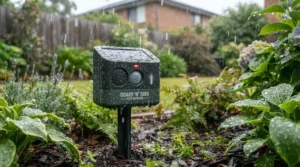
Does a Solar Mouse Repeller for Garden Use Really Work? Real-World Performance
Honest answer: sometimes, partly, and for a while. Pest-control firms and university extension researchers consistently report little to no verified long-term effect on rodents. The usual explanations are habituation, since animals get used to a repeated sound, and physics, since ultrasound is directional and absorbed by soft materials like foliage and soil. That is why a repeller placed behind a shed or buried in planting can seem to do nothing.
Yet reviewers do report wins, especially against cats, foxes and squirrels using motion-triggered, strobe-equipped models. Several buyers describe beans, beds and borders left alone after a unit went in. Part of that may be the visual flash rather than the ultrasound, and part may simply be a pest’s natural wandering. Careful buyers should read such stories as encouraging but not conclusive.
What does this mean for you? Think of any outdoor ultrasonic repeller as a nudge, not a barrier. It works best alongside food and shelter removal: tidy compost heaps, lidded bins, no spilled seed under the bird feeder, and cut-back clutter. If a pest has a reason to be there, a sound alone rarely changes its mind.
Solar Powered Pest Deterrent: Panels, Cells and Battery Backup
A solar powered pest deterrent has three moving parts: a small panel, a rechargeable cell, and electronics that draw from the cell. The weak link in Britain is not the electronics but the sunshine. In December a south-facing panel may see only a few weak hours of light, and a shaded stake may barely charge at all.
That is why battery backup deserves its own line on your checklist. The Broox Solar Animal Repellent and Green Gardener Solar Outdoor Pest Repeller offer USB top-ups. The Cooper’s of Stortford Ultrasonic Pest Repeller Solar uses ordinary rechargeable AAs that you can swap for charged spares. The Velleman SON202S has a small 800 mAh cell, and a smaller capacity means less cushioning when the weather turns.
A few practical habits help. Fully charge a new unit indoors before installing it. Remove any protective film from the panel. Keep the panel clear of leaves and bird droppings, and face it south if you can. For motion-triggered models, remember that every trigger spends charge, so a busy cat path will drain a battery faster than a quiet corner.
Weatherproof Rating: What It Really Means in a British Garden
A weatherproof rating tells you how well a device resists dust and water, and the code to look for is IP. The first digit covers solids and the second covers water. IP65 means dust-tight and protected against water jets, which handles heavy British rain. IPX4 handles splashes only. IP67 survives temporary immersion. Only the Broox Solar Animal Repellent states a rating in what we reviewed, and its IP65 claim is a reassuring one.
Everything else relies on the word “waterproof” or “rainproof”. The Leaper Solar Ultrasonic Garden Rat Repeller says waterproof for year-round use, and the Solar Powered Ultrasonic Rat Repeller 4-Pack (Octagonal) says rainproof but advises removal in heavy rain or flooding. Read that as a clear warning against putting it on a low, waterlogged lawn.
Winter adds extra stress beyond rain. Frost can crack cheap plastic, and condensation can creep into poorly sealed housings. If your garden is exposed or boggy, pay a little more for a stated rating, or mount units on a wall or post rather than at ground level.
Wildlife-Safe Frequencies: Protecting Hedgehogs, Bats and Pets
No frequency is truly “wildlife-safe” in the sense of only affecting pests, and anyone who claims otherwise is guessing. Dogs and cats hear well into the ultrasonic range, and small pets such as rabbits, guinea pigs and hamsters can find repeller noise stressful. Hedgehogs are the bigger worry, because Oxford research has shown they hear ultrasound. A Hedgehog Street volunteer reported watching a hog visibly flinch near a rat scarer and said that manufacturers are unlikely to test on hedgehogs, so there is no evidence they are unaffected. That is one account rather than a study, but it is a sensible caution.
So build safety into the way you use the device:
- Choose the narrowest detection arc, such as the 70° of the Cooper’s of Stortford Ultrasonic Pest Repeller Solar.
- Aim away from fence gaps, hedgehog highways, ponds and feeding stations.
- Keep units well away from roofs, eaves, bat boxes and mature trees.
- Switch off or remove the unit when you know hedgehogs are visiting, or if you feed them.
Broad-sweep models like the Velleman SON202S, which spans 13.5–23.5 kHz, are worth extra thought near wildlife. If a hedgehog-friendly garden is your priority, a physical solution such as sealing gaps and tidying food sources is kinder than any sound.
Safety and Legal Guide: Bats, Birds and Your Garden
There is a legal side that many buyers overlook. All UK bats and their roosts are protected under the Wildlife and Countryside Act 1981, and disturbing a bat at its roost is an offence. Specialist suppliers explicitly warn that using a sonic deterrent to disturb bats is a criminal offence in the UK and EU. Roosts stay protected even when the bats are not at home.
In practice, that means never pointing any repeller at a roof space, soffit, tree hole or bat box. If you suspect bats, do not try to deter them. Contact a specialist instead. Nesting birds are protected too, so avoid mounting units where they might disturb an active nest during spring.
A quick safety checklist is worth keeping: keep devices out of children’s reach, because the stakes and panels can be fiddly; avoid placing them near ponds where wet hands meet electronics; and never open a sealed unit to replace cells unless the manufacturer says you may.
Outdoor Ultrasonic Repeller vs Traps, Barriers and Other Garden Rodent Control
Garden rodent control is a toolbox, not a single product. Each tool solves a different part of the problem.
| Method | Effort | Wildlife Risk | Evidence | Best For |
|---|---|---|---|---|
| Solar ultrasonic stake (e.g. Broox Solar Animal Repellent) | Low | Moderate: affects hedgehogs and bats | Weak for rodents | Aimed zones |
| Mains outdoor unit (e.g. Yard Guard Outdoor Ultrasonic Pest Repeller, over £100) | Medium | Moderate | Weak for rodents | Fixed, concentrated areas |
| Sealing and tidying | Medium | Low | Strong | Preventing entry |
| Snap or enclosed traps | Medium | Depends on set-up | Strong | Active infestations |
| Professional pest control | Low | Managed | Strong | Persistent rat problems |
Reading across the table, the solar devices win on convenience and cost but lose on evidence. Sealing gaps, removing food and using properly placed traps remain the most reliable garden rodent control. A mains-powered unit like the Yard Guard Outdoor Ultrasonic Pest Repeller states a speaker range of 8–10 m and an oval pattern about 7.5 m wide. It shares the same limits: ultrasound is line-of-sight, so complex layouts need several speakers.
If you have a genuine rat problem, such as droppings, gnawing or burrows near the house, a repeller is not the answer. Call a professional.
Practical Guide: Setting Up and Maintaining Your Repeller
A good set-up costs nothing and improves your odds more than any upgrade.
Week one: install smartly.
- Charge the unit fully, preferably indoors by USB or in a bright window.
- Choose a spot with several hours of direct sun and a clear view of the path you want to cover.
- Push the stake in so the sensor faces the approach route, around 20–30 cm above ground for mice-sized targets.
- Keep the sensor away from swaying branches, which can cause constant false triggers and flatten the battery.
Month one: watch and adjust.
- Move the unit every couple of weeks to slow habituation.
- Check the panel for dirt and wipe it.
- Note whether activity changes, and look for hedgehog or bat activity near the device. If you see it, move or remove the unit.
Autumn and winter: protect and back up.
- Bring the unit in during storms, hard frost or flooding.
- Use the USB or spare-cell route to top up when sunshine is scarce.
- Store NiMH cells charged, since they self-discharge, and replace them if run-times shrink noticeably.
Common first-month mistakes. Aiming at a wall, burying the sensor in plants, and leaving a protective film on the panel are the big three. Fix those before blaming the product.
Real-World Scenarios: Which Repeller for Which Garden
Scenarios help translate specs into decisions. These are illustrative profiles built from the specs above, not testimonials.
The allotment holder with a polytunnel. Mice are nibbling seedlings. A motion-triggered stake with a narrow arc, such as the Cooper’s of Stortford Ultrasonic Pest Repeller Solar, can sit at the tunnel’s entrance. Pair it with sealed seed trays and a snap trap inside the tunnel.
The family garden with cats on the lawn. Neighbourhood cats keep using the beds. The Broox Solar Animal Repellent or Green Gardener Solar Outdoor Pest Repeller can cover the border, with the sensor aimed at the usual entry route. Check that small pets and children are kept clear.
The hedgehog-friendly garden. Hedgehogs visit nightly through a fence gap. Here the answer is probably no ultrasonic device at all. Seal food sources and rely on physical barriers.
The lawn with molehills. A cluster like the Solar Powered Ultrasonic Rat Repeller 4-Pack (Octagonal) spreads vibration points across the turf, though you should lift them in heavy rain.
The budget tester. Curious but sceptical, a low-cost Parkside Solar Powered Animal Repellent or Leaper Solar Ultrasonic Garden Rat Repeller lets you test the idea cheaply. If you’re unsure about wildlife near your plot, the Bat Conservation Trust can advise on bats before you install anything.
Long-Term Cost and Maintenance
Running costs are almost nil, which is the real selling point. There are no refills, no poison and no mains bills. The ongoing cost is replacement of rechargeable cells, which typically wear out after a few seasons, and the occasional replacement of a unit whose plastic has been battered by frost or sun.
Think in terms of cost per season. A modest-priced unit that lasts three summers and protects one bed is a very cheap experiment. A four-pack like the Solar Powered Ultrasonic Rat Repeller 4-Pack (Octagonal) at around the mid-£30s works out at roughly £9 per stake. A premium mains unit such as the Yard Guard Outdoor Ultrasonic Pest Repeller at over £100 needs a much longer horizon to justify itself, particularly given the weak evidence for rodents.
The best value habit is the least glamorous: check cells yearly, wipe panels, and store the unit indoors over deep winter. A cheap device kept dry and charged often outlasts an expensive one left to rot.
FAQ
❓ Does a solar mouse repeller for garden use keep working in winter?
❓ Can an outdoor ultrasonic repeller harm hedgehogs or pets?
❓ How many repellers do I need for a small garden?
❓ Is it legal to use ultrasonic deterrents near bats?
❓ Will a repeller work if I have a real rat problem?
Conclusion
A solar mouse repeller for garden duty is best understood as a low-cost, low-effort nudge rather than a cure. The evidence for ultrasound against rodents is thin, habituation is real, and wildlife such as hedgehogs and bats deserves a careful hearing before you flip the switch. That does not make these devices pointless. Motion-triggered models with strobes appear to help with cats, foxes and squirrels, and a solar powered pest deterrent costs almost nothing to run.
If you want one safe starting point, the Broox Solar Animal Repellent pairs a stated IP65 rating with USB battery backup. The Cooper’s of Stortford Ultrasonic Pest Repeller Solar is the most controllable thanks to its 70° arc and standard AA cells. The Green Gardener Solar Outdoor Pest Repeller suits long borders, and the Solar Powered Ultrasonic Rat Repeller 4-Pack (Octagonal) is the specialist for lawns. The Velleman SON202S, Parkside Solar Powered Animal Repellent and Leaper Solar Ultrasonic Garden Rat Repeller are worth a look if availability and price suit you.
Whatever you choose, combine it with proper garden rodent control: seal, tidy, trap where needed, and keep wildlife in mind.
✨ Ready to Protect Your Plot?
🔍 Check current prices on your favourite pick, aim it carefully and give your garden the best chance of staying pest-free this year! 🌱
Recommended for You
- Mouse Repellent For Kitchen: 7 Best Picks For UK Homes (2026)
- Mouse Repellent For Loft: 7 Best Picks That Help (2026)
- Plug In Mouse Repeller: 7 Honest Picks For UK Homes (2026)
Disclaimer: This article contains affiliate links. As an Amazon Associate, I earn from qualifying purchases. If you purchase products through these links, we may earn a small commission at no additional cost to you.
✨ Found this helpful? Share it with your friends! 💬🤗
