
In This Article
There’s a very specific kind of dread that comes with hearing a scratch behind the skirting board at 2am. You lie there, doing the maths on how many mice that scratching might represent, and by the time the kettle’s boiled in the morning you’ve decided: something needs to happen, but you’d rather not have blood on your hands about it. That’s the whole appeal of humane mouse traps for home use — you get your kitchen back without turning bedtime into a horror film. This guide walks through genuinely available options on amazon.co.uk, from simple single-catch boxes to cages built for a proper multi-mouse capture job, all researched against real specifications and real aggregated review sentiment rather than marketing fluff.
So, what is a humane mouse trap? It’s a live-capture device — usually a small box or cage — designed to hold a mouse unharmed after it takes the bait, so you can release it outdoors rather than kill it. No snap, no glue, no poison; the mouse walks in, a door closes behind it, and the rest is up to you. It’s the mechanism behind every catch and release mouse trap on the market, and it’s exactly what makes this approach different from the traditional spring trap sat in your nan’s shed. According to the RSPCA’s living-with-rodents advice, Britain is home to several native mouse species alongside the common house mouse, which is worth bearing in mind before assuming every visitor is a pest rather than passing wildlife.
We’ve dug into seven real products, cross-referenced their specs against genuine buyer feedback, and built in the RSPCA guidance UK households actually need to use these traps responsibly — because a humane trap left unchecked for three days isn’t humane at all. Let’s get into it.
Quick Comparison Table
| Product | Type | Capacity | Best For |
|---|---|---|---|
| Pest-Stop Trip-Trap | Single-catch, see-through | 1 mouse | Budget starter trap |
| Pest-Stop Multi Catch Metal Trap | Multi-catch, galvanised steel | Up to 10 mice | Serious multi-mouse capture |
| ROSHIELD Humane Mouse Trap 2-Pack | Single-catch, dual door | 1 mouse each | Families wanting inspection windows |
| Kensizer Small Animal Humane Live Cage | Wire-mesh cage trap | 1 mouse | Outdoor sheds and garages |
| The Big Cheese Live Catch Mouse Trap | Ready-baited plastic tip trap | 1 mouse | No-touch, zero-setup convenience |
| The Big Cheese Rat Cage Trap STV075 | Heavy-duty cage trap | Up to 5 rodents | Mixed rat and mouse problems |
| The Big Cheese Live Multi-Catch Mouse Trap | Multi-catch, walk-through | Multiple mice | Persistent infestations |
Looking at the spread here, the pattern is fairly obvious once you see it laid out: single-catch traps are cheaper and easier for a light, one-or-two-mouse problem, while multi-catch designs earn their higher price by letting you walk away for a day or two without needing to check constantly. If you’re not sure how bad your infestation actually is, starting with two single-catch traps and one multi-catch model gives you a reasonable spread without overcommitting. Anyone with a confirmed nest, though, should skip straight to a multi-mouse capture trap — you’ll thank yourself in a week.
💬 Found a trap that fits your situation? Tap through to check today’s availability before you decide..🤗
Top 7 Humane Mouse Traps for Home Use: Expert Analysis
1. Pest-Stop Trip-Trap — cheapest reliable entry point
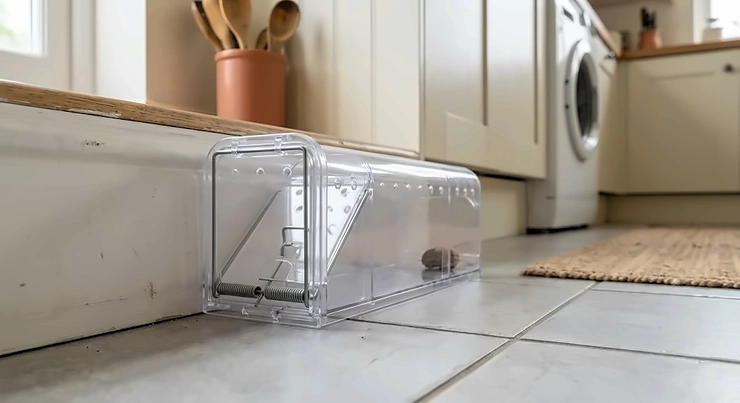
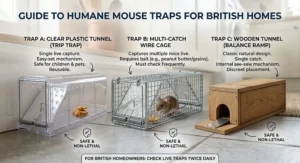
British-designed and about as no-nonsense as humane trapping gets, the Pest-Stop Trip-Trap is a small clear-plastic box that mice walk into and simply can’t walk back out of. Measuring around 180mm x 55mm x 50mm, it’s compact enough to slide behind a fridge or under a kickboard, and the see-through construction means you can check occupancy at a glance instead of picking the thing up and shaking it (please don’t do that).
On paper this is about as basic as catch and release mouse traps get, and that’s precisely the point — there’s no bait station gimmick, no electronics, nothing to misfire. The trigger plate sits at the far end so a mouse has to fully commit to reach it, which cuts down on the “grabbed the bait and legged it” problem that plagues cheaper designs. Reviewers consistently report that the ventilation holes are generous enough that a mouse left overnight isn’t gasping by morning, though several buyers note the trigger can feel a touch sensitive in cold weather when the plastic contracts slightly.
Based on the spec comparison with pricier cage traps, this is squarely a beginner’s tool — ideal if you’ve spotted one or two mice and want to solve the problem before it becomes an infestation. What most buyers overlook is that the small size actually works in its favour indoors: it fits spaces a big wire cage never will.
Pros:
- ✅ Compact enough for tight indoor gaps
- ✅ Clear plastic makes checking effortless
- ✅ Genuinely cheap way to start trapping
Cons:
- ❌ Single-catch only, so it needs frequent resetting
- ❌ Trigger sensitivity can vary in cold conditions
Priced in the low-single-figures per trap when bought in multipacks, this sits at the budget end of the market — solid value if you’re testing the waters before investing in something bigger.
2. Pest-Stop Multi Catch Metal Trap — best for multi-mouse capture
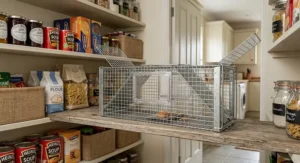
If your problem is bigger than “the odd visitor,” the Pest-Stop Multi Catch Metal Trap is where the maths starts working in your favour. Built from galvanised steel rather than plastic, it’s rated to hold up to ten mice in a single setting before you need to empty it — a genuinely useful spec if you suspect a breeding nest rather than a lone wanderer.
The mechanism uses a see-saw treadle design: a mouse walks up a ramp toward the bait, its weight tips the platform, and it drops into a holding chamber it can’t climb back out of, while the ramp resets itself for the next one. That’s a meaningful upgrade over single-catch boxes because it means one trap can quietly do the work of several overnight, which matters enormously if you’re not keen on checking traps every couple of hours. Reviewers consistently flag the galvanised build as noticeably sturdier than the plastic alternatives, with several long-term owners reporting years of reuse without rust or warping.
Here’s what to weigh before buying: multi-catch traps like this one only stay humane if you check them at least once daily, ideally morning and evening, because a chamber holding several mice with no food or water becomes stressful fast — this is precisely the RSPCA guidance point about live-trap welfare depending on checking frequency, not just design.
Pros:
- ✅ Holds up to ten mice per setting
- ✅ Durable galvanised steel construction
- ✅ Genuinely suited to real infestations
Cons:
- ❌ Costs noticeably more than single-catch boxes
- ❌ Needs strict twice-daily checking to stay humane
Expect to pay in the mid-teens to low-twenties in pounds for this one — steep next to a basic trap, but the per-mouse cost drops fast if you’re dealing with a genuine nest rather than a stray.
3. ROSHIELD Humane Mouse Trap 2-Pack — best inspection window design
The ROSHIELD Humane Mouse Trap 2-Pack leans into a detail a lot of competitors skip: a transparent inspection window that lets you glance at a trap without touching it. Sold as a pair with a live catch and release mechanism, ROSHIELD markets it as suitable for both indoor and outdoor use, with the brand describing the trap as safe around children and pets.
What that inspection window actually buys you, in practical terms, is fewer unnecessary disturbances. Every time you lift a lid or shake a box to check for a catch, you’re adding stress to a mouse that might already be inside — a window lets you check from a distance instead. The dual-door design several buyers describe also reduces the chance of a mouse getting its tail caught on the way in, a small but genuine welfare detail that separates a well-designed catch and release trap from a crude one.
Aggregated buyer sentiment around ROSHIELD’s humane range skews positive on ease of setup, with the reusable, wash-and-reset design coming up repeatedly as a selling point over disposable alternatives; a smaller number of reviews mention that very cautious mice can take a night or two longer to trigger the door than expected.
Pros:
- ✅ Inspection window reduces unnecessary handling
- ✅ Sold as a pair for better indoor coverage
- ✅ Reusable and simple to wash between catches
Cons:
- ❌ Cautious mice may take longer to trigger it
- ❌ Two traps may not be enough for a bigger problem
At around £10-£18 for the pair depending on the listing, this sits comfortably in the mid-budget range — a sensible pick for anyone wanting two traps working in tandem across a kitchen and utility room.
4. Kensizer Small Animal Humane Live Cage — best for sheds, garages and outbuildings
Where plastic box traps are built for tucking into a kitchen corner, the Kensizer Small Animal Humane Live Cage is built for rougher environments. It’s a wire-mesh cage roughly 12 inches long, with a pedal-trigger mechanism at floor level and a door that auto-locks the instant the trigger is pressed — no gravity-tip mechanism to fail, no partial closures.
The galvanised wire construction is the standout feature here: rather than a chewable plastic shell, it’s fine-gauge metal mesh that Kensizer states won’t be easily gnawed through, which matters if a trap is going to sit in a shed overnight where a determined mouse has hours to work at it. Based on the spec comparison with the plastic traps on this list, that toughness comes at the cost of bulk — this is a noticeably larger, heavier trap that’s harder to hide indoors but easier to see and manage outdoors.
Reviewers consistently note the trigger as genuinely sensitive once bait is correctly placed on the treadle rather than dangling loose, with several buyer accounts describing successful first-night catches; a recurring complaint is that bait wedged under the plate rather than on it can prevent the trap from firing at all, so careful baiting really does matter here.
Pros:
- ✅ Rugged galvanised mesh resists chewing
- ✅ Reliable pedal-trigger, auto-locking door
- ✅ Well suited to sheds, garages and outbuildings
Cons:
- ❌ Too bulky for most indoor gaps
- ❌ Incorrect bait placement can stop it triggering
Typically priced in the mid-to-high teens in pounds, it’s a fair-value pick specifically for anyone whose mouse problem lives outside the house rather than in it.
5. The Big Cheese Live Catch Mouse Trap — best no-touch, ready-baited option
For anyone who wants trapping to require the absolute minimum effort, The Big Cheese Live Catch Mouse Trap ships pre-baited and ready to place straight out of the packet — no fiddling with peanut butter, no touching anything remotely mouse-related until it’s time to release. It’s a simple plastic tip-trap: the mouse enters to reach the bait, its weight tips the unit, and the door swings shut behind it.
The mechanism’s real selling point is the release process — you simply tip the trap away from you and lift the door, so the mouse exits under its own steam and you never make contact with it at any stage. That’s a genuine design win over cage traps that require you to physically open and hold a door while a frightened mouse decides whether to leave. The Big Cheese sells a separate “Fresh ‘n Tasty” attractant for reuse once the pre-loaded bait is spent, which extends the trap’s working life well past the first catch.
What most buyers overlook is how much this trap depends on that pre-baited freshness for its first-use success rate — aggregated review sentiment is broadly positive on first catches, though a portion of buyers note that after several resets without fresh attractant, catch rates noticeably drop, which tracks with how scent-driven mouse foraging behaviour actually works.
Pros:
- ✅ Arrives ready-baited, zero setup needed
- ✅ Genuinely no-touch release mechanism
- ✅ Reusable with optional attractant refills
Cons:
- ❌ Catch rate drops without fresh attractant
- ❌ Plastic build is less durable than metal cages
Sitting in the budget-to-mid range, usually a few pounds per trap in multipacks, it’s excellent value for anyone who wants trapping to feel closer to “set and forget” than “DIY project.”
6. The Big Cheese Rat Cage Trap (STV075) — best for mixed rat and mouse activity
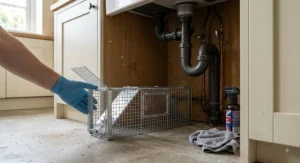
Slightly oversized for pure mouse duty, The Big Cheese Rat Cage Trap STV075 earns its place here because plenty of UK households dealing with “mice” behind the shed discover, on closer inspection, they’ve actually got a rat problem too — and this cage trap handles both. At 36cm x 14cm x 16cm with a galvanised mesh body, it’s rated to capture up to five rodents in a single setting.
The spring-loaded door is the mechanical upgrade over gravity-tip designs: rather than relying on weight alone to swing a door shut, a tensioned setting arm snaps the door closed the instant the treadle triggers, which The Big Cheese states delivers a noticeably faster, more reliable capture than older gravity-led cage designs. Practically speaking, that means fewer “nearly caught it” misses where a lighter mouse doesn’t generate enough tip-weight to fully close a door.
Aggregated reviewer feedback describes the trap as reliable once you understand the slightly fiddly initial setting process — several buyers note it takes a go or two to get the arm-and-treadle tension right, but that afterward, resetting becomes second nature. The solid top and carrier handle also come up repeatedly as genuinely useful for safely transporting a captured animal to a release site without needing to touch the cage itself.
Pros:
- ✅ Handles both rats and mice in one trap
- ✅ Spring-loaded door beats gravity-tip designs
- ✅ Carrier handle makes transport straightforward
Cons:
- ❌ Fiddly to set correctly the first few times
- ❌ Overkill if you only have mice, not rats
At around £25-£35, it’s the priciest single unit on this list, but justified if your problem spans more than one species of unwelcome houseguest.
7. The Big Cheese Live Multi-Catch Mouse Trap — best for persistent, ongoing infestations
Closing out the list, The Big Cheese Live Multi-Catch Mouse Trap is built on the same walk-through principle as the Pest-Stop multi-catch model but in The Big Cheese’s poison-free, catch-alive range, aimed squarely at households with a persistent rather than occasional mouse presence. It uses a pre-loaded attractant to lure mice through a one-way entrance, allowing repeated catches before the trap needs emptying.
The practical case for a multi-catch unit like this one is straightforward arithmetic: if you’re catching one mouse a night with a single-catch trap, you’re resetting it daily indefinitely; a multi-catch trap absorbs several nights’ worth of activity into one holding chamber, which suits anyone managing an active infestation rather than a one-off intruder. Based on the spec comparison with The Big Cheese’s single-catch models, the trade-off is that this unit is bulkier and needs a dedicated spot rather than squeezing into a tight gap.
Reviewers consistently mention the poison-free attractant as effective at pulling in repeat visitors over several nights, with a recurring theme in feedback being that households with confirmed nests see the fastest results because there’s simply a higher local mouse population to intercept.
Pros:
- ✅ Captures multiple mice before resetting
- ✅ Poison-free attractant genuinely draws repeat catches
- ✅ Suited to active, ongoing infestations
Cons:
- ❌ Bulkier footprint than single-catch traps
- ❌ Still needs daily checking for welfare reasons
Mid-range pricing, typically in the high-teens to low-twenties in pounds, makes this a sensible step up once you’ve confirmed your one-mouse problem is actually a colony.
How to Choose a Humane Mouse Trap
- Estimate the scale of the problem first. One dropping a week suggests a single visitor; droppings in multiple rooms, or scratching at night from more than one direction, points to a nest — and a nest calls for multi-mouse capture, not a single box.
- Match the environment to the build material. Plastic traps are quieter and easier to hide indoors; galvanised steel cages survive damp sheds and determined chewing far better outdoors.
- Check the release mechanism before buying, not after. No-touch tip-and-release designs suit anyone squeamish about contact; cage traps with carrier handles suit anyone relocating an animal some distance away.
- Think about checking frequency honestly. A multi-catch trap you can’t realistically check twice a day isn’t the humane choice it looks like on paper — a single-catch trap you’ll actually check regularly often serves the mouse better.
- Factor in reusability. Ready-baited disposables are convenient but need refill attractant to stay effective; reusable cages cost more upfront but work out cheaper across a whole season.
- Consider pets and children in the house. Look for traps explicitly marketed as pet- and child-safe, and always site them out of reach of curious paws regardless of the marketing claims.
- Don’t ignore the exclusion side of the problem. A trap without sealed entry points is a temporary fix — plan to block gaps once trapping is under way, not after.
Practical Usage Guide: Setting Up Your Trap Correctly
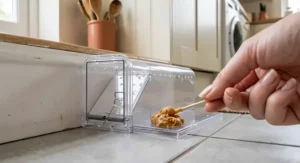
Getting a humane trap right in the first 48 hours makes a genuine difference to your success rate. Start by placing traps along walls rather than in open floor space — mice navigate by keeping a paw or whisker in contact with a surface, so a trap sat in the middle of a room is far less likely to be found than one tucked at right angles to a skirting board. Bait with something strong-smelling but hard to steal in one bite: a small dab of peanut butter or chocolate spread pressed directly onto the trigger plate works better than a loose piece of food a mouse can grab and run with.
For the first few nights, resist the urge to move traps around if nothing’s happened — mice are naturally cautious of new objects in familiar spaces, and it can take two or three nights before they trust an unfamiliar trap enough to fully enter it. Check every trap at least once a day, ideally at the same time morning and evening, and always wear gloves when handling a set or occupied trap, both to protect yourself from disease transmission and to avoid leaving a strong human scent that can make mice more wary of the trap next time. Clean reusable traps with hot soapy water between catches rather than just wiping them, since residual scent from a previous capture can either attract or deter the next visitor depending on the trap type.
A common first-month mistake is under-baiting multiple traps at once rather than concentrating effort — three well-baited traps along a single confirmed route will consistently outperform six traps scattered on a hunch.
Releasing Mice Safely: What the Evidence Actually Says
This is the section that catches a lot of well-meaning trappers off guard, so it’s worth being straightforward about it. Release timing and location matter more than most people assume. Release rodents at dawn or dusk when it’s quieter, and give the animal space to leave the trap on its own rather than tipping it out forcibly. Relocating well away from the original site — commonly cited as at least a mile — reduces the chance of the same mouse finding its way straight back in through the gap it originally used.
There’s a harder truth worth acknowledging honestly rather than glossing over: available research on relocated small mammals suggests survival rates in unfamiliar territory are often disappointingly low, meaning release isn’t automatically the kinder outcome it feels like. That doesn’t make catch and release traps the wrong choice — most UK households aren’t weighing “humane trap versus professional culling,” they’re weighing “humane trap versus doing nothing,” and for that comparison, a well-managed live trap is unambiguously the better welfare outcome. But it does mean the responsible approach is to release close to natural cover (hedgerows, woodland edges, away from roads) rather than an arbitrary “far enough” spot, and to release promptly rather than let an animal sit trapped for hours while you find the perfect location.
One detail specific to nursing females is worth knowing, courtesy of Humane Wildlife Solutions’ trapping guidance: if a trapped rodent appears to be lactating, it’s generally best to release it back at the exact point of capture, since removing a nursing mother elsewhere just leaves her young to starve inside your property — an outcome nobody’s aiming for.
📍 Ready to sort your mouse problem properly? Check current availability on the traps above before your next trip out.🤗

Common Mistakes When Buying Humane Mouse Traps
Plenty of first-time buyers reach for the cheapest single trap on the page and assume the job’s done — then wonder why mice keep reappearing. The most common misstep is buying one trap for what’s actually a multi-mouse problem; a single trap resets nightly at best, while an active nest can produce activity faster than one box can keep up with. A close second is ignoring build material for the environment: a plastic trap left in a damp shed over winter can warp or crack, while a metal cage indoors can feel unnecessarily bulky and intrusive.
Another frequent error is skipping the “check daily” commitment before buying a multi-catch trap — it’s genuinely humane only if someone’s actually checking it, and a trap that gets forgotten for three days stops being the kind option. Finally, a lot of buyers underestimate how much bait placement affects trigger reliability; food placed loosely rather than directly on the treadle is the single biggest cause of “the mouse ate the bait and the trap never went off” complaints across nearly every brand on this list.
Real-World Scenario: Matching the Trap to Your Situation
The renter with one shy visitor. You’ve seen a single mouse dart across the kitchen floor once, late at night, and nothing since. A Pest-Stop Trip-Trap or The Big Cheese Live Catch Mouse Trap is proportionate here — cheap, easy to hide, no commitment to a bulky cage sitting out in a rented flat.
The family with a confirmed nest in the loft. Scratching from multiple directions, droppings in more than one room, and the odd nibbled food packet all point to an established population. This calls for a Pest-Stop Multi Catch Metal Trap or The Big Cheese Live Multi-Catch Mouse Trap, run alongside a proper daily-checking routine and, ideally, entry-point sealing done in parallel.
The homeowner with a shed or garage problem that’s spread to rats. Outdoor structures, especially near compost or bird feed, often escalate past mice. Here, The Big Cheese Rat Cage Trap STV075 covers both species in one device, while a Kensizer Small Animal Humane Live Cage placed near suspected entry points adds outdoor coverage without dragging metal cages through the house.
Benefits vs Traditional (Lethal) Alternatives
| Factor | Humane Live Traps | Snap Traps | Poison Bait |
|---|---|---|---|
| Welfare outcome | Live capture, releasable | Instant if well-designed | Slow, often days |
| Child/pet safety | Generally high | Moderate (finger/paw risk) | Poor (secondary poisoning risk) |
| Effort required | Daily checking essential | Low, check periodically | Low, but carcass search needed |
| Reusability | High, wash and reset | High | Single-use bait |
| Best For | Households wanting no-kill control | Fast, hands-off single catches | Severe infestations, professional use |
The trade-off here is really about effort versus outcome rather than one method being simply “better.” A well-checked live trap gives you a genuinely no-kill result but demands daily attention; poison, by contrast, needs almost no ongoing effort but comes with real secondary poisoning risk to pets, foxes and birds of prey that eat affected rodents, which is precisely why UK wildlife charities have been steering households toward humane deterrents and traps over poison as the more responsible default.
Long-Term Cost & Maintenance
A single-catch plastic trap costs very little upfront but, across a persistent infestation, needs replacing or intensively cleaning more often, since repeated resets wear down triggers and hinges. A galvanised multi-catch cage costs more initially — often three to five times the price of a basic box — but with proper washing between uses, several buyer accounts describe years of reliable service, meaning the effective cost-per-catch drops sharply over a full trapping season. If you’re dealing with an ongoing, recurring mouse presence (a common issue in older UK terraced housing with historic gaps around pipework), it’s genuinely more economical to invest once in a durable multi-catch cage than to keep replacing cheap single-catch boxes every few months.
Maintenance itself is minimal either way: hot soapy water, a thorough dry, and fresh bait before each reset. The main hidden cost is the deterrent side of the equation — sealant, wire wool for gaps, and time spent proofing entry points — which, done properly once, saves considerably more in repeat trap purchases than most people expect.
Safety, Regulations and Welfare Guidance
UK law and welfare best practice both shape how you should use any mouse trap, humane or otherwise. Glue traps deserve a specific mention here: it remains legal for retailers to sell them to the public, but according to the RSPCA’s wildlife deterrents guidance, their use by members of the public is restricted, with professional pest controllers only permitted to use them under specific licensed circumstances — a strong signal about how seriously animal welfare bodies treat prolonged-suffering trap types compared with the humane cage and box traps covered in this guide.
For live traps specifically, welfare guidance is consistent on a few points worth repeating: check traps at least once daily (twice for multi-catch models), never leave a trapped animal without checking overnight, and release promptly rather than transporting an occupied trap around for hours. If you find a trapped rodent that appears sick, injured, or too young to be independent, the RSPCA’s general position is not to attempt DIY care but to seek advice, since wild rodents have very different needs from pet mice and require specialist handling for the best chance of a successful release.
For further reading on your legal position and wider wildlife welfare standards, the RSPCA’s wildlife advice pages are a genuinely useful UK-specific reference, as is the British Pest Control Association’s pest advice hub for anyone wanting professional-standard guidance on identification and control methods beyond trapping alone.
Features That Actually Matter (And Those That Don’t)
Marketing copy on mouse traps loves to lean on words like “professional grade” and “military strength,” most of which tell you very little. What actually matters: trigger sensitivity calibrated for a mouse’s genuine weight (too stiff and it won’t fire; too loose and false triggers waste your bait), a door mechanism that locks rather than just closes (a door that can be nudged back open defeats the entire purpose), and ventilation holes sized to keep a captured animal comfortable, not just decorative slots.
What matters far less than the marketing suggests: colour (mice don’t care if their trap is blue or grey), branded “attractant scent” claims when plain peanut butter performs just as well according to most aggregated reviewer experience, and inflated capacity claims on multi-catch traps that assume perfect conditions rarely replicated in a real kitchen. If you’re comparing two similarly priced traps, spend your attention on the trigger mechanism and door lock, not the packaging claims.
Problem → Solution: Common Trapping Issues
Problem: The trap’s been out for three nights with no catch. Solution: check bait placement — food should sit directly on or beside the trigger, never loose where it can be grabbed without setting off the mechanism. Try relocating along a different wall route before assuming the trap itself is faulty.
Problem: The mouse escaped after being caught. Solution: this is almost always a door-seal issue rather than mouse cunning — inspect for warped plastic or a bent mesh gap large enough to squeeze through, and consider stepping up to a metal cage design like the Kensizer Small Animal Humane Live Cage if it recurs.
Problem: You’re catching the same mouse repeatedly near the same spot. Solution: you’re likely releasing too close to the original entry point. Relocate further away and prioritise sealing that specific gap immediately, since it’s clearly an active route.
Problem: Bait keeps disappearing without triggering the trap. Solution: switch to a stickier bait like peanut butter rather than loose seeds or nuts, and press it firmly onto the trigger rather than balancing it on top.
Buyer’s Decision Framework
If you’ve spotted one mouse and no droppings elsewhere, choose a single-catch box trap because the problem is likely isolated and doesn’t justify a bigger investment. If you’re hearing activity from multiple rooms or finding droppings in more than one location, choose a multi-catch cage because you’re very likely dealing with an established population rather than a lone visitor. If the trap needs to survive outdoors in a shed or garage, choose galvanised metal over plastic because chew-resistance and weatherproofing matter more there than indoors. If you can’t commit to checking a trap daily, choose the lowest-maintenance no-touch tip-trap design rather than a multi-catch cage, because welfare depends on checking frequency as much as trap design.
✨ Don’t Miss These Exclusive Deals!
🔍 Take your pest control approach to the next level with these carefully selected humane traps. Click through to check current pricing and availability on amazon.co.uk — a straightforward, no-kill fix your whole household can feel good about.
FAQ
❓ Are humane mouse traps as effective as snap traps?
❓ How often should I check a live mouse trap?
❓ What's the best bait for a catch and release mouse trap?
❓ Can I release a mouse in my own garden?
❓ Are multi-mouse capture traps humane if I can't check them daily?
Conclusion
Humane mouse traps for home use aren’t a single product so much as a spectrum — from a cheap single-catch box that solves a one-off visitor problem, right through to a galvanised multi-catch cage built for an established nest. What separates a genuinely good outcome from a frustrating one usually isn’t the specific trap you buy, it’s whether you match the trap to the actual scale of your problem and commit to checking it properly. The Pest-Stop Trip-Trap and The Big Cheese Live Catch Mouse Trap cover the light end of that spectrum well; the Pest-Stop Multi Catch Metal Trap and The Big Cheese Live Multi-Catch Mouse Trap handle the heavier end; and the Kensizer Small Animal Humane Live Cage and The Big Cheese Rat Cage Trap STV075 fill in the outdoor and mixed-rodent gaps in between.
Whichever you choose, the RSPCA guidance is consistent and worth holding onto: check often, release promptly and thoughtfully, and pair trapping with sealing up the gaps that let mice in to begin with. Do that, and you’ve got a genuinely humane, genuinely effective solution — no drama at 2am required.
Recommended for You
- Snap Traps vs Humane Mouse Traps: 7 Honest UK Picks (2026)
- Best Mouse Traps UK 2026: 7 Proven Picks That Actually Work
- 7 Best Mouse Traps Under £20 in 2026: Real Budget Picks
Disclaimer: This article contains affiliate links. As an Amazon Associate, I earn from qualifying purchases. If you purchase products through these links, we may earn a small commission at no additional cost to you.
✨ Found this helpful? Share it with your friends! 💬🤗
