
In This Article
Rats do not knock. They turn up in the loft, the compost bin, or that gap behind the shed you swore you’d fill in three summers ago, and suddenly you’re standing in the garden centre aisle wondering which little wax brick is going to sort the problem out. Here’s the short version: how to use rat bait blocks safely comes down to three things — the right product, the right tamper-resistant station, and the right placement, checked regularly until the job’s done. Get any one of those wrong and you’re not just risking a failed treatment; you’re risking your dog, the neighbour’s cat, or a barn owl that had absolutely nothing to do with your rat problem.
A rat bait block is a compressed, weatherproof brick of cereal, wax and an anticoagulant active ingredient, designed so rodents gnaw it and take a lethal (though slow-acting) dose back to the nest. That’s the “what” out of the way. The trickier part — the part most packaging skims over — is the “how,” and that’s genuinely where most DIY treatments go wrong, according to the Health and Safety Executive, which regulates rodenticides as biocidal products precisely because of the risk they pose beyond the target rat.
This guide walks through seven real, currently available UK bait block products, honest analysis of who each one suits, and — more importantly — the safety guidelines, placement rules, and dosage guidance that actually keep pets, kids and wildlife out of harm’s way. No fluff, no invented reviews, just the research.
Quick Comparison Table
| Product | Format | Active Ingredient | Best For | Price Range |
|---|---|---|---|---|
| Roshield Wax Block Bait | Wax blocks | Second-gen anticoagulant | Budget indoor/outdoor start | £10-£15 |
| Pest Expert Formula B+ Kit | Wax blocks + 2 stations | Brodifacoum 0.0025% | Full kit, tough infestations | £25-£35 |
| The Big Cheese All-Weather Bait Block | Small 10g blocks | Anticoagulant | First-timers, light activity | £8-£12 |
| Pest Expert Formula B+ Refill | Wax blocks (600g) | Brodifacoum 0.0025% | Owners who already have stations | £14-£20 |
| RatKil Rat Poison Bait Sachets | Grain sachets | Anticoagulant | Garden/outbuilding use | £8-£14 |
| Rentokil Rodine Grain Bait | Grain bait | Difenacoum | Trusted-brand, general use | £8-£16 |
| Elixir Gardens Ready-Baited Bait Box | Paste + ready station | Difenacoum 0.0025% | No-mess, beginner-friendly | £15-£22 |
Looking at this line-up, the split isn’t really “strong versus weak” — it’s “kit versus component.” Pest Expert Formula B+ Kit and Elixir Gardens Ready-Baited Bait Box hand you a compliant station out of the box, which matters if you don’t already own one, while RatKil, Rentokil Rodine and the Roshield blocks assume you’re topping up bait you already have housed properly. Budget alone shouldn’t decide this: buying loose bait without a tamper-resistant station to put it in isn’t cheaper, it’s just non-compliant.
💬 Found this comparison useful? A share helps other pet owners avoid the same mistakes!😊
Top 7 Rat Bait Blocks: Expert Analysis
1. Roshield Wax Block Bait — UK-manufactured, all-weather budget starter
The standout here is straightforward: this is a wax block made in the UK from wheat and cereal cut with edible waxes, which matters more than it sounds like it should. Cheaper imported blocks can turn soft and unappetising the moment damp weather sets in, whereas Roshield’s hot-cast process is built specifically to survive attics, cellars and outdoor sheds without disintegrating.
What most buyers overlook is the bittering agent. Roshield adds denatonium benzoate — one of the most bitter substances known — specifically to make accidental human ingestion instantly unpleasant rather than tempting. It’s not a safety guarantee on its own, but it’s a genuinely useful extra layer, particularly in households with young children who might otherwise mouth a dropped block before anyone notices.
Reviewers consistently describe this as reliable rather than spectacular: steady results over one to two weeks rather than dramatic overnight kills, which lines up with how anticoagulant rodenticides are actually meant to work — slowly, so the rat doesn’t associate the bait with feeling ill and start avoiding it.
Pros:
- ✅ UK-manufactured, genuinely weatherproof wax formulation
- ✅ Denatonium benzoate bittering agent reduces accidental ingestion risk
- ✅ Works well in damp sheds, attics and outbuildings
Cons:
- ❌ No bait station included — you’ll need to buy one separately
- ❌ Multi-feed formulation means slower results than single-feed blocks
Priced around £10-£15 for a starter pack, this is sound value provided you already own, or budget for, a tamper-resistant station — buying the bait without one isn’t a saving, it’s a compliance gap.
2. Pest Expert Formula B+ Advanced Bait Block Kit — strongest single-feed option, stations included
If Roshield is the sensible starter, this is the “I’ve had enough” upgrade. Formula B+ uses brodifacoum at 0.0025%, the maximum concentration permitted for UK use, and the manufacturer’s own data claims it as several times more potent by weight than bromadiolone or difenacoum equivalents. On paper, this means a rat can absorb a lethal dose in a single visit rather than needing to return to the bait repeatedly — genuinely useful against a large or resistant population where you don’t want to give rats multiple chances to wise up.
Here’s what the strength doesn’t tell you: single-feed brodifacoum products carry a higher secondary poisoning risk precisely because they’re so potent, which is exactly why the kit bundles two lockable bait boxes rather than leaving you to source your own. Reviewers who’ve used the kit report visibly reduced activity within a fortnight, with the included stations praised for being genuinely tamper-resistant rather than just “child-resistant” in name only.
Pros:
- ✅ Maximum legal-strength brodifacoum kills in a single feed
- ✅ Two lockable bait stations included — nothing extra to buy
- ✅ Effective against anticoagulant-resistant rat populations
Cons:
- ❌ Higher secondary poisoning risk to pets and wildlife than weaker actives
- ❌ Overkill for a one-or-two-rat garden problem
At around £25-£35 for the full kit, this is genuinely good value against buying bait and stations separately, but it’s the product to reach for when the problem is established, not when you’ve spotted one rat once.
3. The Big Cheese All-Weather Bait Block — best for first-time, low-level infestations
The standout advantage of this one is portion size: individually wrapped 10g blocks rather than a single large brick, which means you can place exactly as much bait as the situation calls for instead of guessing how to break a bigger block down. For a first-timer dealing with the odd dropping in the shed rather than a full-blown infestation, that’s genuinely more manageable.
Based on the spec sheet, this is a standard anticoagulant formulation designed to be damp-proof and weather-resistant, positioning it for both indoor and outdoor use once housed in a station. What most first-time buyers overlook is the “pet safe” wording on packaging like this — it typically refers to the block being designed for safe use inside a tamper-resistant station, not that the bait itself is harmless if a pet gets at it directly. Reviewers seem to appreciate the manageable size and ease of use, though some flag that stubborn rats occasionally need extra encouragement, such as pairing the bait with a small amount of peanut butter to boost palatability.
Pros:
- ✅ Small 10g blocks make dosing light infestations straightforward
- ✅ Damp-proof and weather-resistant for indoor or outdoor stations
- ✅ Popular, well-reviewed entry point for first-time buyers
Cons:
- ❌ “Pet safe” labelling refers to in-station use, not direct contact
- ❌ Small block size means more frequent restocking for bigger problems
At roughly £8-£12, this is the sensible low-commitment pick for anyone unsure whether they’re dealing with one rat or ten.
4. Pest Expert Formula B+ Advanced Refill (600g) — best value if you already own stations
This is essentially the bait half of product two, sold without the stations, and the standout feature is simple: if you already have compliant bait boxes from a previous treatment, there’s no reason to pay again for hardware you don’t need. Same brodifacoum 0.0025% single-feed formulation, same manufacturer claims about outperforming bromadiolone and difenacoum blocks on strength.
What the spec sheet won’t tell you is how this changes the maths on long-term use. Buying refill-only bait repeatedly works out considerably cheaper per treatment than rebuying full kits, which matters for anyone in a rural property or near watercourses where rat activity is a recurring, seasonal event rather than a one-off. Reviewers who’ve used this as a top-up report the same fast single-feed action as the full kit, with the obvious caveat that this product must never be used loose — it still needs housing in a tamper-resistant station to be both legal and safe.
Pros:
- ✅ Same maximum-strength brodifacoum as the full kit
- ✅ Considerably cheaper per treatment for repeat or seasonal use
- ✅ Compact 300g tubs are easy to store between treatments
Cons:
- ❌ No station included — unsuitable if you don’t already have one
- ❌ Still carries the same secondary poisoning considerations as the kit version
At around £14-£20, this is the smart economical choice for anyone treating recurring rat activity on the same property year after year.
5. RatKil Rat Poison Bait Sachets — flexible grain format for gardens and outbuildings
The standout feature is format rather than strength: sachets of loose grain bait rather than a solid block, which some rats — particularly younger or more cautious ones — take to more readily than a dense wax brick. Grain bait mimics natural foraging behaviour more closely, and reviewers note it tends to disappear from stations faster than block bait in the early days of a treatment.
Based on the spec comparison, this is marketed as an all-weather, single-feed formulation, which on paper puts it in the same performance bracket as the brodifacoum blocks above, though sachets generally suit smaller-scale garden or outbuilding problems better than a serious indoor infestation, simply because loose grain is messier to manage at scale and slightly more prone to being dragged out of a station by a determined rodent. Aggregated reviewer sentiment leans positive on effectiveness, with the main recurring gripe being that six sachets don’t go far if the infestation is bigger than expected.
Pros:
- ✅ Grain format often more palatable to cautious or younger rats
- ✅ Genuinely all-weather formulation for outdoor use
- ✅ Compact sachets are easy to place inside a station without handling loose grain
Cons:
- ❌ Small pack size may run out quickly on larger infestations
- ❌ Loose grain is more easily displaced than a solid block if a station isn’t secure
Priced around £8-£14, this is a solid budget pick specifically for garden and shed situations rather than a house-wide problem.
6. Rentokil Rodine Rat & Mouse Killer Grain Bait — the trusted household name
There’s no getting away from it: the standout feature here is the brand. Rentokil is arguably the most recognised name in UK pest control, and Rodine is the product most people default to the first time they discover a rat problem, available in supermarkets, hardware shops and, of course, Amazon. The active ingredient is difenacoum, a well-established second-generation anticoagulant effective against both rats and mice.
Here’s the honest analysis: difenacoum sits in the middle of the potency scale — less aggressive than brodifacoum, but still a proper second-generation anticoagulant rather than an older, weaker first-generation option like warfarin. For most household infestations that haven’t developed resistance, that’s genuinely sufficient, and the brand recognition brings a certain reassurance that the formulation, packaging and instructions will be clear and well-tested. Reviewers frequently mention this as their “go-to” simply because it’s what they already know, though a fair few also note that a moderate infestation can take a bit longer to clear than the brodifacoum-based blocks above.
Pros:
- ✅ Well-established difenacoum formulation with decades of use
- ✅ Widely available and backed by the UK’s most recognised pest control brand
- ✅ Clear, well-tested instructions for amateur use
Cons:
- ❌ Multi-feed action means slower control than single-feed brodifacoum options
- ❌ Grain format still requires a compliant station, sold separately
At around £8-£16, Rodine is the safe, familiar choice for anyone who’d rather stick with a name they already trust.
7. Elixir Gardens Ready-Baited Rat Bait Box — best no-mess option for beginners
The standout feature is convenience: a difenacoum paste bait supplied already loaded into a ready-baited station, so there’s no handling loose bait, no working out which box to buy, and no guesswork about compatibility. For someone treating their first-ever rat sighting who doesn’t want to touch rodenticide with bare hands, that’s a genuinely meaningful advantage.
What most first-time buyers overlook is that paste bait behaves differently to blocks or grain — it doesn’t dry out or spoil in the way loose grain can, and reviewers note it tends to hold its palatability well even in slightly damp outdoor conditions. Elixir Gardens has supplied UK gardeners for over three decades, and the honest analytical take is that this product suits light-to-moderate infestations being tackled for the first time far better than a large-scale established problem, where the bulkier kits above offer better value per gram of active ingredient.
Pros:
- ✅ Fully ready-baited — no handling of loose poison required
- ✅ Paste format resists drying out better than grain in damp conditions
- ✅ Ideal entry point for first-time users nervous about handling bait
Cons:
- ❌ Less economical per treatment than buying bulk refill blocks
- ❌ Better suited to light infestations than large, established populations
At roughly £15-£22, this earns its price through sheer convenience rather than raw strength — a fair trade for many first-time buyers.
Top 7 Products: Full Specification Comparison
| Product | Active Ingredient | Feed Type | Pack Size | Best For | Price Range |
|---|---|---|---|---|---|
| Roshield Wax Block Bait | 2nd-gen anticoagulant | Multi-feed | 600g | Damp sheds, budget start | £10-£15 |
| Pest Expert Formula B+ Kit | Brodifacoum 0.0025% | Single-feed | 1.5kg + 2 stations | Established infestations | £25-£35 |
| Big Cheese Bait Block | Anticoagulant | Multi-feed | 15 x 10g | Light activity, first-timers | £8-£12 |
| Pest Expert Formula B+ Refill | Brodifacoum 0.0025% | Single-feed | 600g | Repeat/seasonal treatment | £14-£20 |
| RatKil Bait Sachets | Anticoagulant | Single-feed | 6 x 25g | Gardens, outbuildings | £8-£14 |
| Rentokil Rodine | Difenacoum | Multi-feed | Varies | Trusted general use | £8-£16 |
| Elixir Gardens Bait Box | Difenacoum 0.0025% | Single-feed | Ready-baited box | Beginners, no-mess use | £15-£22 |
The clearest pattern in this table is the trade-off between strength and station-inclusion: the two brodifacoum products from Pest Expert sit at the top for raw potency, but only the kit version bundles the tamper-resistant hardware you’re legally required to use them in. If you’re starting from absolutely nothing — no station, no bait, no experience — the Elixir Gardens Ready-Baited Bait Box or the Pest Expert Formula B+ Kit remove the guesswork; if you already have compliant stations from a previous treatment, refill-only options like RatKil or the Formula B+ Refill stretch your budget considerably further.
✨ Ready to sort your rat problem properly? Compare current prices and pick the option that matches your infestation size!
How to Use Rat Bait Blocks Safely: Step-by-Step Setup Guide
Getting this right in the first 24 hours sets the tone for the entire treatment, so it’s worth doing properly rather than rushing.
First, survey the site before you place anything. Look for droppings, gnaw marks, greasy rub marks along skirting, and burrow entrances, because bait placed randomly is bait wasted — and worse, bait left where a pet or child can reach it unnecessarily.
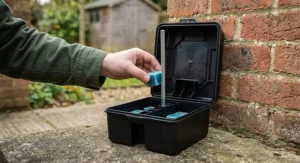
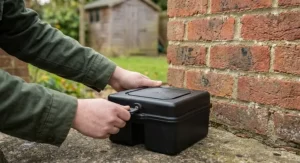
Second, always use a UK-approved tamper-resistant bait station, never loose bait on the ground. This isn’t optional advice; it’s the legal condition attached to every amateur-use rodenticide sold in the UK.
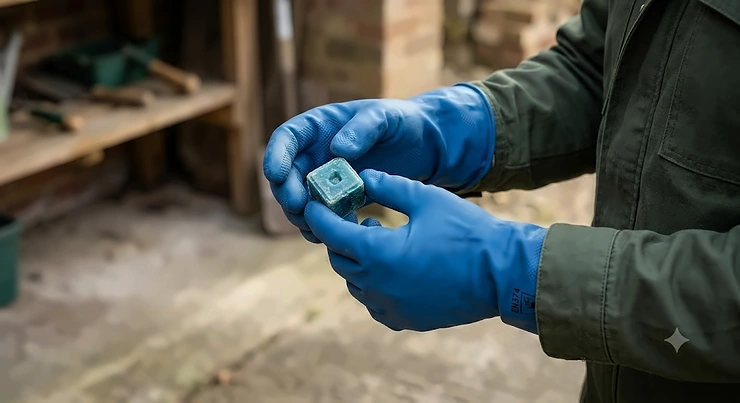
Third, wear gloves when handling blocks. Human scent transfer can occasionally reduce palatability to rats, and it also keeps the active ingredient off your skin, which the product label will explicitly instruct.
Fourth, secure the bait inside the station so it can’t be dragged out — most stations have an internal rod or clip for exactly this reason.
Fifth, label the station clearly and log where you’ve placed it; a simple note on your phone of location and date prevents forgotten bait becoming a hidden hazard months later.
Sixth, check every three to five days, topping up consumed bait and searching nearby for dead rodents, which should always be removed and disposed of safely to prevent secondary poisoning.
Finally, once feeding stops for a week or more, remove all bait — leaving rodenticide down indefinitely is both unnecessary and non-compliant with UK stewardship guidance.
Bait Block Placement Indoors: Best Practice
Indoor placement lives or dies on one principle: bait belongs exactly where rodents travel, not where it’s convenient for you. Rats and mice run along edges — skirting boards, pipework, the base of cupboards — rather than crossing open floor space, so stations placed flush against walls near these routes get far more traffic than ones dropped in the middle of a room.
Loft spaces, under-stairs cupboards, and the back of kitchen units where pipes enter the building are classic high-traffic zones. What most people overlook is child and pet accessibility indoors specifically: a station tucked behind the washing machine might be perfectly secure from a curious toddler but still reachable by a determined terrier who can squeeze into gaps a person can’t.
Placing multiple smaller stations roughly one to two metres apart along a suspected run tends to outperform one large station, since it gives rodents more opportunities to encounter bait without needing to travel far from cover — and reviewers of block products across this list consistently note faster uptake when bait is close to signs of activity rather than in a single central spot.
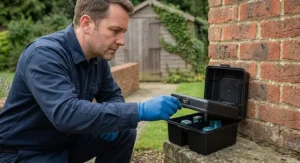
Where to Place Rat Bait Blocks Outside
Outdoor placement comes with an extra legal layer that indoor placement doesn’t: since July 2024, UK rules restrict second-generation anticoagulant rodenticides to use in and around buildings only, not in open fields or areas unconnected to a structure, precisely because of the damage documented in non-target wildlife.
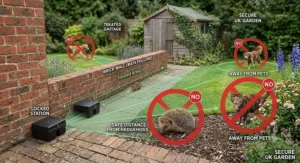
Practically, that means stations belong along the base of exterior walls, near shed and outbuilding entrances, along fence lines adjoining a building, and near compost bins or bird feeders that are drawing rats in — all locations genuinely “around a building” rather than out in open garden or farmland.
Secure the station so it can’t be tipped, dragged, or opened by wind, rain, foxes or curious dogs, and raise it slightly off waterlogged ground where possible, since standing water degrades even weatherproof wax blocks faster than manufacturers’ claims sometimes suggest. Reviewers of outdoor-rated blocks like Roshield and RatKil frequently mention checking stations after heavy rain specifically because a compromised seal lets moisture in far quicker than expected.
Rat Bait Block Dosage: How Much Bait to Use
Dosage isn’t about “more is better” — anticoagulant rodenticides work through cumulative feeding, so overloading a station doesn’t speed up results, it just increases the amount of active ingredient sitting around waiting to be misused, spilled, or dragged off by a non-target animal.
As a general guide reflected across UK product labels, rat treatments typically call for around four to five blocks per station on runs and entry points, while mouse treatments need far less — often a single block per station, spaced roughly one to two metres apart in areas of activity. Single-feed brodifacoum products like Pest Expert Formula B+ need less bait replenished per visit than multi-feed options such as Roshield, since rats consume a lethal dose faster and stop returning sooner.
| Target | Typical Bait Amount | Spacing | Check Frequency |
|---|---|---|---|
| Rats (multi-feed) | 4-5 blocks per station | Along runs, entry points | Every 3-5 days |
| Rats (single-feed) | 2-3 blocks per station | Along runs, entry points | Every 3-5 days |
| Mice | 1 block per station | Every 1-2 metres | Every 5-7 days |
Always defer to the specific product label over general guidance like this, since formulations and concentrations genuinely vary between manufacturers.
Rodenticide Safety Guidelines You Must Follow
UK rodenticide use isn’t a free-for-all — it sits under the Biocidal Products Regulation, enforced domestically by the HSE, with practical, everyday guidance built around the CRRU UK Code of Best Practice, the industry stewardship framework developed specifically to stop the “stubbornly static” wildlife contamination levels that prompted tighter rules in the first place.
For amateur users, the core guidelines are consistent across every product in this guide: use only amateur-approved products in amateur-approved pack sizes, always house bait in a tamper-resistant station, never use second-generation anticoagulants in open areas away from buildings, search for and remove dead rodents promptly, and never leave bait down once activity has stopped. Store all rodenticide in its original packaging, locked away from children, and wash your hands after handling — every product label in this guide repeats some version of this instruction because it genuinely matters, not as legal box-ticking.
If an infestation doesn’t respond within two to three weeks of correct treatment, that’s a signal to call a certified pest controller rather than simply doubling the bait, since persistent activity despite correct use often points to resistance or a scale of problem beyond amateur-strength products.
Is Rat Poison Safe for Pets? Reducing the Risk to Cats and Dogs
The honest answer is that no rat bait is inherently “safe” for pets — it’s the containment and placement that determines the real-world risk, not the product itself. Dogs in particular are drawn to rodenticide because manufacturers deliberately make it palatable to rats, and that same appeal doesn’t disappear for a food-motivated Labrador rummaging behind the shed.
According to PDSA, anticoagulant rodenticide poisoning in dogs can take several days to show symptoms — internal bleeding, lethargy, pale gums — because clotting reserves take time to run out, which is exactly why “my dog seems fine” in the hours after suspected exposure is not reassurance. Secondary poisoning, where a pet eats a poisoned rodent rather than the bait itself, is a genuine risk too, which is why searching for and removing dead rats promptly is part of correct use, not an optional extra.
Practical risk reduction looks like this: only ever use tamper-resistant stations, never loose bait; place stations where pets genuinely cannot reach, not just where they’re inconvenient for them to reach; and if you suspect any ingestion, contact a vet immediately rather than waiting to see if symptoms develop.
Secondary Poisoning Risk: Protecting Wildlife and Non-Target Species
This is the part of rat bait block safety that rarely gets mentioned on packaging, and it deserves more attention than it gets. Predators and scavengers that feed on rodents — barn owls, kestrels, foxes, hedgehogs — can absorb anticoagulant residues by eating rats or mice that have themselves fed on bait, and the scale of this isn’t marginal.
According to the Barn Owl Trust, contamination rates in surveyed barn owls have remained stubbornly high for years despite stewardship efforts, precisely because these birds feed almost exclusively on small mammals and are therefore disproportionately exposed to whatever anticoagulant residue those mammals are carrying. This is the direct reason UK rules now restrict second-generation anticoagulants to use in and around buildings rather than open countryside — it’s not bureaucratic caution, it’s a response to measured, ongoing wildlife impact.
Practically, this means: prefer the lowest-potency active ingredient that will actually solve your problem rather than automatically reaching for the strongest brodifacoum option, remove dead rodents promptly so they can’t be scavenged, and treat “job done” as the moment to remove bait entirely rather than leaving stations topped up indefinitely as insurance.
How to Choose the Right Rat Bait Block
- Assess the scale of the problem first. A single sighting suits smaller-format products like Big Cheese blocks; visible runs, multiple droppings and gnaw damage point towards a stronger single-feed option like Pest Expert Formula B+.
- Check whether you already own a compliant station. If not, buy a kit or ready-baited box rather than loose bait you can’t legally deploy.
- Match active ingredient to urgency. Difenacoum-based products like Rentokil Rodine suit routine problems; brodifacoum suits established or resistant infestations.
- Consider your surroundings. Properties near watercourses, farmland or known wildlife activity warrant extra caution and the lowest effective potency.
- Factor in format. Grain and paste bait, like RatKil sachets or the Elixir Gardens box, often outperform blocks with cautious or juvenile rodents.
- Budget for the whole treatment, not just the bait. Stations, gloves and disposal bags all factor into genuine cost.
- Plan your check-and-remove schedule before you buy anything, since ongoing monitoring is what actually determines success.
Rat Bait Blocks vs Bait Stations, Traps and Professional Pest Control
Bait blocks aren’t the only option, and it’s worth being honest about where they sit. Snap traps offer instant, visible results with zero secondary poisoning risk, but they demand far more hands-on effort — checking, resetting and disposing of catches daily — and struggle against larger populations where blocks can work passively across dozens of individuals simultaneously.
Professional pest control brings access to stronger, professional-only actives and legally mandated certification, plus the accountability of a trained technician managing placement and disposal. It costs considerably more than a DIY kit, but for infestations that haven’t responded to amateur-strength products within a few weeks, it’s usually the more cost-effective route overall once you factor in wasted bait and prolonged damage.
Bait stations themselves — the hardware rather than the bait — matter more than people expect. A poorly designed station undermines even the best bait inside it, letting rain in or allowing pets to tip it open, which is exactly why kits like the Pest Expert Formula B+ bundle genuinely tested stations rather than leaving buyers to guess.
Common Mistakes When Using Rat Bait Blocks
The single most common mistake is using loose bait without a station at all, usually out of a misplaced belief that “it’s just for the shed, nobody will touch it.” Non-target animals absolutely will.
A close second is giving up too early: anticoagulants take several days to work by design, and stopping after 48 hours because “nothing’s happened” usually just means the bait needs topping up, not that the product has failed. Related to this is over-baiting, dumping in far more blocks than the label recommends in the hope of speeding things up, which mainly increases the amount of poison sitting around unnecessarily.
Forgetting to search for dead rodents is another recurring issue, since this is precisely the pathway that drives secondary poisoning in pets and wildlife. Finally, leaving bait down indefinitely after activity has clearly stopped is both non-compliant and pointless — remove it, log the treatment as complete, and only redeploy if activity genuinely resumes.
Real-World Scenarios: Matching the Right Bait Block to Your Situation
If you’re a first-time buyer who’s spotted one or two droppings in the shed and nothing else, the Big Cheese All-Weather Bait Block or the Elixir Gardens Ready-Baited Bait Box make sense — small, manageable, no loose poison to handle.
If you’re dealing with an established infestation in a semi-rural property, with visible runs and gnaw marks along the loft, the Pest Expert Formula B+ Kit earns its higher price through genuine single-feed strength and included stations, especially where you can’t rule out resistant rats.
If you’ve treated this before and just need to top up existing stations for a recurring seasonal problem — common near allotments, chicken coops or compost heaps — the Pest Expert Formula B+ Refill, RatKil sachets or Roshield blocks stretch your budget considerably further than buying a full kit each time.
And if you’d simply rather stick with a name you already trust and the problem seems moderate rather than severe, Rentokil Rodine remains a perfectly sound, well-tested choice.

FAQs
❓ Are rat bait blocks safe to use around pets?
❓ How long does it take for a rat bait block to work?
❓ Do I need a bait station to use rat bait blocks legally in the UK?
❓ Can I buy professional-strength rat poison in the UK without certification?
❓ What should I do if I find a dead rat after using bait blocks?
Conclusion
Rat bait blocks genuinely work, but the product you pick matters far less than how you use it. A tamper-resistant station, sensible placement along real rodent runs, correct dosage, regular checks, and prompt removal of both bait and dead rodents — that combination is what separates a safe, effective treatment from a genuine hazard to the family dog or the barn owl two gardens over. Whether you land on the budget-friendly Roshield blocks, the maximum-strength Pest Expert Formula B+ Kit, or the no-mess Elixir Gardens box, the safety principles in this guide apply identically across every product on the list.
✨ Sorted on which bait block suits your situation? Check current availability and get your treatment started properly today!
Recommended for You
- Best Rat Bait Blocks 2026: 7 Top Picks That Actually Work
- Multi Catch Rat Trap vs Single Snap Trap: 7 Best Picks 2026
- Multi Catch Rat Trap: 7 Best Picks for UK Homes (2026)
Disclaimer: This article contains affiliate links. As an Amazon Associate, I earn from qualifying purchases. If you purchase products through these links, we may earn a small commission at no additional cost to you.
✨ Found this helpful? Share it with your friends! 💬🤗
