
In This Article
There’s a particular kind of dread that comes with hearing scratching in the loft at 2am, or finding a neat little pile of droppings behind the shed. Bromadiolone rat poison is, for most British households, the first thing they reach for once they’ve accepted the problem isn’t going away on its own. It’s the active ingredient behind dozens of bait blocks, grain sachets and pasta baits sold across garden centres and amazon.co.uk, and it’s been the backbone of domestic rat control in the UK since the early 1980s.
But “bromadiolone” isn’t one product — it’s one chemical, sold under wildly different brand names, formulations and strengths, and increasingly hedged around by rules most buyers have never heard of. Get the wrong format for a damp shed, or ignore the bait station requirement, and you’ll waste money and possibly break the law. Get it right, and a fairly modest outlay solves a problem that would otherwise chew through cables, insulation and your peace of mind.
This guide walks through seven genuine bromadiolone (and closely related) rat poison products sold in the UK, explains honestly where each one earns its keep, and digs into the regulatory side that most listings skip entirely — including the 2024 rule change that quietly reshaped how this poison can legally be used outdoors. As the HSE’s biocides guidance makes clear, this is a tightly regulated substance, not a casual purchase, so we’ll treat it that way throughout.
What Is Bromadiolone Rat Poison?
Bromadiolone rat poison is a second-generation anticoagulant rodenticide — a “super-warfarin” chemical that stops a rat’s blood from clotting, causing fatal internal bleeding after the rodent feeds on treated bait. It’s a chemical relative of warfarin (see Wikipedia’s overview of bromadiolone for the underlying chemistry), first introduced to the UK market in 1980 specifically to defeat rat populations that had grown resistant to older poisons.
Quick Comparison Table
Before the deep dive, here’s how the seven products stack up at a glance.
| Product | Active Ingredient | Feed Type | Best For |
|---|---|---|---|
| Roshield Wax Bait Blocks | Bromadiolone 0.0025% | Multi-feed | All-weather outdoor sheds |
| Elixir Gardens Rodex25 Station Kit | Bromadiolone 0.0025% | Multi-feed | First-time buyers needing a station |
| Elixir Gardens Rodex Grain Sachets | Bromadiolone | Multi-feed | Large gardens, bulk baiting |
| Lodi Jade Bromagrain Sachets | Bromadiolone 0.005% | Multi-feed (from 2 feeds) | Persistent, cautious rats |
| Rentokil Rat Killer Grain Bait | Bromadiolone | Multi-feed | Trusted-brand buyers, mixed sites |
| Pest Expert Formula B+ Blocks | Brodifacoum 0.0025% | Single-feed | Severe or fast infestations |
| RatKil Bait Sachets | Brodifacoum | Single-feed | Budget single-feed option |
Looking at the table, the clear pattern is that pure Roshield, Elixir Gardens, Lodi Jade and Rentokil products give you genuine bromadiolone at sensible prices, while Pest Expert Formula B+ and RatKil step up to the stronger, single-feed brodifacoum for buyers who want faster knockdown. Based on the spec comparison, budget-conscious households with a modest infestation are usually better served by bromadiolone’s multi-feed approach, since it’s cheaper per gram and still highly effective when rats can’t access alternative food sources.
💬 Just one click — help others make better buying decisions too!😊
Top 7 Bromadiolone Rat Poison Products: Expert Analysis
1. Roshield Wax Bait Blocks — best all-weather blocks for sheds and outbuildings
The standout feature here is the wax-cast construction, which shrugs off damp conditions that turn cheaper grain baits to mush within days. Each 20g block contains bromadiolone at 0.0025%, formulated using culinary-grade wheat flour bound with edible waxes, and the centre hole lets you thread blocks directly onto the rod inside a bait station — a legal requirement for UK use, not just a nice-to-have.
What most buyers overlook about this format is that the wax isn’t just weatherproofing; it also slows consumption slightly compared with loose grain, which in practice means the bait stays fresh and attractive for longer between checks. Reviewers consistently report solid results in damp lofts, garages and garden sheds where paper-wrapped sachets would otherwise disintegrate. It’s a sensible pick for anyone dealing with an outdoor or semi-exposed infestation rather than a clean, dry kitchen.
Pros:
- ✅ Genuinely weatherproof in damp sheds and outbuildings
- ✅ Centre hole fits standard tamper-resistant stations
- ✅ Reasonable bromadiolone concentration for repeat dosing
Cons:
- ❌ Multi-feed formula means slower results than single-feed options
- ❌ Wax coating can put off fussier, well-fed rats
At around £15-£20 for a 600g bundle, this sits firmly in the mid-range and delivers solid value for anyone with a genuinely outdoor rat problem rather than an indoor emergency.
2. Elixir Gardens Rodex25 Rat Station Kit — best complete starter kit with lockable box
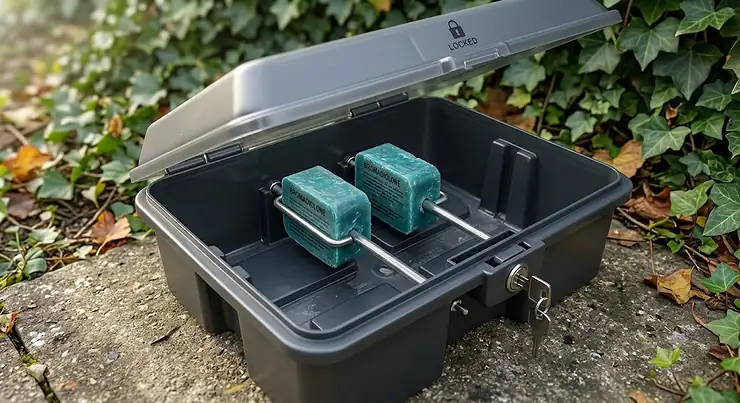
This is the rare listing that bundles the bait and the bait station together, which matters more than it sounds — buying poison without a compliant lockable station is where most first-time buyers go wrong. The kit pairs 15 x 20g bromadiolone blocks (0.0025%, with denatonium benzoate added as a bittering agent) with a tamper-proof, key-locking station designed for pet and child safety.
Here’s what to weigh: the blocks themselves are formulated with a chocolate scent specifically to overcome rat neophobia — their instinctive wariness of new food sources — which genuinely speeds up first contact compared with unscented grain. Reviewers note that rats which ignored plain bait for days took to the chocolate-scented blocks within 24-48 hours, though individual results always depend on how much competing food is available nearby. For someone who has never bought a rodenticide before, this kit removes the guesswork around compliance.
Pros:
- ✅ Bundles compliant lockable bait station with the poison
- ✅ Chocolate scent measurably improves early bait uptake
- ✅ Contains bittering agent as an added child-safety layer
Cons:
- ❌ Single station may be insufficient for a serious infestation
- ❌ Refill blocks need buying separately once used up
Priced in the £20-£30 range as a kit, this is genuinely good value once you account for what a separate bait station would otherwise cost.
3. Elixir Gardens Rodex Whole Wheat Grain Sachets — best bulk value for large gardens
The standout advantage is sheer volume per pound spent — ten 100g sachets of whole wheat bromadiolone bait, individually sealed to keep each dose fresh until it’s opened. That sachet format matters practically: rather than handling loose grain that spills and attracts damp, you drop a sealed pack straight into the station.
Based on the spec comparison with wax blocks, whole wheat grain tends to be more immediately palatable to rats because it mimics natural forage more closely, though it doesn’t hold up as well in genuinely wet conditions. What most buyers overlook is that this makes it a strong match for baiting multiple points across a large garden perimeter — fence lines, compost areas, shed bases — where you need enough bait to cover several stations without the cost climbing steeply. Reviewers who battled recurring garden infestations reported needing to replenish stations every few days initially, which is standard for a multi-feed anticoagulant rather than a product-specific weakness.
Pros:
- ✅ Ten individually sealed sachets stretch across many stations
- ✅ Whole wheat grain is highly palatable to foraging rats
- ✅ Noticeably cheaper per gram than block formats
Cons:
- ❌ Less weather-resistant than wax blocks in exposed spots
- ❌ Requires more frequent inspection and top-ups
Expect to pay in the £10-£15 range for the standard pack, making this one of the cheapest genuine bromadiolone options on amazon.co.uk.
4. Lodi Jade Bromagrain Sachets — best for persistent, bait-shy rats
The headline feature is concentration — Jade Bromagrain runs at 0.005% bromadiolone, roughly double the strength found in several wax block competitors, specifically aimed at rat populations that need more than a token nibble to succumb. It’s distributed through PestFix, a registered supporter of the Campaign for Responsible Rodenticide Use.
What the spec sheet won’t tell you, but industry guidance does, is that higher-concentration bromadiolone baits like this are typically positioned for situations where a first-generation product or a weaker SGAR has already failed to shift a resistant population. On paper this means Jade Grain is a reasonable step up before jumping straight to a single-feed brodifacoum product, particularly for households wary of the stronger secondary-poisoning risk that comes with brodifacoum. The cereal-based, freshly produced grain is designed to stay appealing through the full multi-feed cycle, which the manufacturer states can achieve control in as few as two feeds under favourable conditions.
Pros:
- ✅ Higher 0.005% concentration for tougher, bait-shy rats
- ✅ Sourced from a CRRU-supporting UK distributor
- ✅ Sachet format limits spillage and moisture exposure
Cons:
- ❌ Still a multi-feed product, so not instant
- ❌ Smaller pack sizes cost more per gram than bulk grain
Typically priced around £10-£18 depending on pack size, this is the pick for anyone who has already tried a milder bait without success.
5. Rentokil Rat Killer Grain Bait — best trusted-brand pick for mixed indoor/outdoor sites
The standout feature is the name on the packet — Rentokil is one of the few brands most non-specialists recognise, and that brand recognition is backed by a straightforward whole-grain bromadiolone formulation approved for both indoor and outdoor use around buildings. The grain bait ships in resealable sachets designed to slot straight into standard bait stations.
Honest analysis here: paying a premium for a household name doesn’t automatically mean better chemistry — the active ingredient and mechanism are the same bromadiolone found in cheaper alternatives — but reviewers do note that consistency between batches and clear labelling reduce the guesswork for anyone unfamiliar with rodenticide handling. This makes it a sensible middle-ground choice for someone who wants a recognisable brand without stepping up to single-feed brodifacoum. It performs comparably to the other bromadiolone entries on this list in terms of raw kill rate, which reinforces that brand alone shouldn’t be the only factor in your decision.
Pros:
- ✅ Recognisable, long-established UK pest control brand
- ✅ Clear labelling suited to first-time rodenticide buyers
- ✅ Approved for both indoor and around-building outdoor use
Cons:
- ❌ No meaningful chemistry advantage over cheaper bromadiolone baits
- ❌ Smaller pack sizes than some dedicated bulk grain options
Priced around £8-£14 for a standard multipack, the value here is really about confidence and familiarity rather than raw potency.
6. Pest Expert Formula B+ Advanced Bait Blocks — best single-feed option for severe infestations
The standout feature is single-feed brodifacoum at 0.0025%, meaning a lethal dose can, in principle, be delivered from one visit to the bait station rather than the several feeds bromadiolone typically requires. The wax-cast blocks are pitched as weatherproof and designed for rapid uptake through a food-grade formulation.
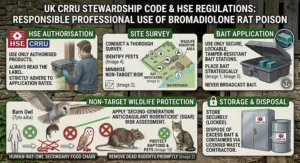
Reviewers consistently report faster visible reductions in rat activity compared with multi-feed bromadiolone baits, which lines up with the underlying chemistry — brodifacoum is markedly more potent per feed. What most buyers overlook, though, is that faster knockdown isn’t automatically “better” for every situation: because brodifacoum persists longer in rodent tissue, it carries a higher secondary-poisoning risk to predators like owls and foxes that might eat a dying rat, which is precisely why the current UK stewardship regime restricts unstewarded outdoor use of the most potent SGARs. For a severe, fast-moving infestation indoors or in a controlled outbuilding, this product’s strength is a genuine asset; for casual garden use, it’s arguably overkill.
Pros:
- ✅ Single-feed brodifacoum delivers faster visible control
- ✅ Weatherproof wax blocks suit damp or outdoor sites
- ✅ Maximum legal amateur-market strength available
Cons:
- ❌ Higher secondary-poisoning risk to wildlife if misused
- ❌ Overkill for light, easily-managed infestations
Expect to pay a premium in the £18-£30 range depending on pack size, reflecting the stronger active ingredient rather than any change in format.
7. RatKil Bait Sachets — best budget single-feed alternative
The standout feature is affordability relative to other single-feed options — six 25g sachets of brodifacoum bait at a noticeably lower price than premium competitors, while still delivering the same “kill in one feed” mechanism. Independent reviews note this is enough bait to deal with a meaningful population despite the modest overall weight.
What the spec sheet won’t tell you, but comparative reviews do, is that RatKil’s smaller pack size means you’ll likely need a repeat purchase for anything beyond a light-to-moderate infestation, since 150g total doesn’t stretch as far as bulkier grain packs. On paper this makes sense as an entry point into single-feed brodifacoum rather than a long-term solution for recurring, large-scale rat problems — pair it with a proper bait tray or station rather than scattering it loose, since loose baiting both breaches UK label requirements and dramatically increases risk to pets.
Pros:
- ✅ Cheapest single-feed brodifacoum option in this list
- ✅ Enough bait for a genuine, moderate rat population
- ✅ Easy sachet format for quick station loading
Cons:
- ❌ Small overall pack size versus premium alternatives
- ❌ Needs a separately purchased bait tray or station
Typically priced under £10, this is the value pick for anyone who wants brodifacoum’s speed without Pest Expert’s price tag.
Practical Usage Guide: Setting Up Bromadiolone Bait Stations Correctly
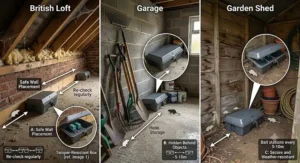
Getting bromadiolone rat poison to actually work comes down to placement and discipline as much as the product itself. Start by identifying genuine activity — smear marks along skirting, gnawed timber, or fresh droppings — rather than guessing at high-traffic areas. Bait stations should sit directly on established rat runs, typically along walls or fence lines where rats naturally travel, spaced roughly 5-10 metres apart for a serious infestation.
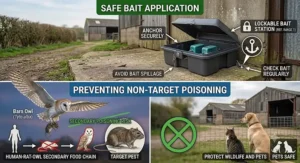
Every station must be tamper-resistant and lockable; loose bait scattered on the ground isn’t just less effective, it’s a direct hazard to pets, wildlife and children, and breaches most UK product labels. In the first 30 days, the most common mistake is under-baiting: placing a single small block and assuming the job is done. Check stations every 2-3 days initially, topping up any bait that’s been taken, and remove competing food sources like bird feed or accessible pet food nearby, since rats with easy alternatives will simply ignore your bait.
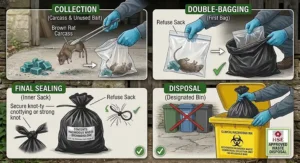
A less obvious optimisation trick: note which bait format disappears fastest at each station. Rats in different environments show genuine preferences — some populations take to grain readily, others prefer wax blocks — and switching format after a week of no uptake often succeeds where persisting with the same bait fails. Once activity stops for around a week, remove the bait entirely rather than leaving it as a “just in case” permanent measure, and dispose of any dead rodents promptly in a sealed bag in general waste, following local council guidance.
Real-World Scenarios: Which Bromadiolone Product Fits Your Situation
Consider three genuinely different households. A first-time buyer with a single mouse-sized scratching noise in the loft, no prior experience with rodenticides, and two young children in the house is best served by the Elixir Gardens Rodex25 Station Kit — the bundled lockable station removes the compliance guesswork, and the moderate bromadiolone concentration is proportionate to a small, early-stage problem.
A homeowner with an established rat run along a garden fence, competing bird feeders nearby, and a budget that needs to stretch across four or five bait points is better matched to the Elixir Gardens Rodex Grain Sachets or Rentokil Rat Killer Grain Bait — both offer enough volume to bait multiple stations without the per-gram cost of premium single-feed products, and the multi-feed approach is entirely adequate when there’s time to let the bait work over a week or two.
A landlord or smallholder facing a genuinely severe infestation — audible movement in walls, visible daytime activity, damage to wiring or feed stores — needs the faster knockdown of Pest Expert Formula B+ Advanced Bait Blocks, accepting the higher cost and the added responsibility of stricter monitoring, given brodifacoum’s greater persistence and wildlife risk.
Bromadiolone Active Ingredient & Rodenticide Chemistry Explained
Bromadiolone rodenticide belongs to the coumarin family of anticoagulants, chemically related to warfarin but engineered for far greater potency against resistant rodent populations. As a bromadiolone active ingredient, it works by blocking the recycling of vitamin K within the liver, a process the rat’s body relies on to manufacture clotting factors. It was first introduced to the UK market in 1980, developed specifically to remain effective against rat populations that had already grown resistant to first-generation anticoagulants like warfarin.
In practical terms, this means a rat that has fed on bromadiolone doesn’t die instantly — internal bleeding develops gradually, typically over several days, which is actually a deliberate feature rather than a flaw. Because the effect is delayed, rats don’t associate the bait with illness and continue feeding normally, avoiding the “bait shyness” that plagued older, faster-acting poisons. UK-authorised amateur bromadiolone products are formulated at low concentrations, generally around 0.0025-0.005%, precisely calibrated to be lethal to target rodents while limiting (though not eliminating) risk from a single accidental exposure.
Second Generation Rat Bait Explained: Why It Replaced Warfarin
Second generation rat bait refers to a class of anticoagulants — including bromadiolone, brodifacoum, difenacoum and difethialone — developed specifically to overcome resistance that had built up against first-generation compounds like warfarin and chlorophacinone over decades of use. The key practical difference is potency per feed: while warfarin often required repeated feeding across a week or more to prove fatal, second generation compounds achieve a lethal dose far more efficiently, with bromadiolone typically needing between two and several feeds, and the most potent members of the group capable of single-feed kills.
This matters for buyers because “second generation” isn’t a single strength tier — there’s meaningful variation within the category itself. Bromadiolone and difenacoum sit at the milder end of second-generation potency, while brodifacoum, difethialone and flocoumafen are considerably stronger and correspondingly more tightly restricted in outdoor, unstewarded use. Knowing where a product’s specific active ingredient sits within this spectrum should genuinely influence which one you choose, not just the marketing claims on the packaging.
Anticoagulant Rodenticide Safety: What Every Buyer Should Know
Every anticoagulant rodenticide, bromadiolone included, works by the same underlying mechanism that makes it dangerous well beyond its intended target. Because it interferes with blood clotting generally, accidental ingestion by a pet, or secondary poisoning of a predator that eats a poisoned rat, carries real risk — this isn’t marketing caution, it’s basic pharmacology. As the UK’s competent authority for biocides, the CRRU UK stewardship regime exists precisely because regulators require evidence that authorised products can be used without unacceptable risk to wildlife and non-target species before they reach the market at all.
For household buyers, the practical safety takeaway is straightforward: always use a genuinely tamper-resistant, lockable bait station rather than loose bait; keep products in their original packaging with labelling intact; wash hands thoroughly after handling; and know that if a child or pet is suspected to have ingested bait, the appropriate first step in the UK is to call NHS 111 or a vet immediately rather than wait for symptoms to appear, since anticoagulant effects are often delayed by design.
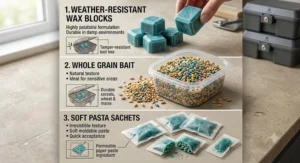
How to Choose Bromadiolone Bait Blocks
- Match the format to the environment. Wax blocks resist damp sheds and outdoor stations; grain sachets suit dry indoor spaces and offer better value per gram.
- Check the concentration, not just the brand. Products range from around 0.0025% to 0.005% bromadiolone — higher concentrations suit bait-shy or previously resistant populations.
- Buy or already own a compliant bait station. Using bromadiolone bait blocks without a tamper-resistant, lockable station isn’t just risky, it breaches most UK product labels.
- Estimate volume honestly. A single small pack rarely covers a genuine infestation across multiple stations — budget for several sachets or blocks per site.
- Consider household risk factors. Homes with young children, dogs, or nearby wildlife such as owls and foxes should lean toward bromadiolone over stronger, more persistent alternatives like brodifacoum.
- Factor in monitoring time. Multi-feed bromadiolone needs regular top-ups over one to two weeks; if you can’t commit to that schedule, a single-feed product may suit you better.
- Read the authorisation number. Genuine UK-authorised rodenticides carry an HSE authorisation code on the packaging — a useful quick check that you’re buying a properly regulated product.
Bromadiolone Effectiveness: What the Data and Reviews Show
Bromadiolone effectiveness against Norway rats and house mice is well established in the toxicology literature, though it’s genuinely less potent per feed than brodifacoum, difethialone or flocoumafen. Bromadiolone and difenacoum were the first compounds of the second generation introduced to the market, and while highly effective, bromadiolone is somewhat less potent than the three strongest modern anticoagulants. In practice, this translates to a multi-feed requirement rather than a single-visit kill for most rat populations.
Aggregated customer feedback across the products in this guide consistently points to the same pattern: results within a week for a moderate infestation, provided competing food sources are removed and bait is topped up promptly. Reviewers frequently note that bromadiolone struggles more visibly when rats have easy access to alternative food, which isn’t a product failing so much as a reflection of how multi-feed anticoagulants work generally — the rat has to choose your bait over everything else, repeatedly, for the mechanism to succeed.
Rat Poison Professional Strength vs Amateur Bromadiolone
Rat poison professional strength products differ from amateur bromadiolone baits in two main ways: permitted active ingredients and required certification. Second-generation anticoagulant rodenticides including brodifacoum, bromadiolone, difenacoum and flocoumafen remain the most common professional rat and mouse poisons, but the highest-potency formulations and largest pack sizes are restricted to certified professional users under the UK rodenticide stewardship regime.
For everyday households, this means the bromadiolone products sold on general retail sites and amazon.co.uk are deliberately capped at amateur-safe concentrations and pack sizes — you’re not missing out on some secretly superior professional formula by buying consumer-grade bait. Where professional-strength product genuinely earns its premium is in large-scale infestations, commercial premises, or persistent populations that have shrugged off amateur baiting entirely, at which point calling a certified pest controller is usually more cost-effective than escalating DIY purchases anyway.
Common Mistakes When Buying Bromadiolone Rat Poison
The single most common mistake is buying bait without a bait station, assuming loose blocks scattered near a hole will do the job — this both breaches UK labelling requirements and needlessly endangers pets and wildlife. A close second is underestimating quantity: one small sachet rarely covers a genuine infestation spread across a garden or loft space with multiple entry points.
Buyers also frequently ignore competing food sources, baiting stations while bird feeders or accessible pet food sit metres away, which dramatically slows results regardless of product quality. Finally, many people give up on a multi-feed bromadiolone product after just two or three days, assuming it isn’t working, when the honest expectation — grounded in how these anticoagulants function — is closer to one to two weeks for full control.
Safety, Regulations and Stewardship: The Rules You Must Follow
UK rules around bromadiolone have tightened meaningfully in recent years. As BPCA’s industry reporting explains, the CRRU UK board unanimously decided that bromadiolone and difenacoum, alongside the more potent SGARs, would no longer be authorised for use in open areas and waste dumps, extending a restriction previously applied only to the strongest anticoagulants — largely in response to persistently high rodenticide residue levels found in barn owls, the sentinel species used to monitor wildlife exposure.
For amateur buyers this doesn’t ban bromadiolone outright — it remains fully authorised for use in and around buildings, which covers the overwhelming majority of domestic rat problems. But it does mean genuinely open, unstructured outdoor baiting (well away from any building) now falls outside legal use for this active ingredient. Always keep products in a locked, tamper-resistant station, store unused bait securely away from children and pets, and dispose of any dead rodents according to your local council’s household waste guidance rather than leaving carcasses for scavengers to find.
Long-Term Cost & Maintenance: Is Bromadiolone Good Value
Judged purely on cost-per-kill, bromadiolone remains one of the more economical rodenticide options available to UK households, typically undercutting single-feed brodifacoum products by a meaningful margin per gram of active bait. The trade-off is time and monitoring: multi-feed products demand more frequent station checks and top-ups over a one-to-two week window, which has a genuine labour cost even if the product itself is cheap.
Total cost of ownership should also factor in the bait station itself, which is a one-off purchase that can be reused indefinitely across future infestations, and any replacement bait needed if a population proves resistant to a particular formulation. For a single moderate infestation, the cheaper bromadiolone grain and block products in this guide represent the best value; for recurring, severe, or commercial-scale problems, the faster single-feed alternatives — or professional intervention — often work out cheaper overall once labour and repeat-purchase costs are properly weighed.
✨ Don’t Miss These Exclusive Deals!
🔍 Take your rat control seriously with these carefully selected, genuinely effective bromadiolone products. Click on any highlighted item to check current pricing and availability, and get your home back under control this week!
FAQ
❓ Is bromadiolone rat poison safe to use around pets?
❓ How long does bromadiolone take to kill a rat?
❓ Can I buy bromadiolone rat poison without certification in the UK?
❓ Does bromadiolone rat poison work on mice as well as rats?
❓ Why was bromadiolone restricted for outdoor use in 2024?
Conclusion
Bromadiolone rat poison earns its long-standing popularity honestly: it’s affordable, well-understood, and genuinely effective against both naive and moderately resistant rat populations, provided it’s used properly in a compliant bait station with realistic expectations about timing. The seven products covered here — from the weatherproof Roshield blocks to the bundled Elixir Gardens starter kit, the higher-concentration Lodi Jade grain, the familiar Rentokil name, and the stronger single-feed Pest Expert and RatKil alternatives — cover most household scenarios you’re likely to face.
The honest takeaway is that no single product is universally “best.” A first infestation in a dry loft calls for a different purchase than a persistent garden problem or a genuinely severe indoor outbreak, and matching the product to the situation matters more than chasing the strongest chemical on the shelf. Whichever you choose, respect the bait station requirement, remove competing food sources, and give the process the one-to-two week window multi-feed anticoagulants genuinely need to work.
Recommended for You
- Where to Place Rat Bait Stations: 7 Top UK Picks for 2026
- Best Rat Bait Station UK: 7 Tamper-Proof Picks for 2026
- How To Use Rat Bait Blocks Safely: 7 Top UK Picks 2026
Disclaimer: This article contains affiliate links. As an Amazon Associate, I earn from qualifying purchases. If you purchase products through these links, we may earn a small commission at no additional cost to you.
✨ Found this helpful? Share it with your friends! 💬🤗
